
Does semaglutide powder need to be refrigerated
Yes, semaglutide powder needs to be kept in the fridge at temperatures between 2°C and 8°C to keep its chemical stability and treatment effectiveness. This active pharmaceutical ingredient is very sensitive to changes in temperature because it is a GLP-1 receptor agonist peptide with a complicated chemical structure (CAS 910463-68-2). Keeping the peptide chain in the right way in the cold keeps its chemical structure and extends its shelf life to up to two years. For B2B buying workers who need to buy this compound for pharmaceutical development, knowing these storage requirements is important for planning the supply chain and making sure the quality of the product.
Comprehending Semaglutide Powder and Its Storage Requirements
Semaglutide is a new kind of glucagon-like peptide-1 analog that was created for metabolic study and to treat type 2 diabetes. The lyophilized powder form is clearly better than liquid versions, especially when it comes to keeping the powder stable during global shipping and giving pharmaceutical companies more freedom to make changes.
What Makes Semaglutide Unique Among Peptide APIs?
This molecule, which has the molecular formula C187H291N45O59 and a molar mass of 4,113.64 g/mol, has a special fatty acid change that makes its biological half-life longer. This change to the structure also makes the molecule more sensitive to stressors in the surroundings. Unlike simpler peptides, the albumin-binding gap connected to Lysine-26 can change shape when heated or damp, which directly impacts its ability to bind to receptors.
Pharmaceutical businesses and study centers like this peptide because it stays active when it is handled properly. The hygroscopic powder, which is white to off-white, easily soaks up water, which speeds up the hydrolysis processes that break peptide bonds. This is the reason why manufacturers say that keeping in a refrigerator is required and not just suggested.
Environmental Factors Affecting Peptide Stability
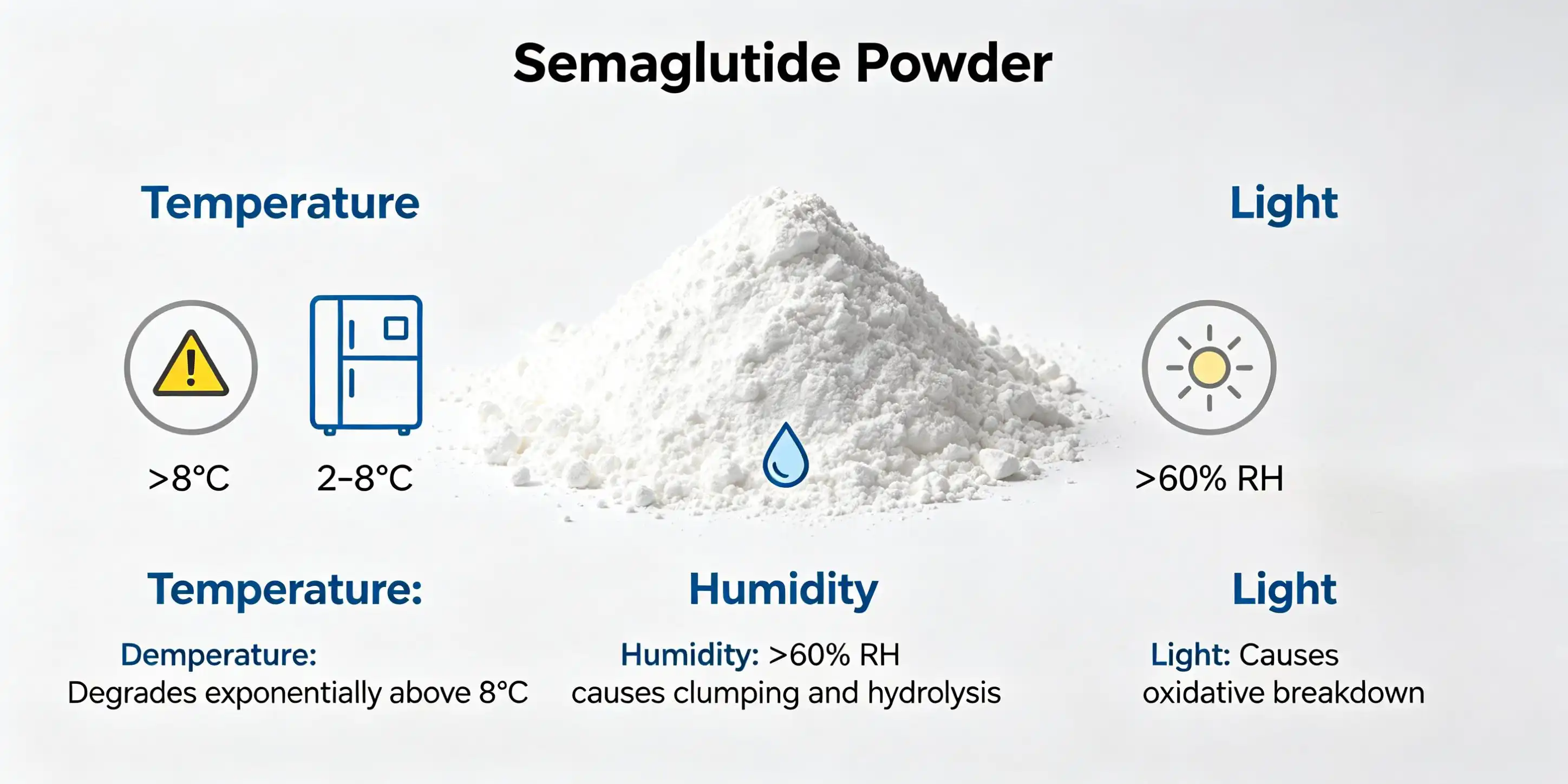
Temperature is the most important factor, but humidity and light exposure can also hurt the quality of a product. The rate at which chemicals break down quickly rises exponentially when kept above 8°C. Studies on similar GLP-1 analogs show that the purity of peptides drops by 2% to 5% every month when kept at room temperature. However, samples that are kept in the fridge stay 98% or higher pure for longer periods of time.
Light causes oxidative breakdown, which affects methionine and tryptophan residues in the chain the most. To keep things safe while they're being stored, use amber glass bottles or dark packaging materials. Controlling humidity is just as important. Relative humidity levels above 60% can make powders clump together and absorb water, even in containers that are tightly sealed. This makes the powders less bioavailable.
The Science Behind Semaglutide Powder Stability
Understanding the chemical processes that break down peptides helps buying teams choose the best suppliers and plan their procedures more efficiently.
How GLP-1 Receptor Agonists Respond to Temperature?
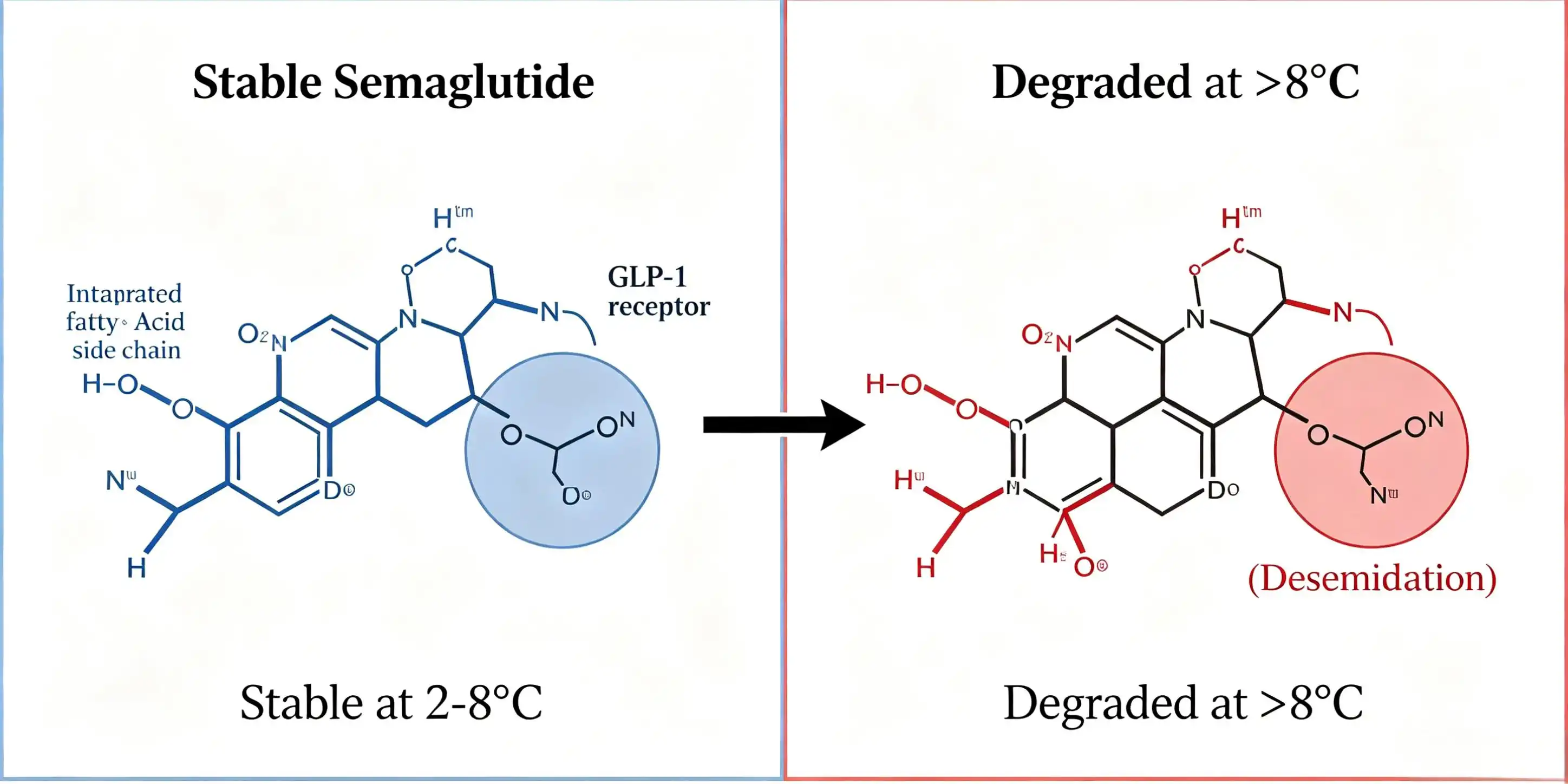
The acylated peptide structure has many breakdown processes that are triggered by heat. When the temperature is high, asparagine and glutamine residues deamidate more quickly, converting them into aspartic acid and glutamic acid, respectively. This small change alters the three-dimensional shape necessary for the receptor to bind.
The fatty acid side chain that is linked through the gap can also be oxidized and broken down by water. This modification contributes to the drug's longer half-life, enabling once-weekly dosing for therapeutic purposes. However, it also makes storage more challenging. In wet conditions, the ester bonds in the spacer region are particularly susceptible to breakdown by a base. Semaglutide powder is especially vulnerable in these conditions, requiring careful handling and storage to maintain its stability and efficacy.
Comparing Powder and Injectable Formulation Requirements
Lyophilized powder is more stable over time than liquids that have been reconstituted. Injectable mixtures usually only stay stable for 56 days after being reconstituted in cold water, but powder stays active for two years when kept at 2–8°C. This difference comes from the fact that water acts as a reaction medium. Most breakdown pathways need watery settings to work at high speeds.
Chemical processes move much more slowly in lyophilized form because it doesn't have any water in it. Cycles of freeze and thaw are dangerous for both types, but they do so in different ways. Powder can handle small changes in temperature better than solutions during shipping, as long as the changes don't last too long and the material is quickly put back in the fridge.
Best Practices for Handling and Storing Semaglutide Powder in B2B Environments
Procurement managers need to set up strong rules that cover the whole supply chain, from the factory to the lab where the product is used.
Temperature Control Strategies for Bulk Procurement
The best way to store a lot of things is in dedicated medicine freezers that continuously monitor the temperature. The temperatures in these units remain stable, unlike most freezers, which can experience temperature fluctuations. Digital data loggers that take temperature readings every 15 minutes create audit trails that are essential for quality reviews and GMP compliance.
Facilities that handle more than one peptide API should use separate storage to avoid cross-contamination and set environmental controls specific to each material. When storing more than 50 grams, backup cooling systems and emergency plans should be in place. Plan B in case of power failure should include the longest amount of time materials, such as semaglutide powder, can be left outside at a controlled temperature before their quality starts to be compromised.
Packaging Materials and Container Selection
Packaging made for pharmaceuticals guards against many types of damage at the same time. Here are the important parts of the packaging that keep the stability of the peptide:
- Primary Containers: Standard plastics don't work as well as high-density polyethylene bottles that let little moisture vapor through. Because they don't react with chemicals and don't let them through, glass jars are still the best choice for research-grade materials. The size of the container should meet how it will be used. Smaller containers are better because they don't have to be opened over and over, which can bring moisture and dirt.
- Desiccants and Humidity Control: Silica gel packets soak up any remaining wetness in packages that are tightly sealed. When to replace them depends on how they are stored, but desiccants that change color when they get wet make it easy to keep an eye on them. Putting humidity warning cards inside secondary packaging lets people know when moisture might be getting in before it damages the product.
- Light Protection: The powder is kept from breaking down by amber glass or thick plastic. Extra protection in the form of metal foil pouches during travel and storage is added by secondary packing. This method with multiple barriers works especially well for moving things through environments with changing conditions.
These methods for packing work together to keep the 99% purity level that pharmaceutical uses need and extend the shelf life of the product. When suppliers pay attention to these details, the goods they send are usually more reliable and work as expected.
Cold Chain Logistics for Global Distribution
Temperature-sensitive peptides face special problems when they are shipped across international borders. Depending on the weather outside, phase-change materials in qualified shipping containers can keep temperatures between 2 and 8°C for 48 to 96 hours. Shipping businesses should provide validation data to show that their crates work well in harsh environments.
Real-time tracking devices with temperature monitors let you see what's going on during travel. When temperature changes, these systems send out alerts so that the problem can be fixed before the material comes. Some high-tech systems connect to customs files to speed up clearance and cut down on time spent in unregulated areas.
Comparing Storage Practices Among Top Semaglutide Powder Suppliers
On the world market for peptide APIs, there are different producers with different quality control and storage methods. Taking these differences into account helps buying teams choose partners whose quality standards are similar to their own.
Regional Manufacturing Standards and Certifications
Manufacturers in Europe and North America usually follow the strict rules set by the FDA and EMA, managing the cold chain from production to delivery. These facilities keep their ISO 9001 certification and follow GMP guidelines, demonstrating that they handle quality in an organized way. Their storing procedures often go beyond what is required by law, with multiple environmental controls and in-depth stability testing programs.
There are more types of Asian producers, especially those that manufacture products for study use. Top Chinese and Indian suppliers meet Western quality standards and run sites reviewed by the FDA with similar infrastructure. These businesses understand that export markets require cold chain paperwork that can be verified, so they invest in chilled storage and shipping methods that have been proven to work, ensuring that semaglutide powder and other sensitive materials remain stable throughout the process.
Evaluating Supplier Storage and Handling Documentation
Documents with a Certificate of Analysis should include proof of how the material was stored and testing dates that show how old the material is. When suppliers give you stable data, it means they are sure of how they store your peptides. Look for studies that show peptide purity over time under certain conditions. Companies that test samples they keep for six, twelve, and eighteen months show that they care about quality after the original production.
Addressing Common Concerns: Semaglutide Powder Safety, Efficacy, and Handling
Decisions about purchases affect the results of study and the time it takes to make a product. Teams can put in place the right safeguards when they know how storage problems show up.
Consequences of Improper Temperature Management
Products of peptide degradation can mess up analysis methods and lead to wrong study results. Even if only a small part of the main peptide is broken down, it may still create related chemicals that make HPLC analysis harder and can change how receptor-binding assays work. When high molecular weight proteins show up, it means that they are clumped together, which lowers the quantity of the active molecule.
In most cases, losing your potency happens slowly over time instead of all at once. Material kept at 15–20°C might still be 90% effective after three months, which seems fine but isn't enough for precise dose-response studies or developing new pharmaceutical formulations. Because of this small loss of quality, temperature tracking is necessary all along the supply chain.
Reconstitution and Handling Protocols
When research labs get lyophilized material, they should make standard operating methods for putting it back together. Using cold, clean, bacteriostatic water to dissolve peptides keeps them from sticking together too much. Instead of forceful shaking, gentle spinning stops foam formation and mechanical stress on peptide bonds. Reconstituted solutions need to be kept cold right away and used within the stability window that has been proven.
Conclusion
Keeping semaglutide powder in the fridge at 2–8°C is the only way to make sure it stays in good shape for the two years it can be stored. Because the peptide has a complicated chemical structure with a long amino acid sequence and a fatty acid modification, it is naturally easy for temperature to break it down. Business-to-business buyers should give preference to providers who can show full cold chain skills, from production to final delivery.
Supply chain risks can be reduced by choosing partners with proven storage methods, the right certifications, and clear quality documents. Putting money into proper refrigeration storage and handling pays off with consistent material performance, less waste from degraded product, and accurate study results. When procurement teams understand these storage principles, they can make strategic choices that combine making sure quality with making sure operations run smoothly.
FAQ
Q1: Can semaglutide powder tolerate brief periods at room temperature?
A: Temperature drops below 25°C for less than 24 hours usually don't ruin the product completely, but they do shorten its shelf life. Temperature changes that happen over and over again are worse for the environment than one short change. Before being used in important situations, materials that have been at room temperature should be tested for their effectiveness.
Q2: How can you identify degraded semaglutide powder?
A: Visual inspection shows some signs of decline; for example, yellowing or clumps shows that the material has been exposed to water and could be changing chemically. The most accurate way is still HPLC analysis, which shows a smaller main peak area and bigger impurity peaks. No matter how it looks, material that doesn't meet the 98% purity requirement should be thrown away.
Q3: What documentation should suppliers provide regarding storage?
A: Suppliers with a good reputation send shipped goods with Certificates of Analysis that include proof of storage conditions, reports of stability studies, and cold chain documents. Temperature logs from travel show that the right way to handle things was done. These papers make the audit trail that is needed for quality reviews and following the rules.
Partner with Xi'an Yihui for Reliable Semaglutide Powder Supply
Xi'an Yihui Bio-technology Co., Ltd. knows how important it is to keep sensitive peptide APIs in the right cold chain. As a company that has been making semaglutide powder for 13 years and has been serving the global pharmaceutical and research markets, we make sure that all of our facilities have GMP-compliant cold storage. Our monthly production capacity of 5000g allows for both research-scale purchases (1g minimum order number) and large needs for formulating.
We offer high-purity material (99% test, ≤0.5% impurities) with full paperwork, such as a certificate of analysis (COA), data on stability, and shipping that has been checked for cold chain integrity. Our ISO, Halal, and Kosher certificates show that we have complete quality systems that cover all aspects of storage and dealing. Customers in Asia, Europe, and the United States trust us to keep the 2-8°C holding standard from production to delivery.
Our professional team is available 24 hours a day, seven days a week to answer technical questions about storage practices, reconstitution processes, and handling needs that are specific to an application. You can talk about your buying needs, ask for samples, or find out more about our custom synthesis services by emailing sales@yihuipharm.com. We only work with business-to-business customers and offer flexible payment options like T/T, LC, and DA. This way, you can be sure that you will get pharmaceutical-grade materials that are reliable enough for your projects.
References
1. Buckley ST, Bækdal TA, Vegge A, et al. Transcellular stomach absorption of a derivatized glucagon-like peptide-1 receptor agonist. Science Translational Medicine, 2018; 10(467): eaar7047.
2. Lau J, Bloch P, Schäffer L, et al. Discovery of the once-weekly glucagon-like peptide-1 (GLP-1) analogue semaglutide. Journal of Medicinal Chemistry, 2015; 58(18): 7370-7380.
3. International Council for Harmonisation. Stability Testing of New Drug Substances and Products Q1A(R2). ICH Harmonised Tripartite Guideline, 2003.
4. Manning MC, Chou DK, Murphy BM, et al. Stability of protein pharmaceuticals: an update. Pharmaceutical Research, 2010; 27(4): 544-575.
5. European Medicines Agency. Guideline on the Requirements for the Chemical and Pharmaceutical Quality Documentation Concerning Investigational Medicinal Products in Clinical Trials. EMA/CHMP/QWP, 2017.
6. United States Pharmacopeia. General Chapter <1079> Good Storage and Shipping Practices. USP 43-NF 38, 2020.

Send Inquiry
Related Industry Knowledge
- How to verify the purity of semaglutide raw powder
- Semaglutide API: Global Price Trends and Market Analysis
- PQQ Disodium Salt :A Powerful Antioxidant
- Does Bicalutamide API Beget Weight Gain?
- Is Abamectin Toxic to Humans?
- What Is the Mechanism of Action of Pizotifen Malate?
- What Is Doxorubicin Hydrochloride Use For?
- Does vitamin k2 mk7 cause blood clots?
- What is bimatoprost used for?
- Does phosphatidylserine lower cortisol?