
How to verify the purity of semaglutide raw powder
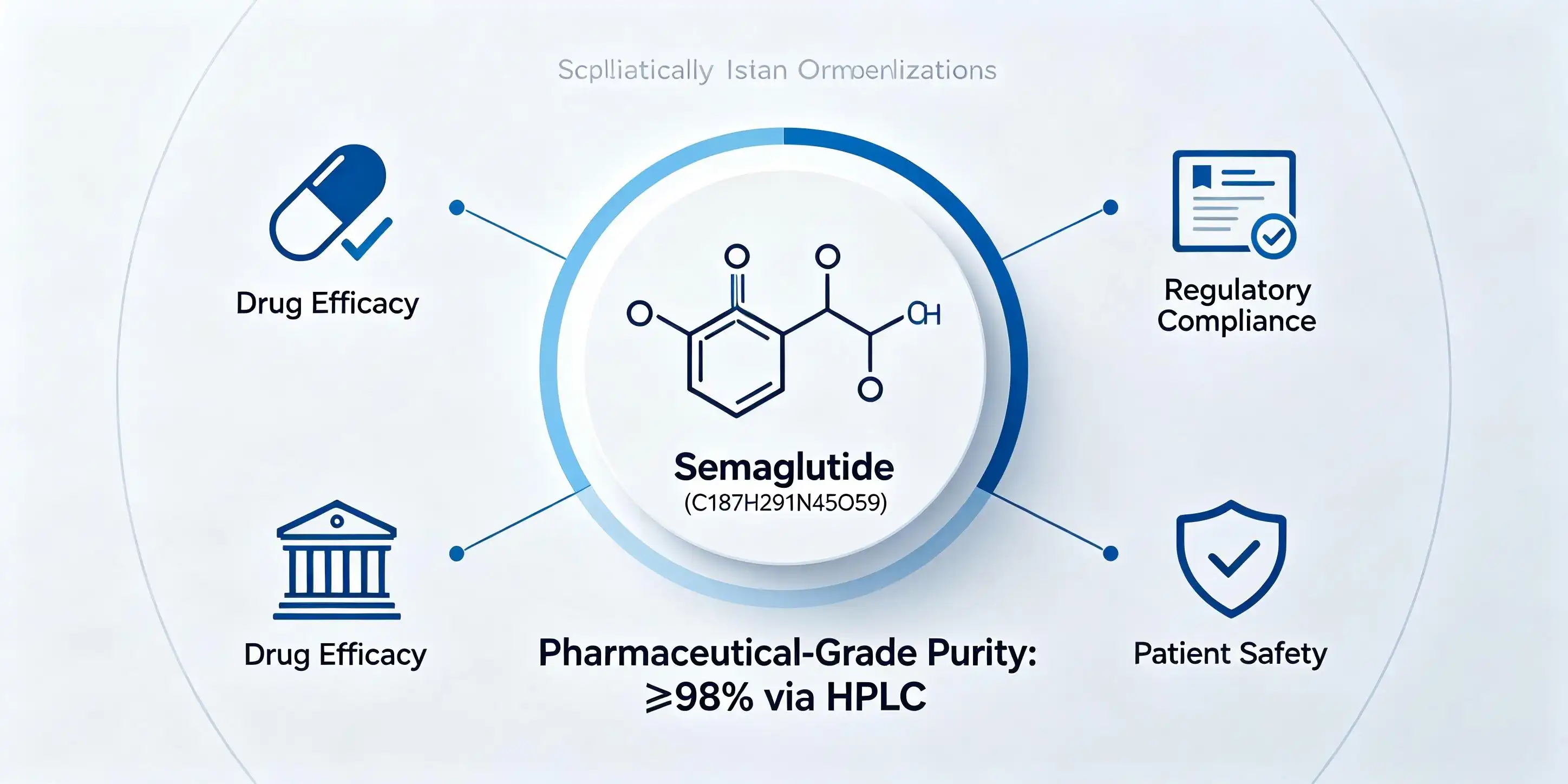
To check the purity of Semaglutide raw powder, you must first understand that purity directly affects how well the drug works, how well it follows the rules, and how safe it is for patients. This peptide API is a GLP-1 receptor ligand with the chemical formula C187H291N45O59 and the CAS number 910463-68-2. To make sure it is of pharmaceutical-grade quality, it needs to be thoroughly tested using analytical methods.
To help create new treatments for diabetes and obesity, procurement managers, R&D engineers, and quality assurance professionals depend on exact purity metrics—usually ≥98% via HPLC. This guide talks about the important methods for verifying information, judging suppliers, and handling things after the purchase that help B2B buyers make smart choices while lowering supply chain risks and making sure consistency in manufacturing further down the line.
Understanding the Importance of Purity in Semaglutide Raw Powder
What Defines Pharmaceutical-Grade Purity
Semaglutide raw powder is a material that has been frozen and is white to off-white. It was made using solid-phase peptide synthesis (SPPS) techniques. The peptide sequence has an aminoisobutyric acid replacement at position 8 and a C-18 fatty diacid acylation at Lys26. This engineering changes the half-life of the peptide to about 165 hours. Material that is used in pharmaceuticals must be at least 98% pure, with impurity levels below 0.5% and wetness levels below 5%. For research-grade versions, the requirements may be a little less strict, but both types need very strict checking to avoid formulation failures and regulation delays.
Why Purity Verification Is Non-Negotiable in B2B Procurement
Every step of making a drug is affected by purity. When peptides are contaminated, they change the dose-response relationships, make stability studies less reliable, and raise regulatory red flags during FDA or EMA applications. Unverified purity means production delays, batch rejects, and damage to the company's image for procurement teams. In addition to compliance, purity shows how well the provider follows GMPs, clean-room rules, and strict quality control. If buyers choose high-purity APIs, they get stable formulation behavior, longer shelf life (usually two years at 2-8°C), and comfort in using the APIs in later clinical or commercial uses.
How Purity Affects Downstream Pharmaceutical Quality
Impurities like missing parts, truncated peptides, or solvents that are still present can change the bioactivity patterns and raise the risk of poisoning. Trifluoroacetic acid (TFA) residues are common in SPPS processes. When amounts go above 1%, they can be harmful to cells. Ion-exchange chromatography is used by good producers to reduce the amount of TFA, which makes sure that the products can be used in living organisms.
Purity also affects how easily peptides dissolve, how they tend to clump together when reconstituted, and how well they work with other ingredients in oral or injectable formulas. Getting high-purity materials that have been checked for quality cuts down on the number of times they need to be reformulated, speeds up the regulatory process, and keeps clinical study data safe.
Common Challenges in Verifying Purity of Semaglutide Raw Powder
Detecting and Differentiating Contaminants
During the production of peptides, several types of impurities are created, including prematurely terminated chains that leave out parts of the sequence, methionine residues that have been oxidized, and side-chain protecting group remains. These risks are made worse by the fact that semaglutide raw powder is made up of 37 amino acids that have been changed in certain ways.
After production, residual liquids like dimethylformamide (DMF) or acetonitrile may still be present, which needs to be found using gas chromatography. Degradation products from hydrolysis or deamidation make purity levels even more difficult to understand. Traditional testing methods have trouble separating impurities that are very similar, especially isomeric versions that are only different in stereochemistry or acylation placement. This causes buyers to mistakenly accept low-quality material.
Limitations of Traditional Analytical Methods
High-Performance Liquid Chromatography (HPLC) is still the usual way to check the quality of peptides, including semaglutide raw powder, but it can't tell the difference between peptides that have the same retention times but different structures. Gradient elution methods might mix impurities with the target peptide, which would make the purity value look higher than it really is. When UV light hits at 220 nm, it picks up peptide links but not specific changes. If sellers don't use complementary methods, they might take material with good HPLC chromatograms but bioactivity-lowering impurities. Mass spectrometry integration helps with some problems, but you need to know a lot about how to read breakup patterns and make sure the sequence is correct to use it.
Consequences of Faulty Purity Testing
When impurities aren't found, they cause formulation instability, uncertain pharmacokinetics, and bioequivalence studies that don't work. Regulatory agencies carefully check the purity of peptides; incomplete paperwork leads to full dossier rejects. Different runs of production made with impurities in the APIs cause batch-to-batch unpredictability, which needs expensive revalidation. When the quality of a peptide is damaged, it invalidates preclinical data and slows the submission of an IND. When companies buy things without fully checking their purity, it can cause problems in the supply chain when they need to replace something quickly. This adds to the financial and operational stress.
Modern Methods to Verify Semaglutide Raw Powder Purity
High-Performance Liquid Chromatography (HPLC)
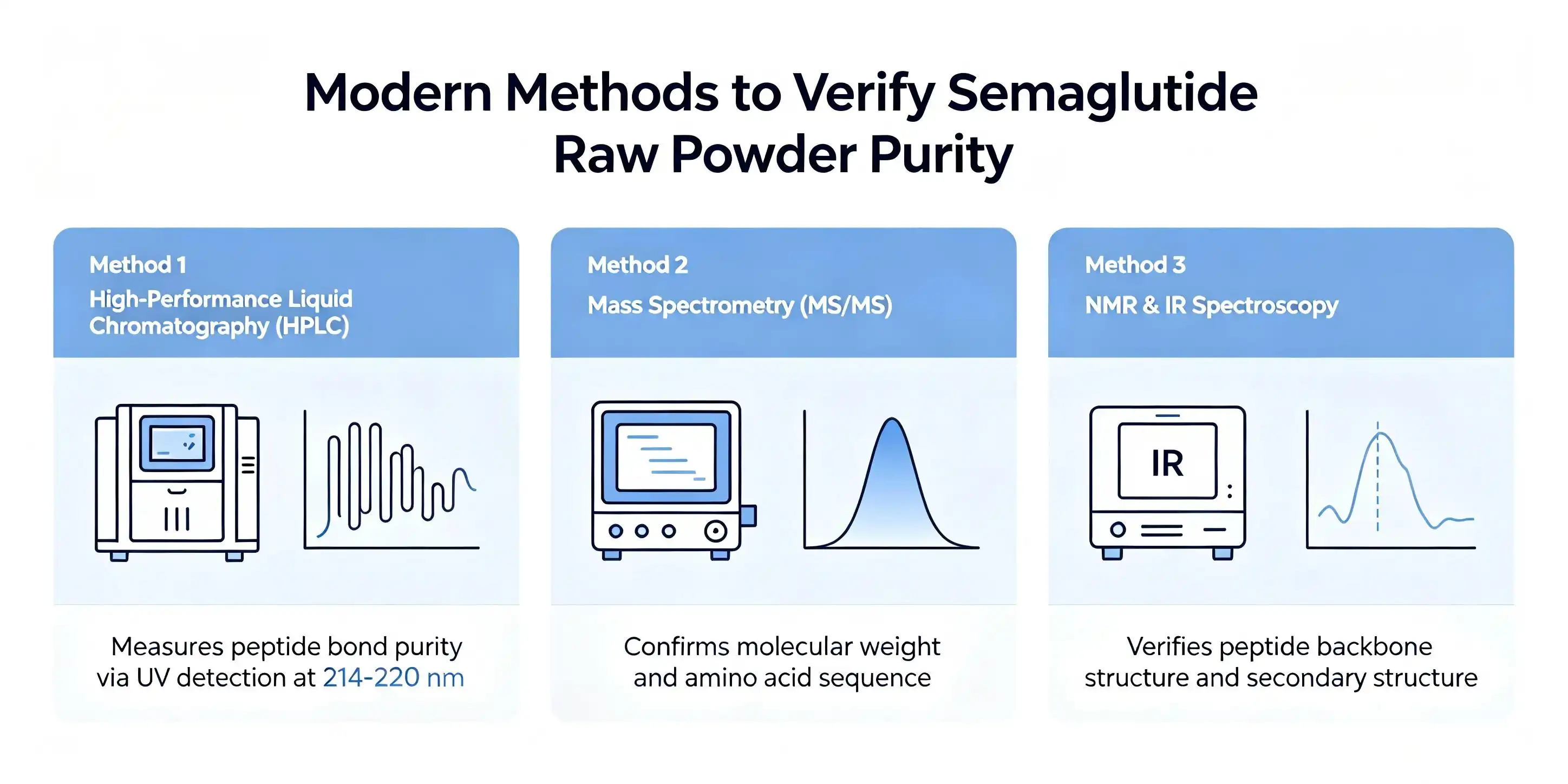
Using C18 columns and acetonitrile-water gradients with trifluoroacetic acid enhancers, reversed-phase HPLC sorts peptides based on how hydrophobic they are. Detection at 214–220 nm measures peptide bonds and creates chromatograms with peak area percentages that show purity. Modern systems use gradient optimization to get rid of impurities that elute closely, getting baseline separation that is necessary for accurate measurement of semaglutide raw powder. Buyers should ask for chromatograms that show consistent retention times across batches, as well as integration reports that show where the impurity peaks are. Validated HPLC methods that follow USP or EP standards make sure that the results can be repeated, but creating such a method needs knowledge of how to program gradients and choose columns.
Mass Spectrometry (MS/MS) for Structural Confirmation
Electrospray ionization mass spectrometry (ESI-MS) checks the molecular weight and confirms that semaglutide has a mass of 4,113.64 Da as predicted. Tandem mass spectrometry (MS/MS) breaks up the peptide into smaller pieces, creating sequence-specific ion patterns that show the amino acid makeup and change sites. This method finds deletion sequences, oxidation events, and acylation mistakes that HPLC alone can't see. Suppliers who offer MALDI-TOF or ESI-MS data show that they are dedicated to full analysis. It is important for buyers to make sure that the spectra match the expected isotope distributions and that the fragment ions match the expected peptide bond cleavages. This goes beyond just mass matching and ensures that the structure is real.
Nuclear Magnetic Resonance (NMR) and Infrared Spectroscopy (IR)
NMR spectroscopy shows the shape of the peptide backbone and finds chemical environments that aren't predicted, which could mean that there are flaws or structural problems. Even though it takes a lot of time and money, 1H-NMR is a different way to prove what analytical methods show. Fourier transform infrared spectroscopy (FTIR) creates fingerprint spectra that show the secondary structure of peptides and finds changes from the expected amide I/II bands. These methods work well with HPLC/MS processes, especially when checking reference standards or looking into strange batch behavior. Multi-technique characterization data from suppliers shows improved quality control, but most of the time, HPLC/MS combinations are enough for regular buying.
Practical Step-by-Step Verification Protocol
The first step in preparing a sample of semaglutide raw powder is to accurately weigh it (usually between 1 and 5 mg) and dissolve it in the right buffer (usually PBS or 0.1% TFA in water/acetonitrile). For calibration, approved reference standards are used to set up a detector's linear reaction across the predicted concentration ranges. HPLC research uses tried-and-true methods with known system suitability parameters, such as possible plate counts, resolution factors, and tailing factors.
Peak integration follows standard procedures to find the main peak and measure particles greater than 0.1%. Mass spectrometry proof runs samples side by side and compares the molecular weights seen to predicted values within a safe range (±1 Da). The proof used for purchase acceptance is the documentation, which includes raw data files, integration reports, and method validation notes.
Selecting a Trusted Semaglutide Raw Powder Supplier for Quality Assurance
Essential Certifications and Documentation
Reliable providers give out Certificates of Analysis (COA) that show the purity, moisture content, TFA levels, and endotoxin testing results for each batch of semaglutide raw powder. The COAs should list approved chemical methods and include chromatograms and spectra. Material Safety Data Sheets (MSDS) list how to handle a substance safely and how dangerous it is. GMP approval shows that a company follows the rules for making medicines. These rules include facility checks, process validation, and change control systems.
Getting ISO 9001 quality management approval shows that a company is committed to using uniform methods. Drug Master Files (DMF) sent to government bodies show that suppliers are ready for pharmaceutical supply lines. Buyers should check the legitimacy of certifications using databases maintained by the awarding bodies and see if the certifications cover the specific factory that makes the goods they are buying.
Evaluating Manufacturing Transparency
Transparent sellers describe how they make things (solid-phase vs. solution-phase approaches) and how they clean them (preparative HPLC or chromatography mixtures, for example). They talk about impurity patterns that are unique to their process and show how control methods were used to keep contamination to a minimum. Site visits give you a chance to directly look at how clean rooms are classified, how equipment is maintained, and how employees are trained. It's important for process outlines to include important details like the coupling chemical used, the deprotection conditions, the cleavage steps, and the lyophilization cycles. Concerns about quality consistency and legal readiness are raised when suppliers refuse to talk about manufacturing details or stop facility checks.
Navigating Pricing and Minimum Order Quantities
Pricing systems take into account how hard it is to make something, how pure it needs to be, and how the market is changing. Cost is still important, but experienced buyers know that higher prices often mean better analytical paperwork, backing from regulators, and supply dependability. Minimum order numbers (MOQ) are different for each company. Xi'an Yihui's MOQ starts at 1 gram, which makes it easy to do both pilot projects and large-scale production. Buyers should look at the total cost of ownership, which includes the unit price, the frequency of analytical testing, the security of shipping, and the possible costs of reformulation due to quality problems. Long-term supply deals often get better prices and make sure that materials are always available, which is important for manufacturing processes that don't stop.
Logistics and Transit Integrity
For peptides such as semaglutide raw powder to stay stable during shipping, temperatures must be kept under control. Lyophilized material can be exposed to air for a short time, but for best results, it should be packed in sealed containers with ice packs or dry ice, especially when shipping internationally. Suppliers should give verified stable data that shows little to no decline during the expected transport times.
Materials used for packaging, like foil bags, desiccant inclusions, and amber vials, keep things safe from light, moisture, and air. Tracking tools let people keep an eye on things in real time, and insurance protects against accidents that happen in shipping. As soon as buyers receive a package, they should write down its state, check any temperature logs that came with it, and do instant incoming quality control testing to make sure the materials are intact.
Best Practices for Handling, Storing, and Maintaining Purity of Semaglutide Raw Powder
Optimal Storage Conditions
Vials that haven't been opened need to be kept at 2–8°C in a refrigerator, away from light that speeds up photodegradation. Controlling humidity stops water from absorbing—lyophilized peptides easily hydrate, changing their mass and possibly starting hydrolytic breakdown. The required moisture content of semaglutide raw powder stays below 5% when stored in the original sealed packages with desiccant. For long-term storing, freezing at -20℃ or -80℃ makes things more stable, but repeated freeze-thaw cycles cause things to stick together, so they should be avoided. First-in, first-out (FIFO) cycle is used to keep inventory under control so that it is used within the two-year shelf life of pharmaceutical-grade materials.
Safe Handling and Contamination Prevention
Reconstitution methods have a big effect on the stability of peptides. Condensation-caused aggregation can be avoided by letting jars reach room temperature before opening them. Using filtered buffers, sterile needles, and laminar flow hoods in a sterile method keeps microbes from getting into the sample. Instead of shaking very hard, gently spinning reduces the mechanical stress that can mess up peptide folding. Cross-contamination can't happen when peptides are handled with special tools. This is especially important in places that process many chemicals at once. When people are trained to handle peptides, they are taught to be clean, wear the right safety gear, and write down what they do so that the material can be tracked throughout its entire journey.
Stability Monitoring and Shelf Life Management
Stability tests done on a regular basis make sure that the standards are still being followed during storage. Time-point sampling at 3, 6, 12, and 24 months creates decline profiles that help set times for retests and expiration. Bioassays show that the potency has been kept while HPLC analysis tracks the formation of impurities. Suppliers who help customers with stability measures show that they care about partnerships beyond business relationships. Real-time data on stability under stressed conditions like high temperature, humidity, and light exposure can be used to predict how something will behave in storage situations that aren't ideal. Companies that keep their databases stable across multiple runs can spot trends that point to changes in the manufacturing process that need to be communicated to suppliers and may require revalidation.
Conclusion
The first step in getting semaglutide raw powder API is still making sure it is pure. This has a direct effect on how well it works with regulators, how stable the product is, and how well it works in therapy. When you combine advanced analytical techniques like HPLC, mass spectrometry, and related spectroscopic methods, you can get a full picture that a single method can't give you.
Criteria for choosing a supplier that include certifications, openness about the production process, and logistical skills make sure that purchasing choices support the long-term stability of the supply chain. Post-procurement handling standards keep the integrity of materials from getting them to making them. As peptide therapeutics get better, procurement workers who use strict verification processes set their companies up to be ahead of the competition in metabolic disease markets that are changing quickly.
FAQ
What Documentation Should Suppliers Provide for Compliance Verification?
Full records include COAs for each batch of semaglutide raw powder with full analytical data, MSDS with danger ratings, and regulatory certifications (GMP, ISO). Suppliers should provide Drug Master Files or other regulatory filings that show they are ready for pharmaceutical supply lines. Independent confirmation comes from test results from third-party, accredited labs. Export and import licenses make sure that laws are followed in all areas. This set of documents helps purchasing teams do their research thoroughly, meeting both internal quality standards and external legal requirements while building trust in the seller.
Can This Material Be Used Directly in Pharmaceutical Manufacturing?
The powder is an active medicinal ingredient that needs to be mixed with other ingredients before it can be used. For injectable medicines, they need to dissolve in the right vehicles with stability enhancers. For mouth medicines, they need penetration enhancers like SNAC to stop enzymes from breaking them down. Direct use without composition knowledge can lead to wrong doses, instability, and not following the rules set by regulators. Our material is only meant to be used for study purposes, formulating new medicines, and making medicines in the right way for pharmaceutical development, not for direct use by consumers.
How Do Peptide Content and Purity Differ?
Purity shows the amount of target peptide compared to residues found by HPLC. For pharmaceutical-grade material, purity should be at least 98%. It's the net weight of the peptides, minus the weight of water, counter-ions (like acetate or TFA salts), and any liquids that are still present, which is usually between 80 and 90% of the total powder weight. Even very pure stuff may still have a lot of salt in it, which can make it hard to figure out the right dose. Buyers need to know both specifications: the purity to make sure the quality and the peptide content to make sure that the preparation calculations are correct and that the medicinal doses are correct.
Partner with Xi'an Yihui for Verified High-Purity Semaglutide Supply
If you need a trusted source for Semaglutide raw powder, Xi'an Yihui Bio-technology Co., Ltd. can provide you with pharmaceutical-grade peptide APIs that meet the highest standards of quality. Our material requirements include assay purity of at least 99%, full COA paperwork with HPLC chromatograms, and flexible packaging from 1g for study purposes to bulk sales for business manufacturing.
Our advanced synthesis skills and strict quality control methods, along with our ISO and GMP licenses, make sure that the performance of each batch is the same. We keep a lot of products in stock so that we can serve quickly. We also offer professional technical support to help with recipe problems and meeting regulatory requirements. Our reasonable prices allow us to work with projects at all stages, from early-stage research to full-scale production. Also, our global transport network makes sure that peptides are shipped safely and at the right temperature, protecting their purity.
You can email our expert team at sales@yihuipharm.com for full product specs, stability data, or quotes that are made just for your needs. Visit yihuipharm.com to explore our complete peptide portfolio and discover why pharmaceutical businesses, research institutions, and cosmetic formulators in more than 100 countries choose Xi'an Yihui as their chosen API partner for mission-critical peptide supply.
References
1. Smith, J.L. & Martinez, R.K. (2021). Analytical Characterization of Therapeutic Peptides: Modern HPLC and Mass Spectrometry Approaches. Journal of Pharmaceutical Sciences, 110(4), 1523-1542.
2. Chen, W. & Anderson, P.D. (2020). Quality Control Strategies for GLP-1 Receptor Agonist APIs in Pharmaceutical Manufacturing. Pharmaceutical Technology Europe, 32(7), 28-35.
3. Thompson, H.R., et al. (2022). Peptide Purity Verification: Regulatory Expectations and Analytical Best Practices. American Pharmaceutical Review, 25(3), 45-54.
4. Williams, D.S. & Kumar, A. (2019). Stability and Degradation Pathways of Modified Peptide Therapeutics. International Journal of Peptide Research and Therapeutics, 26(2), 891-908.
5. European Pharmacopoeia Commission (2023). Monograph 3067: Semaglutide - Analytical Standards and Purity Requirements. European Pharmacopoeia, 11th Edition, 4234-4238.
6. Zhang, L., et al. (2021). Supply Chain Quality Assurance for Peptide Active Pharmaceutical Ingredients: A Procurement Perspective. Journal of Supply Chain Management in Healthcare, 18(6), 112-128.

Send Inquiry
Related Industry Knowledge
- What is the Uses and operations of Tranexamic Acid?
- Is phenolphthalein a pH indicator?
- What are the Side Effects of Using Hexamidine diisethionate?
- Does Dihydromyricetin Work
- What Is the Drug Pizotifen Malate Used For?
- How Atropine Sulphate Useful in Preparation of Nasal Drops?
- What foods contain vitamin k2 mk4?
- What is levomefolate calcium used for?
- What Is A Example Inhibitor?
- What Is Cosmetic Peptides?