
GHK-Cu cosmetic peptide
CAS No.: 89030-95-5
Sequence: Gly-His-Lys (GHK), 1:1 chelate complex with Cu²⁺
Molecular Formula: C₁₄H₂₂CuN₆O₄
Molecular Weight: 401.93 Da
MOQ: 1G
Assay: 98%
Available package: 1g, 5g, 10g;100g
Sample Available: Yes
Delivery Time:in stock
Usage: For scientific research use only.
Delivery Time:in stock
Can't sell to individuals

- Fast Delievery
- Quality Assurance
- 24/7 Customer Service
Product Introduction
GHK-Cu Cosmetic Peptide for Research and Cosmetic Formulation Development
Lab teams that study copper peptides in formulation research can source GHK-Cu cosmetic peptide from XI'ANYIHUI KANGYUAN BIO-TECHNOLOGY CO., LTD. The product is Copper Tripeptide-1, also called Prezatide Copper. Solid-phase peptide synthesis produces this blue lyophilized powder. Stated HPLC purity is ≥98%. The listed minimum order is 1G, and samples are available for an initial evaluation. Check the specifications first. Ask for the batch documents that apply to your order. Then confirm stock and shipping before you buy. Supply covers organizational research and cosmetic formulation development. It is not meant for individual purchase or personal use.
Specifications
| Parameter | Specification |
|---|---|
| Product Name | Copper Tripeptide-1 (GHK-Cu, Prezatide Copper) |
| CAS No. | 89030-95-5 |
| Sequence | Gly-His-Lys (GHK), 1:1 chelate complex with Cu²⁺ |
| Molecular Formula | C₁₄H₂₂CuN₆O₄ |
| Molecular Weight | 401.93 Da |
| MOQ | 1G |
| Assay | 98% |
| Available package | 1g, 5g, 10g; 100g |
| Sample Available | Yes |
| Delivery Time | in stock |
| Usage | For scientific research use only. |
| Appearance | Blue lyophilized powder |
| Purity (HPLC) | ≥98% |
| Source | Solid-phase peptide synthesis |
| Solubility | Freely soluble in water and PBS buffer |
| Storage Condition | Sealed at -20℃, protected from light and moisture |
| Shelf Life | 24 months under sealed cold storage |
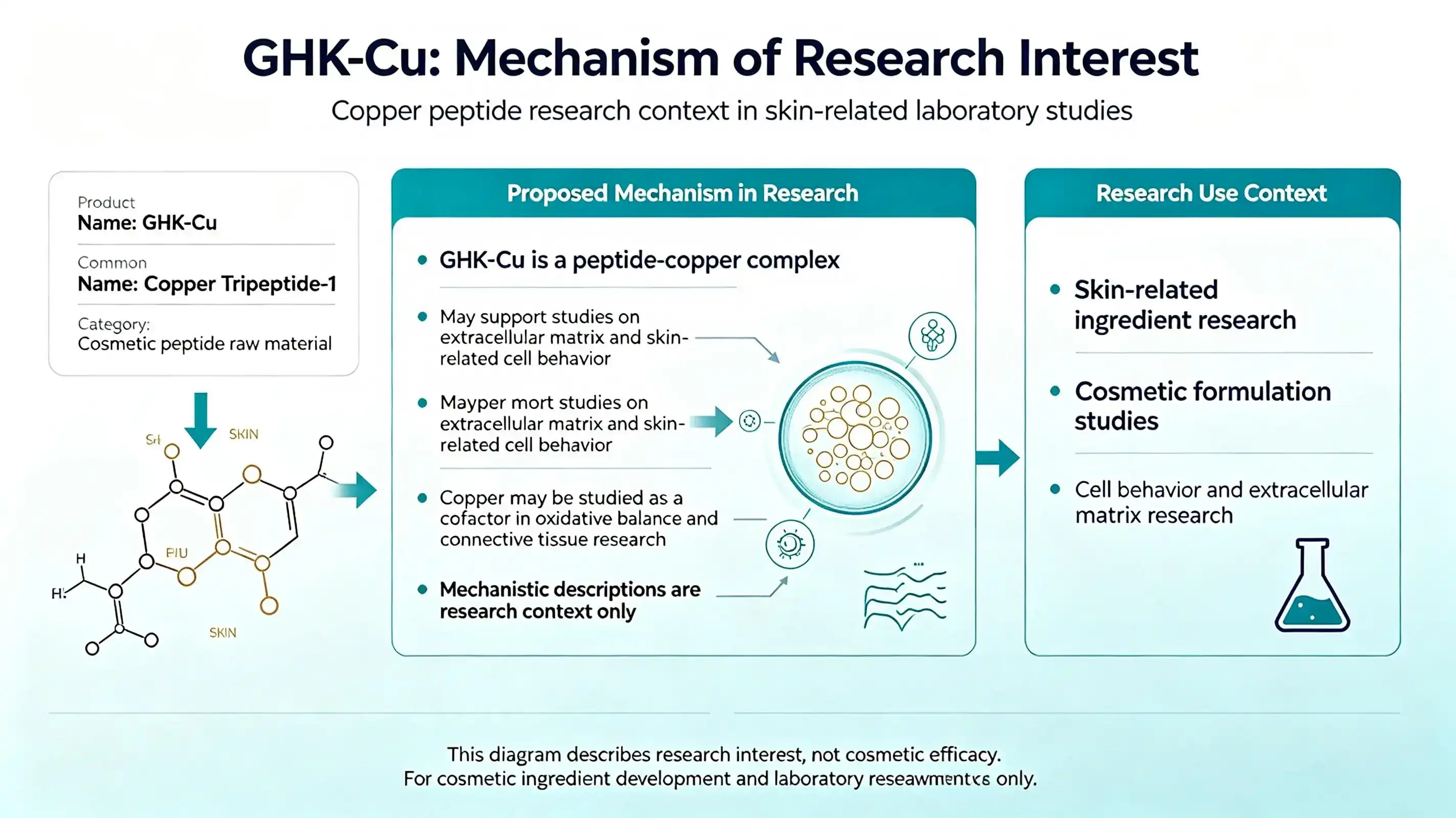
| Note | For research & cosmetic formulation use only. It is a copper-binding tripeptide widely studied for skin regeneration, collagen support and antioxidant research. |
Everything in the table comes from the supplied Product Specifications. No parameters were added from application guidance or company descriptions. Any parameter the table leaves out is still unspecified. If you need one of those, ask for it on its own.
COA
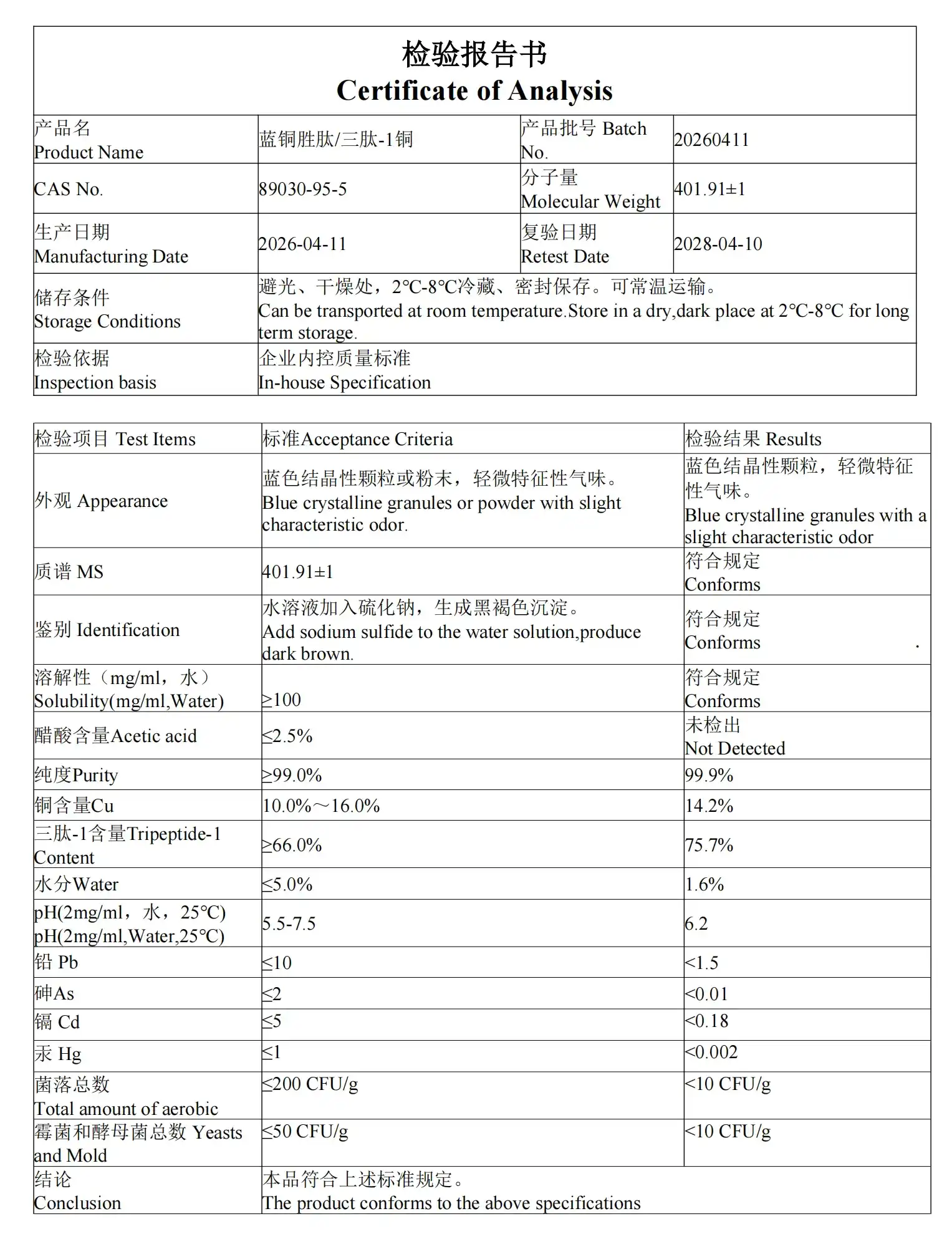
Intended use is described in two different ways across the Usage and Note entries. Confirm what scope is permitted for your project before you buy. Research topics in the Note are not proof that a finished product works. They also do not mean medical use is authorized.
Material Identity and Characteristics
Copper Tripeptide-1 includes the Gly-His-Lys sequence. Copper(II) is bound to that sequence. The supplied specification describes a 1:1 chelate complex. Free GHK alone is not the same. Copper salts by themselves are different too.
Water and PBS-buffer solubility are stated. That supports testing in aqueous laboratory systems. Solubility in these media does not show compatibility. It does not prove stability in a complete cosmetic formula.
Research and Formulation Applications
GHK-Cu cosmetic peptide can be tested in serum and cream development projects. The supplied information covers research areas. Collagen support is one. Antioxidant activity and skin regeneration are others. These are research topics. They are not proven results for this batch. Nor are they proven for a finished cosmetic.
Start with relevant published studies when your development work rests on efficacy claims. Read them and compare the materials they used with your own project. Compare their methods next. Then look at the conditions used to make the formulation. Claims for a finished product need evidence that fits that formulation and the market it is meant for.
Do not take mentions of care after a procedure as approval. The same goes for wound recovery and hair studies. This research material is not approved for those uses.
Formulation Compatibility
The complete formula matters when you review this product. Ingredient level compatibility alone is not enough. During development, keep an eye on pH. Watch the appearance too. Check for precipitation. Track stability as well.
L-ascorbic acid comes up in your formulation discussion. So do strong chelators like EDTA, and anionic thickeners like carbomers. Those are the possible compatibility issues. Run lab tests on any combination you plan to use. Hydroxyethylcellulose is listed there as a non-ionic option. That is not a recommendation that has been proven for every formula.
A shift from blue to green, or a precipitate forming, needs a closer look. Check the pH first. Then the other ingredients and the processing conditions. Do that before you accept the change as normal.
No validated dosage or pH spec for the finished formula appears in the Product Specifications. Test for the project in front of you to set the right conditions. General formulation references are not product parameters, so do not treat them that way.
Quality Documentation and Supplier Qualification
Keep two things apart once you buy this product: the analytical specs in the list, and the results reported for one batch. In the table provided, assay and HPLC purity sit as separate entries. Read them that way.
Each batch, the supplier says, comes with a COA, an MSDS, and chromatogram reports. Before you accept the material, ask for the documents that cover the batch you are offered. Review them first.
Does your project call for copper-content analysis, or for more proof of molecular identity? Then ask whether AAS or mass spectrometry data are available. These methods are not listed as routine release tests in the Product Specifications.
ISO9001 and ISO14001 certificates are listed by the company, and so are SGS test reports. Ask for the current documents when you qualify the supplier. Check what the scope of each one covers. Find out who issued it, and whether it applies to your product. A certificate held at company level does not mean a finished cosmetic has been approved.
Manufacturer and Technical Support for GHK-Cu cosmetic peptide
XI'ANYIHUI KANGYUAN BIO-TECHNOLOGY CO., LTD was set up in 2010. The company is a biotechnology supplier based in Xi'an. Research and development is one of the activities it lists. Production, sales, and technical support are the others.
Buyers with Copper Tripeptide-1 projects can ask for advice on picking products and formulas. Help with factory audits is another option. So is support for third-party testing. Technical help after the sale is available too. Ask what each service covers and whether you can get it on your order.

Ordering and Supply
Orders start at 1G. You can get samples too. Buyers pick from 1g, 5g, 10g, or 100g packs. Stock status on the spec sheet reads "in stock," yet confirm the real quantity and the dispatch date first. Do that before you place the order.
Send these details so the quote fits your needs:
- Your company name, plus what you plan to do with it in research or formulation.
- The quantity you need, plus the package size you prefer.
- Where it needs to go, and the delivery timing you want.
- Batch documents you need, or extra testing you want done.
- What packaging rules or export paperwork you need to meet.
Exports of GHK-Cu cosmetic peptide are something the supplier can support. Several international payment methods are accepted too. When you go through the quotation, check the payment terms. Also confirm which documents your destination requires, plus any customization you want.
Packaging, Shipping, and Storage
Sealed packaging is what the supplier says it uses. Transport is planned as well, so leakage and shipment damage should drop. Before dispatch, check the packaging details. Confirm the transport arrangements for your destination too.
Store the powder sealed at -20℃. Keep it away from light and moisture. Sealed and cold, the stated shelf life is 24 months. That figure says nothing about stability once the product is opened, dissolved, or added to a formula.
FAQ
Q: Is this product meant for personal skincare use?
A: No. Organizational buyers are who we supply, for research and cosmetic formulation development. It is not sold for individual purchase or personal use. Please check the intended-use scope, since the supplied Usage and Note entries do not match.
Q: Is ≥98% HPLC purity enough to prove a cosmetic will perform?
A: No. HPLC purity is a lab spec. It says nothing about efficacy or whether the formula stays stable. Safety and regulatory fit for a finished cosmetic are not covered either.
Q: Can it be combined with vitamin C?
A: The guidance you sent points to compatibility problems with L-ascorbic acid. Put the proposed combination through a test using your own formulation conditions. Do not assume it is compatible.
Q: What details do the specifications leave out?
A: No validated dosage for the finished formula is given. The same goes for pH limits of the formulation. Stability after opening or after dissolution is not covered either. Do not guess these values from general application descriptions. Should your project require them, ask for supporting technical information.
Contact
To ask for a quote or a sample, send wholesale or export inquiries about GHK-Cu cosmetic peptide to sales@yihuipharm.com.
Send Inquiry
You may like