
Where to buy reliable semaglutide raw powder in bulk
Procurement managers and R&D teams need to work with manufacturers that regularly provide pharmaceutical-grade quality, full regulatory paperwork, and clear supply lines when they need to buy semaglutide raw powder in bulk. Semaglutide, a long-acting GLP-1 receptor agonist with the CAS number 910463-68-2, is now an important part of studies on diabetes and weight control.
Because of the high demand from research schools, pharmaceutical businesses, and CRO/CDMO organizations, reliable sourcing has become a top concern. This guide talks about the most important problems that B2B buyers have to deal with, like making sure that purity standards are met, managing bulk logistics, and building partnerships with suppliers that help with long-term formulation development and regulatory submissions.
Understanding Semaglutide Raw Powder and Its Market Demand
What Makes Semaglutide a Strategic API
Semaglutide powder is a big step forward in peptide medicines. It was made using solid-phase synthesis techniques that change certain molecules in particular ways. The compound has an aminoisobutyric acid substitution at position 8 and a C-18 fatty diacid chain attachment at position 26. This keeps the compound from breaking down by enzymes and makes its biological half-life about 165 hours longer. These changes to the structure solve important stability problems that plagued earlier GLP-1 analogs.
The global peptide therapy market is still growing very quickly. This is because metabolic disorders are becoming more common and focused biological treatments are becoming more popular. Pharmaceutical businesses that are working on generic drugs and new ways to send medicines need to be able to consistently get their hands on high-purity active ingredients. For studies on weight management and controlling blood sugar, research institutions need research-grade peptides that meet strict specifications.
Regulatory Landscape Affecting Procurement
When making procurement plans, it's important to think about the rules that apply in each region for peptide API transactions. This is what the FDA says about making peptides in the US: they need a lot of paperwork, like Drug Master Files for medicinal uses. Through its centralized authorization procedures, the European Medicines Agency also makes sure that the same standards are met. When buyers are making products for regulated markets, they need to work with suppliers who have a history of following the rules and who have full traceability systems in place.
Knowing about these frameworks helps procurement teams guess what paperwork will be needed, set dates for checking for compliance, and choose suppliers who can help with regulatory submissions. Barriers in the regulatory environment favor well-known companies with quality management systems that are in line with international pharmaceutical standards.
How to Identify Reliable Semaglutide Raw Powder Suppliers
Core Quality Indicators and Certifications
To find reliable providers, you should first carefully look at their quality control systems. Manufacturers you can trust keep their factories GMP-certified, with tested synthesis methods and thorough testing routines. Each batch should come with a Certificate of Analysis documenting HPLC purity measurements, which usually show that the sample is ≥98% pure and has an impurity profile below 0.5%. In these lab reports, there must be thorough chromatograms that show how the target peptide is separated from leftovers of synthesis like des-Gly fragments and oxidized versions.
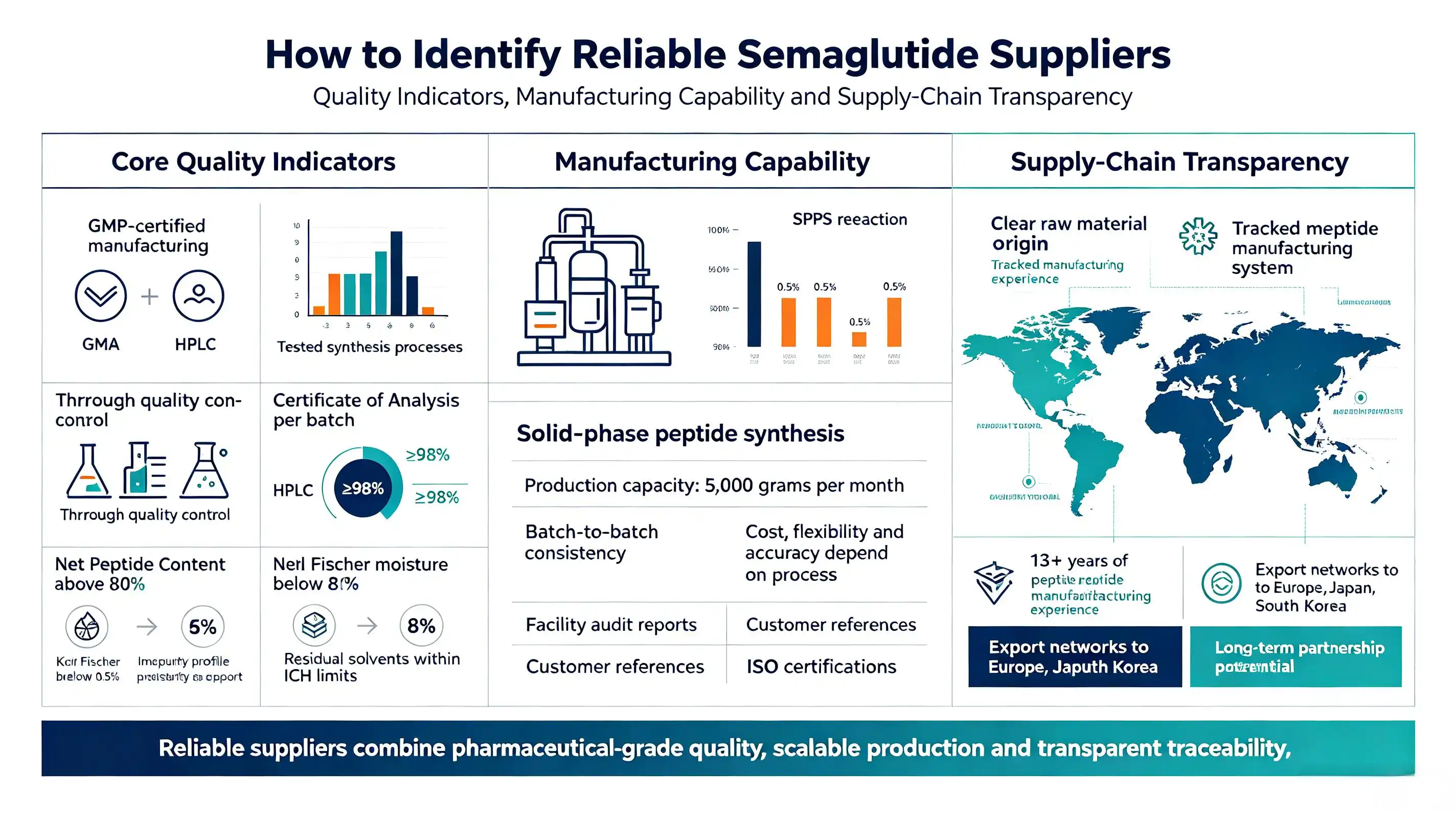
Another important characteristic that is often missed in early source evaluations is the net peptide content. Instead of just comparing the target peptide to impurities in other peptides, NPC takes into account things like water content, residual acetates, and counterions that make it harder to figure out the right dose. Material that is used in pharmaceuticals usually keeps NPC levels above 80%. The Karl Fischer titration should show that the moisture level is less than 8%, and the residual solvent analysis should show that the levels of acetonitrile and trifluoroacetic acid are within the limits set by ICH.
Evaluating Manufacturing Capabilities and Supply Chain Transparency
In addition to quality certificates, buyers should look at the size of the factory and its technical skills. Suppliers that make at least 5,000 grams a month show that they have well-established production systems that can meet ongoing business needs. Costs, flexibility, and accuracy from batch to batch are all affected by the synthesis method, such as solid-phase peptide synthesis or recombinant DNA technology. Semaglutide raw powder is no exception—its purity and performance depend directly on these production factors, so buyers must evaluate suppliers’ capabilities specifically for this active ingredient.
Supply chain transparency gives managers important information for managing risks. Manufacturers should make it clear where their raw materials come from, keep track of the steps used to make their products, and keep batch traceability systems that can be used for regulatory inspections. To prove operational maturity, you can ask for facility audit reports, look at customer references from similar industries, and confirm ISO certifications. Companies that have been making peptides for 13 years and have built export networks to controlled markets like Europe, Japan, and South Korea usually have the security and compliance infrastructure that B2B buyers look for in partners they want to work with for a long time.
Key Considerations When Buying Semaglutide Raw Powder in Bulk
Quality Assessment Beyond Basic Specifications
When you buy in bulk, you need to do a full quality check that goes beyond the COA requirements. Ask for full impurity profiles that list possible byproducts of synthesis and degradation. Mass spectrometry proof (ESI-MS) showing a molecular weight of 4,113.64 g/mol ruling out mistakes in peptide assembly that would cause the weight to be too low. It is necessary to test for bacterial endotoxin using LAL methods for injectable-grade material because specifications usually need levels below 10 EU/mg to stop pyrogenic reactions.
Knowing the difference between the different grade classifications helps make sure that purchases are right for the job. Research-grade peptides help with studies in the lab and early formulation tests. Pharmaceutical-grade material is very pure and comes with all the paperwork that is needed for both clinical development and mass production. By making grade standards clear during the initial discussions with the seller, costly specification errors that are found during the quality review stages can be avoided.
Pricing Structures and Total Cost Analysis
There are more factors that affect the price of bulk peptides than just the cost per gram. Prices that are based on volume usually have big benefits. For example, buying 50 grams usually gets you better prices than buying smaller amounts. Payment terms affect the amount of operating capital that is needed. For example, suppliers who accept letters of credit or documentary acceptance arrangements make foreign deals more flexible, while standard T/T terms require capital to be allocated up front.
When planning a procurement, it's important to pay close attention to hidden costs. When temperature-sensitive peptides are shipped internationally, they need special cold-chain procedures that cost more. Different markets have different import taxes, customs fees, and costs for following the rules. The infrastructure needed to keep the required temperature range of 2 to 8°C adds to the ongoing costs of doing business. Figuring out the total landed cost of a product, which includes the price, shipping, taxes, and storage, helps you make accurate budget projections and compare suppliers in a meaningful way.
Logistics and Product Integrity Management
To keep peptide stability throughout the supply chain, logistics must be carefully coordinated. Specifications for packaging should include vacuum-sealed containers with desiccants, extra containment to keep things from getting damaged, and temperature tracking devices to show that the cold chain is being followed. Shipping times affect how much inventory to keep on hand. If suppliers keep stock on hand, deliveries can happen faster than with made-to-order synthesis, which takes a few weeks.
How a product is stored has a direct effect on how long it lasts and how well it works. Semaglutide powder stays stable for two years if it is kept at 2–8°C in containers that are sealed and kept away from light and moisture. Facilities that receive large shipments need to have cold storage equipment that has been tested, environmental tracking systems, and written storage processes that meet GMP standards. The contracts for buying things should say how much the temperature can change while they're being shipped and who is responsible for any damage that happens because of delays or changes in temperature.
Comparison of Popular Semaglutide Raw Powder Variants and Their Suitability
Raw Powder Versus Formulated Products
Knowing the benefits of buying fresh powder helps buyers make the best decisions about their supply chains. When companies buy APIs in bulk, they have the most control over the formulation process. They can create their own delivery systems, change the doses, and add stabilizing ingredients that are best for each therapeutic application. Being able to precisely control experimental variables and compound modifications is helpful for research institutions that are studying mechanisms or making new analogs. Semaglutide raw powder, in particular, offers these same advantages, as its fresh form ensures higher stability and flexibility for both custom formulation and analytical research.

Buying raw powder is cheaper than buying goods that have already been made. When you get rid of the intermediate steps in the preparation process, the cost per dose goes down by a lot, especially when you're making a lot of drugs. Being able to buy directly from API manufacturers cuts down on supply chains, lowers the risk of handling, and makes it easier to track. Companies that are making both injection and oral versions like how bulk powder can be used in a lot of different ways.
Evaluating Alternative Peptide Options
For certain uses, procurement teams may look at other peptides besides semaglutide, which is the current generation of GLP-1 therapeutics. Liraglutide is an older GLP-1 analog that is cheaper but needs to be dosed more often because its half-life is shorter. Oral semaglutide versions that contain SNAC enhancers make delivery easier, but they add to the complexity of the product and the regulatory paths.
Buying decisions are affected by whether to buy generic or branded drugs at different stages of the pharmaceutical development process. In the beginning, common peptide sources may be used because they are cheap and easy to get. For clinical development and commercial production, pharmaceutical-grade materials with a lot of regulatory support documentation are usually needed. Peptide sourcing should be planned so that it fits with the needs of the development stage, the deadlines for regulatory submissions, and the budget, but quality levels should be able to be raised as projects move forward.
How to Place Bulk Orders and Manage Procurement Effectively
Structured Supplier Engagement Process
Effective bulk buying starts with a full evaluation of the supplier, which can be done by asking for samples and meeting with technical experts. Before making bigger purchases, asking for 1-gram samples lets you check the quality through an independent lab test. HPLC purity proof, mass spectrometry verification, and performance tests in target applications should all be part of the sample evaluation process. This initial evaluation finds any possible compatibility problems and sets standard quality standards.
Catalog enquiries should go beyond simple product descriptions and include thorough technical specs. Ask about the methods used for synthesis, the types of impurities that are common, the largest batch sizes that can be made, and the current stock supply. Talk about your options for customization if the standard specifications don't meet the needs of your project. Many manufacturers can work with qualified customers to change purity levels, packaging configurations, or testing protocols.
Technical conversations with supplier R&D teams often reveal features that aren't clear from standard product catalogues. Semaglutide raw powder is a prime example where such detailed technical enquiries are essential, as its synthesis complexity and impurity profiles vary significantly between suppliers, directly impacting both research outcomes and final product quality.
Contract Negotiation and Risk Management
To get good terms, you have to deal with a lot of different business and technical issues. When talking about prices, people should talk about making big promises that get better rates while still letting you adapt to changes in demand. Initial capital needs are affected by minimum order numbers, which are often as low as 1 gram for testing reasons. However, making reorder commitments of 10 to 50 grams usually leads to better long-term pricing.
Delivery dates should be clearly stated in contracts. Suppliers who keep stock can usually ship within days, but custom synthesis may take two to four weeks to make. Contracts should spell out acceptable wait times, offer ways to speed up the process for urgent needs, and set clear rules for how to talk about production delays. Quality agreements that spell out acceptance criteria, who is responsible for testing, and how to settle disagreements protect both sides and make it clear what is expected from ongoing supply relationships.
Building Strategic Supplier Partnerships
Long-term relationships with suppliers have benefits beyond just making transactions easier. Preferred customers often get first choice when supplies are low, early notice of when products will be made, and better prices when new products come out. Suppliers who know about specific formulation needs can suggest ways to improve the process and the quality of the product based on their knowledge of the application.
Structured metrics for monitoring supplier performance help with continuous improvement and finding risks early on. Keep an eye on key performance measures like the number of on-time deliveries, quality acceptances, full documentation, and responses to technical questions. Quarterly business reviews give people a chance to voice their concerns, talk about planning for capacity, and agree on how to handle changes in regulations that could affect supply continuity. These investments in partnerships give businesses a competitive edge by making the supply chain more reliable and giving them access to technical knowledge that speeds up the product creation process.
Conclusion
To get reliable semaglutide raw powder in bulk, you have to find a balance between technical requirements, following the rules, saving money, and managing your relationships with suppliers. Teams that are good at buying things put a lot of weight on suppliers who can show that their facilities are of pharmaceutical-grade quality and that they can provide full documentation of their processes. Testing methods, purity requirements, and impurity profiles must be carefully looked over to make sure the material is suitable for its intended use.
To make accurate budget plans and useful source comparisons, it's important to understand total cost structures, which include transportation, storage, and compliance costs. Strategic relationships with well-known manufacturers offer long-term supply security, technical help, and the legal support needed to get a product on the market. B2B buyers can build strong supply chains that help them reach their goals in research, development, and production by using the evaluation methods and buying strategies explained in this guide.
FAQ
How can I verify the authenticity of semaglutide powder?
Authenticity verification needs more than one step of proof. Ask for full Certificates of Analysis that include HPLC chromatograms that show retention times that match reference standards and mass spectrometry data that confirms the molecular weight of 4,113.64 g/mol. Testing by a third party, such as an approved lab, gives unbiased proof of quality. Check the certifications of your suppliers using databases maintained by the issuing authority. GMP certificates should be up to date and cover the right areas for making peptides. Suppliers with a good reputation will gladly give you customer references, facility documentation, and records of regulatory inspections that back up their quality claims.
What are typical lead times for bulk semaglutide orders?
Lead times depend on the size of the order and the supplier's current stock. Small amounts (1–10 grams) can be shipped within 3–5 business days by suppliers who keep stock. Larger orders that need special synthesis usually take two to four weeks to produce, test for quality, and prepare paperwork. It takes an extra 5–10 days for international shipping, depending on where it's going and how quickly it can clear customs. Procurement planning should account for these timelines plus buffer periods for potential delays. Setting up framework agreements with set delivery dates helps suppliers make the best use of their production schedules and makes delivery more predictable.
What storage conditions are necessary to maintain peptide stability?
Semaglutide powder needs to be kept in the fridge between 2 and 8°C in containers that are tightly sealed and kept away from light and moisture. Facilities should have validated cold storage units with alarm systems that go off when the temperature starts to rise or fall. Moisture levels are controlled by desiccants inside storage containers. Do not use freeze-thaw processes, as they can damage the structure of peptides. As long as it is stored properly, semaglutide powder stays stable for two years from the date it was made. Keep track of the conditions of storage along the whole supply chain to help with quality checks if there are concerns about stability.
Partner with Xi'an Yihui for Pharmaceutical-Grade Semaglutide Raw Powder Supply
Xi'an Yihui Bio-technology Co., Ltd. provides pharmaceutical-grade semaglutide raw powder (CAS 910463-68-2) that meets the strict quality standards of pharmaceutical companies, research institutions, and manufacturing labs around the world. Our GMP-certified production plants consistently make 99% pure material and keep detailed analytical records to back up regulatory applications. We've been making peptides for 13 years and have established export networks that serve customers in the US, Europe, Japan, and South Korea.
This means we know the technical details and compliance requirements that are important for your purchase to go smoothly. We have many benefits over our competitors, such as flexible minimum order amounts starting at 1 gram, a monthly production capacity of 5,000 grams that guarantees a steady supply, full COA documentation with HPLC and mass spectrometry data, and professional technical help from our experienced R&D team. We keep our ISO, Halal, and Kosher certifications, which show that we are dedicated to quality management excellence.
As a trusted semaglutide raw powder manufacturer, we offer samples to make sure the quality, competitive pricing for large orders, and helpful customer service through our sales@yihuipharm.com team. Contact Xi'an Yihui right away to talk about your specific needs and make sure your supply chain is protected by a dependable partner who wants you to succeed.
References
1. Knudsen LB, Lau J. "The Discovery and Development of Liraglutide and Semaglutide." Frontiers in Endocrinology, 2019, 10:155-174.
2. Aroda VR, Rosenstock J, Terauchi Y, et al. "PIONEER 1: Randomized Clinical Trial of the Efficacy and Safety of Oral Semaglutide Monotherapy in Comparison With Placebo in Patients With Type 2 Diabetes." Diabetes Care, 2019, 42(9):1724-1732.
3. Lau J, Bloch P, Schäffer L, et al. "Discovery of the Once-Weekly Glucagon-Like Peptide-1 (GLP-1) Analogue Semaglutide." Journal of Medicinal Chemistry, 2015, 58(18):7370-7380.
4. Wilding JPH, Batterham RL, Calanna S, et al. "Once-Weekly Semaglutide in Adults with Overweight or Obesity." New England Journal of Medicine, 2021, 384(11):989-1002.
5. Davies M, Pieber TR, Hartoft-Nielsen ML, et al. "Effect of Oral Semaglutide Compared With Placebo and Subcutaneous Semaglutide on Glycemic Control in Patients With Type 2 Diabetes: A Randomized Clinical Trial." JAMA, 2017, 318(15):1460-1470.
6. Buckley ST, Bækdal TA, Vegge A, et al. "Transcellular Stomach Absorption of a Derivatized Glucagon-Like Peptide-1 Receptor Agonist." Science Translational Medicine, 2018, 10(467):eaar7047.

Send Inquiry
You may like
Related Industry Knowledge