
What is the mechanism of Octreotide Acetate?
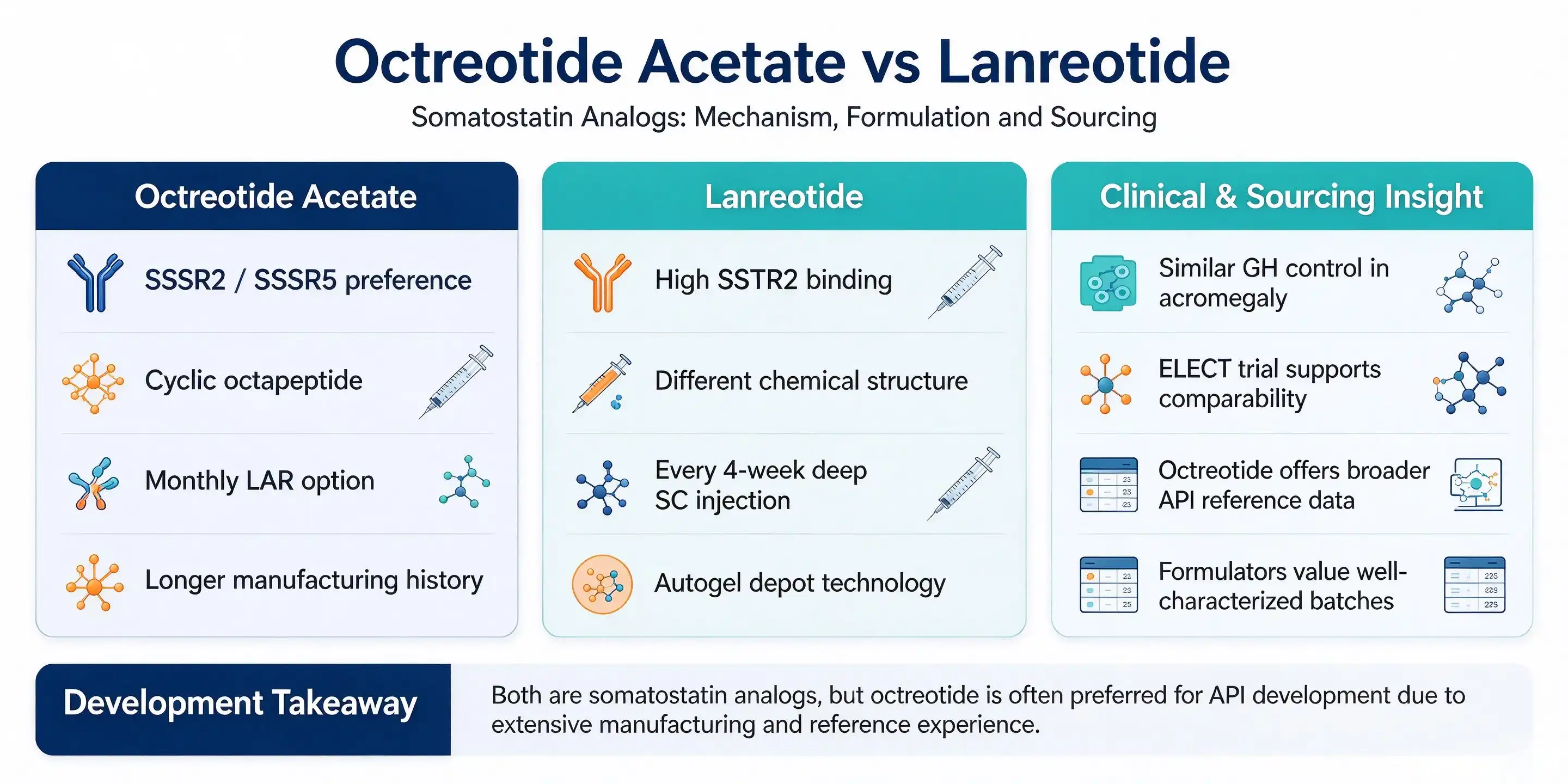
Octreotide acetate powder is a synthetic cyclic octapeptide that mimics natural somatostatin but with far greater metabolic stability. While endogenous somatostatin degrades within 2–3 minutes, octreotide extends its half-life to approximately 1.5 hours. Its core mechanism involves selective binding to somatostatin receptor subtypes 2 and 5 (SSTR2/SSTR5), which triggers inhibition of growth hormone (GH), insulin, glucagon, and several gastrointestinal peptides. This receptor-mediated suppression is the pharmacological basis for treating acromegaly, carcinoid syndrome, and VIPomas. For B2B buyers sourcing research-grade material, this biochemical precision directly informs quality and purity requirements.
Understanding Octreotide Acetate: Overview and Core Mechanism
Chemical Identity and Structural Design
Octreotide acetate has the CAS number 83150-76-9 and the formula C₄H₆N₁O₁S₂. Its molecular weight is 1019.26 g/mol. A cyclic disulfide bridge is made between two cysteine residues by its peptide sequence, which is D-Phe-c[Cys-Phe-D-Trp-Lys-Thr-Cys]-Thr-ol. This cyclic shape isn't there by accident; it makes octreotide resistant to enzymatic cleavage, which is the exact structural property that sets it apart from its natural counterpart and makes it a good candidate for use as an API in pharmaceuticals.
Receptor Binding and Signal Suppression
It is very strong at attaching to SSTR2 and SSTR5, which are G-protein coupled receptors found on neuroendocrine tumor cells and pituitary tissue. When they connect, they stop adenylyl cyclase from working, cAMP levels inside cells drop, and hormones that are released later are slowed down. This is how GH levels drop in people with acromegaly and serotonin and substance P levels drop in people with carcinoid syndrome. Selectivity for SSTR2 over SSTR1, SSTR3, and SSTR4 also reduces cardiovascular effects that aren't meant to happen.
Clinical Relevance for Pharmaceutical Buyers
The process directly affects the need for healthcare services. Controlling acromegaly, endocrine tumors, and GI symptoms all depend on consistent receptor occupancy, which means that API batches need to meet strict purity standards. Formulation makers who are looking for this substance don't want HPLC purity of ≥98.0%; they need it just to make sure that the receptor kinetics are the same across all patient groups.
Octreotide Acetate Powder Usage, Dosage, and Preparation
Dosage Regimens by Indication
When treating acromegaly, doctors usually start by putting 50 mcg under the skin two to three times a day and slowly increase the dose based on how the IGF-1 and GH work. For VIPomas and carcinoid tumors, amounts of 100 to 600 mcg per day should be spread out over the course of the day. There is a lot of information about these areas in the medical literature, and they show how quickly octreotide binds to SSTR2. When making release profiles, formulators who work with bulk API need to take these dosing windows into account.
Reconstitution and Handling Protocols
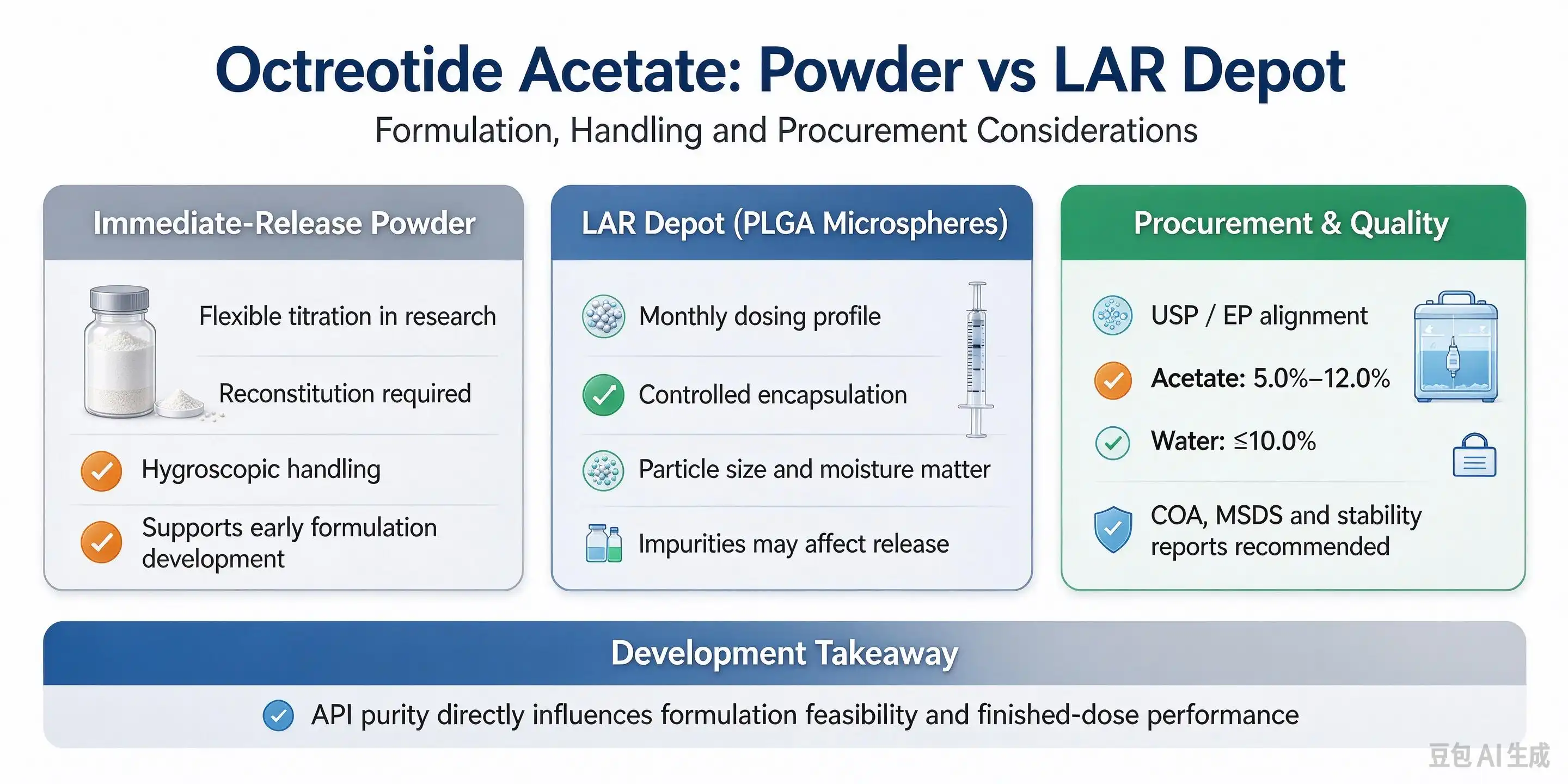
Before it can be given, the octreotide acetate powder needs to be reconstituted in clean saltwater or bacteriostatic water. Because it is hygroscopic, handling must take place in controlled settings to keep it from absorbing water. If you keep reconstituted solutions at 2–8°C, you should use them within 24 hours in a study setting. For long-acting release (LAR) formulations that contain octreotide in PLGA microspheres, the consistency of the release profile is directly related to the particle size distribution and moisture content of the powder that goes into the formulation.
Storage Conditions and Shelf Life
Validated batches made according to GMP are usually kept at -20°C in sealed, moisture-proof packaging with a retest date every two to three years. Accelerated stability data at 2–8°C helps with paperwork for cold-chain shipping trips, which is a necessary part of cross-border pharmaceutical operations. Before agreeing to large orders, procurement teams should ask for stable reports along with COA and MSDS paperwork.
Comparing Octreotide Acetate Powder with Alternative Treatments
Octreotide vs. Lanreotide
Lanreotide is another somatostatin analogy that binds strongly to SSTR2. However, it is not the same as octreotide in terms of its chemical structure or depot formulation. Every four weeks, a deep subcutaneous shot of lanreotide Autogel is given. Once a month, an intramuscular dose of octreotide LAR is given. Head-to-head studies, like the ELECT trial, showed similar GH control in acromegaly. However, formulators say that octreotide's longer history of production gives them more reliable reference standard data for API sourcing.
Immediate-Release Powder vs. LAR Depot
The LAR microsphere depot and immediate-release subcutaneous octreotide are used for different medical purposes. The powder-based immediate-release form is best for research and early formulation work because it allows for quick titration flexibility. Monthly dosing with LAR depots helps patients stick to their treatment plans, but they need the API to be carefully encapsulated into PLGA. The purity of the powder used directly affects how well the encapsulation works. If there are a lot of dimerization or oxidation impurities in the API, they can make the end store product have burst-release artifacts.
Generic vs. Branded Products
Novartis's brand name octreotide, sandostatin, set the therapeutic standard. Generic octreotide acetate powder goods now meet the standards set by the USP and the EP manual. They are also cheaper, which is important for buying in bulk. Generic selection is based on the quality of the peptide, the amount of acetate (5.0%–12.0%), the amount of water (≤10.0%), and proof of an impurity profile. These factors must be checked by an independent HPLC study, not just the certificates given by the seller.
Procurement Considerations: How to Source Octreotide Acetate Powder Efficiently?
Supplier Qualification Criteria
Before choosing a maker, you need to look at their ISO approval, GMP compliance records, and data on how consistent their batches are with each other. To make sure the process is stable, procurement managers should ask for multi-batch HPLC overlays. For orders that are for medicinal use, you must have endotoxin testing results, leftover solvent profiles, and heavy metal content reports. When regulators ask for these documents, suppliers who can't provide them pose an unacceptable risk.
Here are the main types of paperwork that approved sellers must have on hand:
- Certificate of Analysis (COA): Must confirm purity ≥98.0% by HPLC, acetate content, and optical rotation within specification.
- MSDS / Safety Data Sheet: Required for safe handling, shipping classification, and regulatory filing.
- Stability Report: Confirms retest date and supports cold-chain logistics planning.
- Impurity Profile: Identifies dimerization, oxidation, and desamidation products that affect downstream formulation performance.
Any API supplier that wants to get into the pharmaceutical supply chain must first meet these documentation standards. When buyers skip this step of proof, they often have problems with their batches during QC release testing.
Packaging, MOQ, and Logistics
Research labs and industrial formulators can both order the right amount because the bags come in 1g, 100g, and 1kg sizes. The low MOQ of 1g is good for academic and early-stage R&D buyers, and the 1kg package is good for the scaling up and test manufacturing stages. Shipping in the cold chain at -20°C must be approved at the logistics level, and records of temperature monitoring must be included with the shipment paperwork.
Pricing and Volume Strategy
Peptide API prices for octreotide acetate powder depend on how hard it is to make, how many steps are needed to clean it, and how much money is spent on quality control. When you buy octreotide in bulk, the unit cost is usually 20–40% less than when you buy it in small batches. But price should be looked at along with info on batch uniformity. It is possible for a cheaper batch with more impurities to cause processing costs that are higher than the initial savings.
Safety, Side Effects, and Risk Management
Common Adverse Effects
The most common side effects in clinical use are gastrointestinal effects, which include nausea, abdominal cramps, flatulence, and loose stools. These effects happen in about 5–10% of patients. Most of the time, these affects go away in the first two weeks of treatment. A smaller percentage of people who get an injection under the skin experience pain and redness at the injection site.
Long-Term Monitoring Requirements
Some people who take octreotide for a long time may develop cholelithiasis (gallstones) because their gallbladders can't move around as easily. Clinical guidelines say that people who are on long-term therapy should get biliary ultrasound monitoring on a regular basis. Because octreotide only slightly stops insulin and glucagon from being released, thyroid function and glucose metabolism should also be kept an eye on.
Risk Mitigation for Research and Formulation Use
When handling powder in non-clinical study settings, exposure measures like gloves, eye protection, and air flow should be used. When scientists work with radiolabeled octreotide derivatives, like DOTA-conjugated versions, they need to make sure that the API doesn't contain any metal ions that could affect how well it chelates and how much radiolabeling it can produce.
Conclusion
Octreotide acetate powder has been used for decades and is still a clinically important API because it selectively binds to SSTR2/SSTR5 and stops hormones from being released. Understanding this mechanism makes it clear to procurement professionals and formulation scientists why purity, impurity profiling, and storage integrity are such important criteria for sourcing. It doesn't matter if the result is for neuroendocrine research, peptide drug creation, or gut study; what matters is the quality of the input. Get your information from makers whose paperwork backs up what they say.
FAQ
Q1: What distinguishes octreotide acetate powder from the injectable solution?
A: The powder is the lyophilized API used in formulation and research, while the injectable solution is a finished pharmaceutical product. The powder requires reconstitution before administration and offers flexibility in dose preparation. For procurement purposes, the powder form is the relevant material for formulators, CROs, and research institutions.
Q2: Can octreotide acetate powder be stored long-term?
A: Yes. When sealed and stored at -20°C with protection from moisture and light, validated batches maintain specification compliance for 2–3 years. Hygroscopic handling precautions must be observed during weighing and reconstitution to prevent premature degradation.
Q3: How do I verify the authenticity of a generic batch?
A: Request independent HPLC analysis results from a third-party laboratory, confirm the specific optical rotation falls within monograph limits (-66.0° to -76.0°), and review the impurity profile for dimerization and oxidation products. A qualified supplier will provide this documentation proactively.
Q4: What purity grade is required for LAR formulation research?
A: For PLGA microsphere encapsulation studies, purity ≥99.0% is recommended to minimize impurity-driven burst-release effects and ensure reproducible encapsulation efficiency across batches.
Q5: Is octreotide acetate powder available for individual purchase?
A: No. This material is available for institutional, commercial, and research entity procurement only. It cannot be sold to individuals.
Partner with Xi'an Yihui for Reliable Octreotide Acetate Supply
Since 2010, Xi'an Yihui Bio-technology Co., Ltd. has made and sold pharmaceutical peptides to customers in more than 100 countries. Our octreotide acetate powder is ≥98.0% pure according to HPLC standards, is in stock and ready to ship right away, and comes with full analysis documentation. We are a reliable source of octreotide acetate powder and can offer flexible packaging from 1g to 1kg as well as ISO-certified batch consistency. You can email our sales team at sales@yihuipharm.com to get a price or a sample.
References
1. Lamberts, S. W. J., van der Lely, A. J., de Herder, W. W., & Hofland, L. J. (1996). Octreotide. New England Journal of Medicine.
2. Bruns, C., Lewis, I., Briner, U., Meno-Tetang, G., & Weckbecker, G. (2002). SOM230: A novel somatostatin peptidomimetic with broad somatotropin release inhibiting factor receptor binding and a unique antisecretory profile. European Journal of Endocrinology.
3. Melmed, S., Casanueva, F. F., Cavagnini, F., et al. (2005). Guidelines for acromegaly management. Journal of Clinical Endocrinology & Metabolism.
4. Ruszniewski, P., Ish-Shalom, S., Wymenga, M., et al. (2004). Rapid and sustained relief from the symptoms of carcinoid syndrome: results from an open 6-month study of the 28-day prolonged-release formulation of lanreotide. Neuroendocrinology.
5. Anthony, L. B., Martin, W., Delbeke, D., & Sandler, M. (1996). Somatostatin receptor imaging: predictive and prognostic considerations. Digestion.
6. Appetecchia, M., & Baldelli, R. (2010). Somatostatin analogues in the treatment of gastroenteropancreatic neuroendocrine tumours: current aspects and new perspectives. Journal of Experimental & Clinical Cancer Research.

Send Inquiry
You may like
Related Industry Knowledge