
What Is the Difference Between Teduglutide and GLP-2?
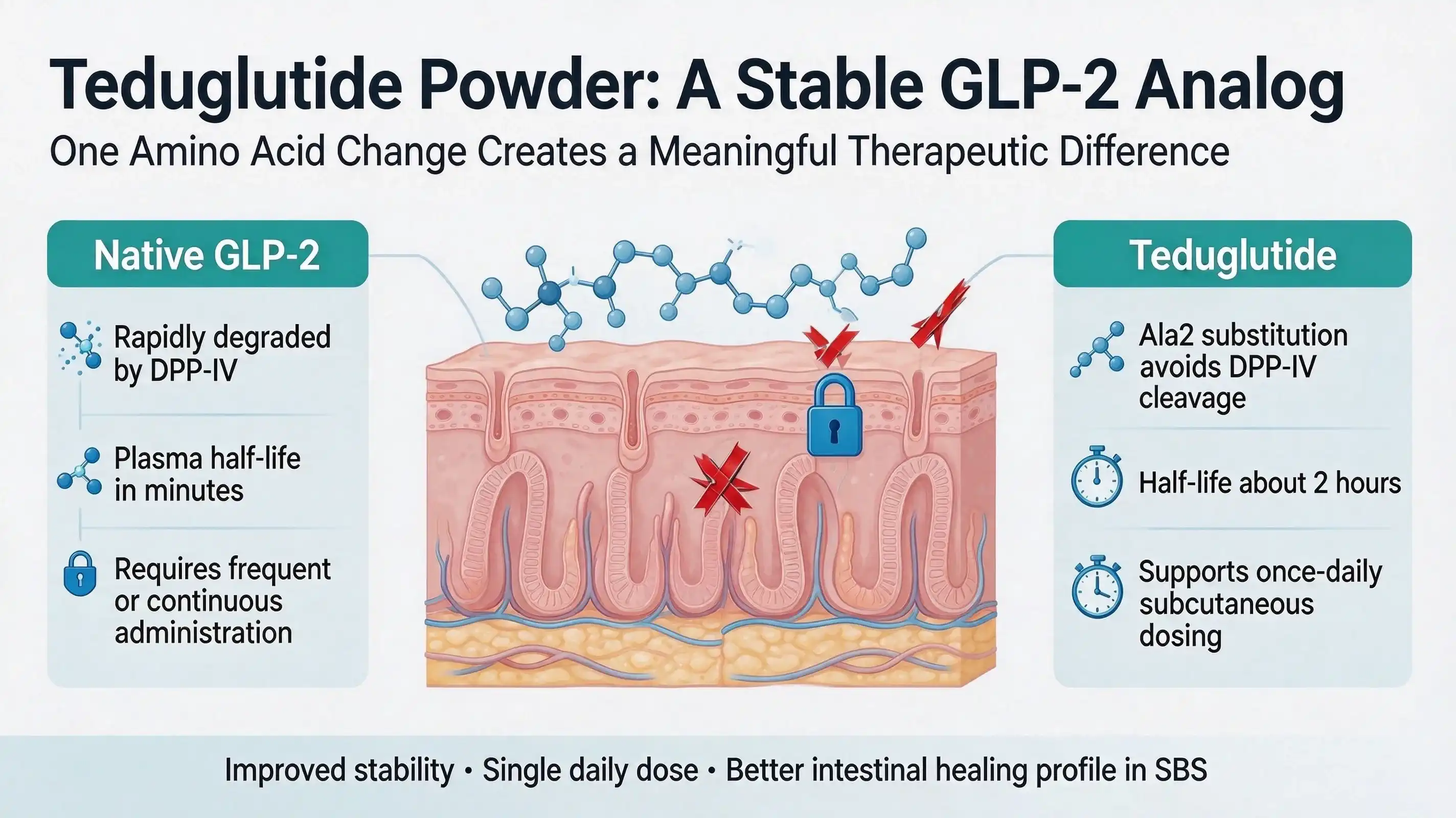
Teduglutide powder is a carefully created copy of the natural Glucagon-Like Peptide-2 (GLP-2). It is different from other GLP-2 analogs by one amino acid swap that completely changes its drug profile. Dipeptidyl peptidase-IV (DPP-IV) enzyme activity breaks down endogenous GLP-2 very quickly within minutes. Teduglutide, on the other hand, doesn't break down, so its half-life is about two hours. This change allows for a single daily dose and greatly improves the healing effects on the intestines for people with Short Bowel Syndrome (SBS). This makes Teduglutide powder an important medicinal answer instead of just a biochemical version.
Understanding the Basics: What Are Teduglutide and GLP-2?
The Natural Role of GLP-2 in Intestinal Health
GLP-2 is a 33-amino acid peptide hormone that is released by enteroendocrine L-cells in the colon and distal ileum. Its main molecular job is to keep the lining of the intestines intact by encouraging mucosal growth, improving barrier function, and controlling the absorption of nutrients. Native GLP-2 helps villus height increase and crypt depth increase while controlling blood flow in the intestines. All of these things help the gut epithelial heal and adaptive reactions after damage or removal of the intestine. However, its therapeutic value is still limited by how quickly it breaks down by enzymes, making it useless for clinical uses that need long-lasting drug effects.
Teduglutide: A Pharmaceutical Innovation
Teduglutide (CAS Number: 467426-48-0) is a synthetic GLP-2 receptor agonist that was created to work around the problems with natural GLP-2. This commercial peptide has a molecular formula of C₁₆₄H₂₅₃N₄₃O₅₄S₂ and a molecular weight of 3752.17 Daltons. At position 2, alanine replaces the glycine that is found in natural GLP-2. This specific change makes it less likely to be cut by DPP-IV while keeping the full agonist activity at GLP-2 receptors. Teduglutide, which has been approved by regulatory bodies like the FDA and EMA, meets the unmet clinical need for intestinal rehabilitation in SBS patients who depend on parenteral nutrition (PN).
Pharmaceutical Properties and Clinical Indications
Teduglutide powder looks like a white to off-white solid that has been frozen and needs to be reconstituted before it can be used. High-performance liquid chromatography (HPLC) shows that the product is at least 98% pure, and it has a test value of 99%. Its 33-amino acid sequence (H-His-Gly-Asp-Gly-Ser-Phe-Ser-Asp-Glu-Met-Asn-Thr-Ile-Leu-Asp-Asn-Leu-Ala-Ala-Arg-Asp-Phe-Ile-Asn-Trp-Leu-Ile-Gln-Thr-Lys-Ile-Thr-Asp-OH) tells us how it binds to receptors and how stable it is in the body. Because of these features, Teduglutide can be used in studies on gastrointestinal health, short bowel syndrome, the digestive system, and the development of peptide drugs.
Mechanism of Action: How Teduglutide Differs from Native GLP-2
Receptor Binding and Signal Transduction
Native GLP-2 and Teduglutide both bind to GLP-2 receptors found on myofibroblasts, enteric neurons, and endothelial cells in the intestine. Mediators like insulin-like growth factor-1 (IGF-1), keratinocyte growth factor (KGF), and nitric oxide are released when receptors are activated through downstream signaling pathways. These helpers coordinate the effects of GLP-2 receptor stimulation on cell growth, cell death, and blood vessels. The two peptides still have similar binding affinity and receptor activation profiles. This means that Teduglutide keeps the healing properties of natural GLP-2.
Pharmacokinetic Advantages Through Structural Modification
The most important difference is in how drugs move through the body. DPP-IV quickly cuts off the N-terminus of native GLP-2, giving it a plasma half-life of about seven minutes. Because it breaks down so quickly, it would have to be continuously infused or given often to have any kind of long-lasting effect, which is not possible in clinical settings. The alanine-to-glycine change at position 2 of Teduglutide gets rid of the DPP-IV cleavage site, which makes the half-life about two hours longer.
This 17-fold increase in stability makes it possible to administer Teduglutide powder subcutaneously just once a day, which makes it much easier for patients to follow the treatment plan and makes it more likely that the therapy will work. When procurement workers look at peptide APIs, they need to know that this improvement in pharmacokinetics directly affects the products' ability to be sold and the demand for them in the market.
Enhanced Intestinal Adaptive Responses
According to clinical studies, Teduglutide causes more noticeable changes in the intestines than what might be possible with native GLP-2. The treatment raises the villus height by 30 to 50 percent and the crypt depth by about the same amount, which improves the surface area that can absorb things. At the same time, Teduglutide increases blood flow in the intestines by 50 to 100%, which makes it easier for nutrients to reach epithelium that is growing.
These structural and functional improvements make it possible for many SBS patients to depend less on parenteral nutrition or not at all. This improves their quality of life and saves money. Teduglutide's pharmacodynamics can be predicted, which makes it easy to plan supplies and make sure that all patients get the same treatment results.
Clinical Effectiveness and Safety: Teduglutide vs GLP-2
Evidence from Pivotal Clinical Trials
Randomized controlled studies have shown that Teduglutide works to treat SBS. Adults with SBS who needed PN support were involved in the STEPS and STEPS-2 studies, which compared Teduglutide 0.05 mg/kg/day to a placebo. At week 24, 63% of patients who were given Teduglutide had a weekly PN volume reduction of 20% or more, while only 30% of patients in the placebo group had that reduction.
PN volume dropped by an average of 4.4 liters per week in the treatment groups compared to 2.3 liters per week in the placebo groups. Subgroup analyses confirmed benefits for a number of underlying causes, such as Crohn's disease, mesenteric ischemia, and volvulus. These numbers show that Teduglutide is a clinically proven therapeutic option, which is a good reason for buying managers to buy it.
Safety Profile and Adverse Event Management
Abdominal pain, reactions at the injection site, nausea, and headaches are all common side effects that are usually low to moderate in intensity. There are serious worries about how faster hidden gut cancers could grow, polyps forming, and fluid buildup from better intake. Labels required by regulators require a colonoscopy before starting treatment and regular checks during therapy.
From the point of view of the supply chain, these safety concerns affect market access by requiring comprehensive safety data sheets (SDS), certificates of analysis (COA), and regulatory compliance certificates to be included in supplier documentation. Quality assurance managers give more weight to suppliers who offer clear toxicological profiles and help with post-market surveillance.
Real-World Data and Treatment Adherence
Observational studies done after the drug was approved show that Teduglutide continues to work well in a variety of clinical settings that are not controlled trial settings. Over the course of 24 to 30 months, long-term tracking data show that patients' PN dependence steadily decreases, and some patients eventually become completely PN independent. In real-world cohorts, adherence rates are higher than 85%.
This is because taking the medicine only once a day is convenient and has real clinical benefits. For procurement teams, demand forecasting models are based on how well a product sells in the market. These adherence measures show that demand is stable and rising among SBS patients. Knowing how long a treatment lasts helps business-to-business buyers predict order amounts and negotiate long-term supply deals.
Procurement Considerations: Sourcing Teduglutide Powder for B2B Clients
Technical Quality Markers and Specifications
When buying Teduglutide powder, people in charge of procurement should check a number of important quality factors. Purity ≥98% proven by HPLC makes sure that there isn't much contamination from related peptides or leftovers of synthesis. The assay value of 99% means that the peptide content is correct, which is important for developing accurate formulations.
Suppliers should give full confirmations of amino acid sequences, mass spectrometry data, and endotoxin testing results (usually less than 1 EU/mg for pharmaceutical-grade material). With 1g, 100g, and 1kg bags as packaging choices, different R&D and production scales can be met. This gives small research schools and bigger pharmaceutical companies more options.
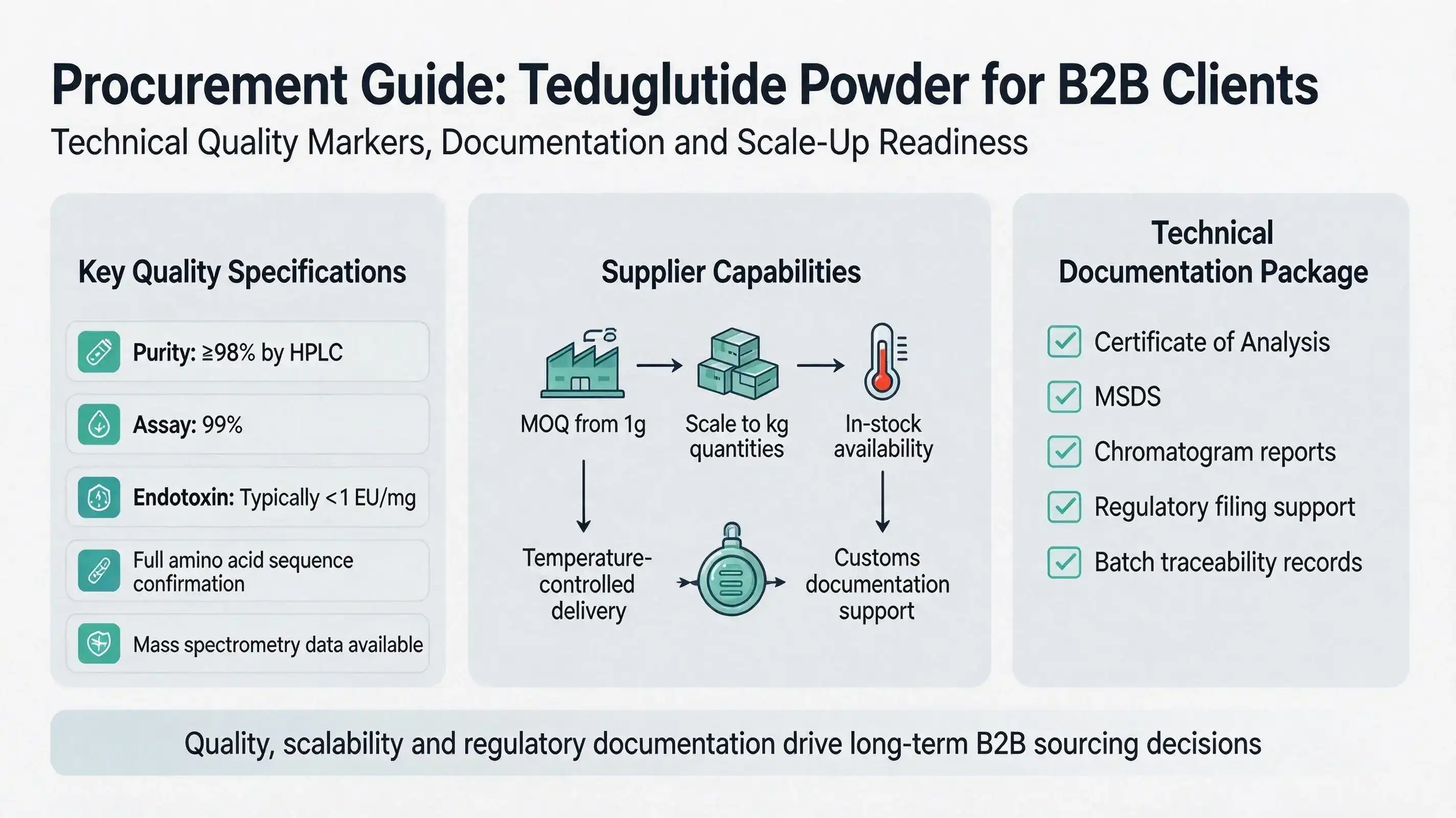
There are more operational factors than just basic product specifications that affect procurement decisions when looking at possible Teduglutide powder suppliers. Minimum order quantities starting at 1g allow for early research phases without requiring too much capital, and the ability to scale up to kilogram quantities meets the needs of commercial production. When something is in stock, there are no unknown lead times that could mess up formulation timelines or clinical trial schedules.
Delivery times, help with customs paperwork, and the ability to handle temperature-controlled operations all show how mature and reliable a provider is. Purchasing managers should give more weight to partners who offer complete technical documentation packages that include COA, MSDS, chromatogram reports, and regulatory filing support materials that make it easier for activities that come after to be compliant.
Regulatory Compliance and Certification Requirements
Pharmaceutical peptide procurement requires strict adherence to rules set by regulators in a number of different countries. ISO certification shows that the quality management system is strong, and GMP compliance (needed for making APIs) makes sure that the manufacturing processes meet standards for pharmaceuticals. FDA Drug Master File (DMF) filing is a quick and easy way for companies that want to sell drugs in countries like the US to get approval from regulators. For European markets, you need to be registered with REACH and follow EMA rules.
Quality and regulatory managers give more weight to suppliers who keep their certifications up to date and let them know about any changes to regulations that might affect product specs or paperwork. Traceability systems connect each batch to a unique synthesis run, a lot of raw materials, and quality control data. These systems also make audit trails that are necessary for regulatory checks.
Pricing Models and Commercial Terms
The price of Teduglutide powder reflects the difficulty of synthesizing peptides, purifying them, and making investments in quality control. Competitive prices usually vary based on the size of the order, the pure grade, and how the product is packed. The total cost of ownership should be looked at by procurement managers. This includes shipping costs, customs duties, storage needs, and any waste that might come from stability degradation.
Long-term supply agreements often get better prices and make sure that projects or commercial products can keep getting supplies for a long time. Different sellers have different payment terms, credit options, and bulk discount structures. This means that there are chances to negotiate in a way that helps with managing cash flow. Because pharmaceutical peptides are so specialized, price should be weighed against quality control, legal support, and the availability of expert service.
Comparison and Decision-Making: Teduglutide vs Alternative Therapies
Therapeutic Positioning Against Growth Hormone
Somatropin, which is a synthetic human growth hormone, is an additional way to help SBS patients heal their intestines. Growth hormone increases the production of IGF-1 throughout the body, but its effects on adaptation in the gut are not as specific or strong as Teduglutide's GLP-2 receptor stimulation. Clinical studies that directly compare the two drugs show that Teduglutide is better at reducing PN volume and has fewer systemic side effects linked to generalized anabolic stimulation.
These therapeutic differences should be taken into account when making procurement choices, as Teduglutide's benefits in this area could lead to higher treatment success rates and better cost-effectiveness, even if the API costs are higher. Teduglutide is becoming more popular in the market as evidence-based guidelines include data on how well different treatments work.
Evaluating Other GLP-2 Analogs and Next-Generation Peptides
Researchers are looking into GLP-2 analogs that have longer half-lives, different receptor selectivity, or dual-agonist properties that combine GLP-2 with pathways that work with it. But Teduglutide powder is still the only GLP-2 analog that has been approved by the FDA and has been used safely and effectively for more than ten years. When procurement teams look at new options, they have to weigh the possible therapeutic improvements against the time it takes for governmental permission, the need for clinical proof, and the uncertainty of market acceptance.
Products that have been around for a while, like Teduglutide, offer a stable supply chain, a lot of safety information, and examples of compensation that lower business risk. Organizations can be ready to change with the times by having strategic sourcing portfolios that include both current-generation APIs and next-generation candidates.
Supplier Reliability and Long-Term Partnership Considerations
Beyond the quality of the product, choosing a supplier also depends on the quality of the relationship and the support system. Reliable manufacturers show consistent quality from batch to batch, clear communication about production schedules, and problem-solving before there are supply disruptions. A technical support team that knows how to deal with problems related to peptide formulation, improving stability, and meeting regulatory documentation needs is very useful in more ways than one.
Strategic partners are different from transactional sellers because they offer after-sales service like transferring analysis methods, working together on stability studies, and helping with regulatory audits. When purchasing things for long-term use, people in charge of purchasing should check to see if the supplier is financially stable, if they have plans to increase their production capacity, and if they are committed to making quality improvements that meet changing customer needs in pharmaceutical peptide applications.
Conclusion
Teduglutide powder is very different from natural GLP-2 because it has a specific amino acid change that turns an endogenous peptide that breaks down quickly into a medicinal agent that can be used in humans. This one structural change increases the half-life, makes dosing schedules more practical, and helps SBS patients recover better from intestinal damage.
When looking for Teduglutide, people who work in procurement have to think about technical specs, legal compliance, source dependability, and total cost, all while putting quality, stability, and strategic partnership at the top of the list. Because Teduglutide has therapeutic benefits and has been clinically proven to work, it is a specialized API that will always be in demand. This makes choosing a supplier an important decision that can affect the success of product development and the business's ability to make money.
FAQ
What are the main clinical advantages of Teduglutide over native GLP-2?
The half-life of Teduglutide is about two hours, much longer than that of native GLP-2, which means that it can be administered subcutaneously once a day. This improvement in pharmacokinetics leads to sustained receptor activation, which makes the adaptive responses in the gut stronger and more clinically meaningful. The change in structure gets rid of the problems that come with native GLP-2 while keeping all of its agonist action. This means that Teduglutide can be used as a medicine to treat Short Bowel Syndrome.
How can procurement teams ensure Teduglutide powder quality and authenticity?
For verification, a lot of paperwork has to be looked over, like certificates of analysis with HPLC purity data, mass spectrometry results proving molecular identity, amino acid sequence analysis, and endotoxin testing results. Supplier certifications like ISO and GMP compliance show that the quality management system is strong. More assurance can be gained by asking for reference samples, having third-party testing done, and inspecting manufacturing facilities. Getting to know suppliers who keep regulatory filings like Drug Master Files up to date shows that you are dedicated to pharmaceutical-grade standards.
What regulatory considerations apply to international Teduglutide sourcing?
When buying drugs across borders, you have to follow the rules about pharmaceutical imports, like how to classify them correctly under harmonized tariff codes and follow any controlled substance protocols that apply. Suppliers should give export permits, certificates of origin, and other paperwork that helps with customs processing. Regulatory managers have to make sure that the places where medicines are made have the right permissions from the authorities in the final destination country and that the product specifications are in line with regional pharmacopeial standards. Using verified cold chain operations and temperature-controlled shipping to get goods from one country to another protects their integrity during travel.
Partner with Xi'an Yihui for Reliable Teduglutide Powder Supply
With pharmaceutical-grade peptides backed by stringent quality control systems and extensive export experience, Xi'an Yihui Bio-technology Co., Ltd. is your go-to supplier for Teduglutide powder. Our Teduglutide powder (CAS 467426-48-0) is very pure, as shown by its ≥98% HPLC verification and 99% assay values. It also comes with full documentation, such as a COA, MSDS, and detailed chromatogram reports. We serve pharmaceutical businesses, research institutions, and CDMO partners in Europe, the United States, Japan, and South Korea.
Our flexible packaging ranges from 1g to 1kg, and we keep a lot of items in stock to ensure fast delivery. Our ISO, Halal, and Kosher certifications show that we are committed to quality, and our professional customer service team is available 24 hours a day, seven days a week to help with technical questions during procurement and formulation development. Contact our team at sales@yihuipharm.com to discuss your specific requirements, request technical documentation, or arrange bulk orders with competitive pricing tailored to long-term partnerships.
References
1. Jeppesen, P.B., et al. "Teduglutide (ALX-0600), a dipeptidyl peptidase IV resistant glucagon-like peptide 2 analogue, improves intestinal function in short bowel syndrome patients." Gut 54.9 (2005): 1224-1231.
2. Drucker, D.J., et al. "Human dipeptidyl peptidase IV-resistant analog of glucagon-like peptide-2 stimulates intestinal growth in rats." Journal of Pharmacology and Experimental Therapeutics 288.2 (1999): 720-725.
3. Jeppesen, P.B., et al. "Teduglutide reduces need for parenteral support among patients with short bowel syndrome with intestinal failure." Gastroenterology 143.6 (2012): 1473-1481.
4. Buchman, A.L., et al. "Teduglutide, a novel mucosally active analog of glucagon-like peptide-2 (GLP-2) for the treatment of moderate to severe Crohn's disease." Inflammatory Bowel Diseases 16.6 (2010): 962-973.
5. Elphick, D.A., and Mahida, Y.R. "Paneth cells: their role in innate immunity and inflammatory disease." Gut 54.12 (2005): 1802-1809.
6. Jeppesen, P.B., and Mortensen, P.B. "Intestinal failure defined by measurements of intestinal energy and wet weight absorption." Gut 46.5 (2000): 701-706.

Send Inquiry
You may like
Related Industry Knowledge