
What is the difference between pharmaceutical grade and research grade peptides?
Being able to tell the difference between pharmaceutical grade and research grade peptides is important when buying them for pharmaceutical production, makeup creation, or lab research. Pharmaceutical grade peptides, like semaglutide raw powder, meet strict Good Manufacturing Practice (GMP) guidelines. They have purity levels that are always above 99%, go through strict batch testing, and come with all the legal paperwork needed for therapeutic production. Research grade peptides are used for exploratory work that isn't clinical. They usually have a purity of 95–98% and have less thorough licensing and quality control management. This basic difference affects how well you follow the rules, the safety of your products, the dependability of your supply chain, and eventually the success of your final application, whether you're making a new diabetes treatment, a skin care product based on effectiveness, or metabolic research.
Understanding Pharmaceutical Grade vs Research Grade Peptides
The peptide business has two main quality categories that have a direct effect on how to buy them, how well they meet regulations, and how well they work for their intended use. These categories show how well the product was made, how it was tested, and what it was meant to be used for.
Regulatory Compliance and Quality Standards
Pharmaceutical grade peptides are made in ways that follow the rules set by the FDA, EMA, and ICH. Production centers keep their GMP approval up to date by following strict rules for sterility, controlling the environment, and using approved analytical methods. A lot of tests are done on each batch, such as an HPLC purity analysis, mass spectrometry proof, endotoxin testing, and heavy metal screening. Documentation packages come with full tracking records that can be sent to regulators, as well as Certificates of Analysis (COA) and Drug Master Files (DMF). These materials are good enough to be used as Active Pharmaceutical Ingredients (APIs) in clinical studies and to make drugs for sale.
In the supply chain, research grade peptides have a different job to do. These materials are mostly made for lab experiments, recipe creation, and preclinical studies, so they don't go through as much strict quality control. Some trustworthy suppliers still give COAs and follow acceptable purity standards, but the level of testing, completeness of paperwork, and compliance with regulations are not as high as what is needed for pharmaceuticals. Facilities that make research-grade peptides might not be GMP-certified, and accuracy from batch to batch is not closely watched.
Purity Levels and Testing Protocols
Purity standards make the differences between grades clear. Pharmaceutical grade peptides are usually ≥99% pure, as shown by RP-HPLC, with impurity profiles that are described and managed below 0.1% for any single impurity. Advanced testing finds deletion sequences, D-amino acid isomers, and compounds linked to modifications and measures their amounts. When making therapeutic goods, this level of accuracy is important because impurity profiles can affect safety, effectiveness, and governmental approval.
Most research grade versions are between 95% and 98% pure, which is good enough for mechanistic studies, screening tests, and formula improvement. Instead of laying out all the impurities, testing works on confirming identity and getting a good idea of purity. This way of testing cuts down on costs while keeping usefulness for non-clinical uses where small changes in composition don't affect study goals.
Quality Control and Certification Impact
The certification market has a big effect on choices about what to buy and how to handle risks later on. Pharmaceutical grade providers follow ISO 9001 quality management systems, get audited by regulators on a regular basis, and use stability programs that have been proven to work. These operational standards make sure that the products are always the same, that the supplies are always on, and that the paperwork is correct, all of which are needed for regulatory files and business production.
There is more variation in the quality methods used by research grade providers. Even though reputable suppliers follow professional standards and give basic paperwork, there isn't enough thorough validation and regulatory control to be sure of batch consistency, stability data, and the long-term reliability of the supply chain. These things are very important for procurement managers to think about when they are planning the supply chain and trying to find the best balance between saving money and reducing risk.
How Differences Influence Semaglutide Raw Powder Use in B2B Procurement?
The drug semaglutide is a big step forward in GLP-1 receptor agonist treatment. It can be used to treat diabetes and reduce weight. The difference between pharmaceutical grade and study grade semaglutide raw powder has a direct effect on how the drug is bought, how long projects take, and how well the regulatory route works.
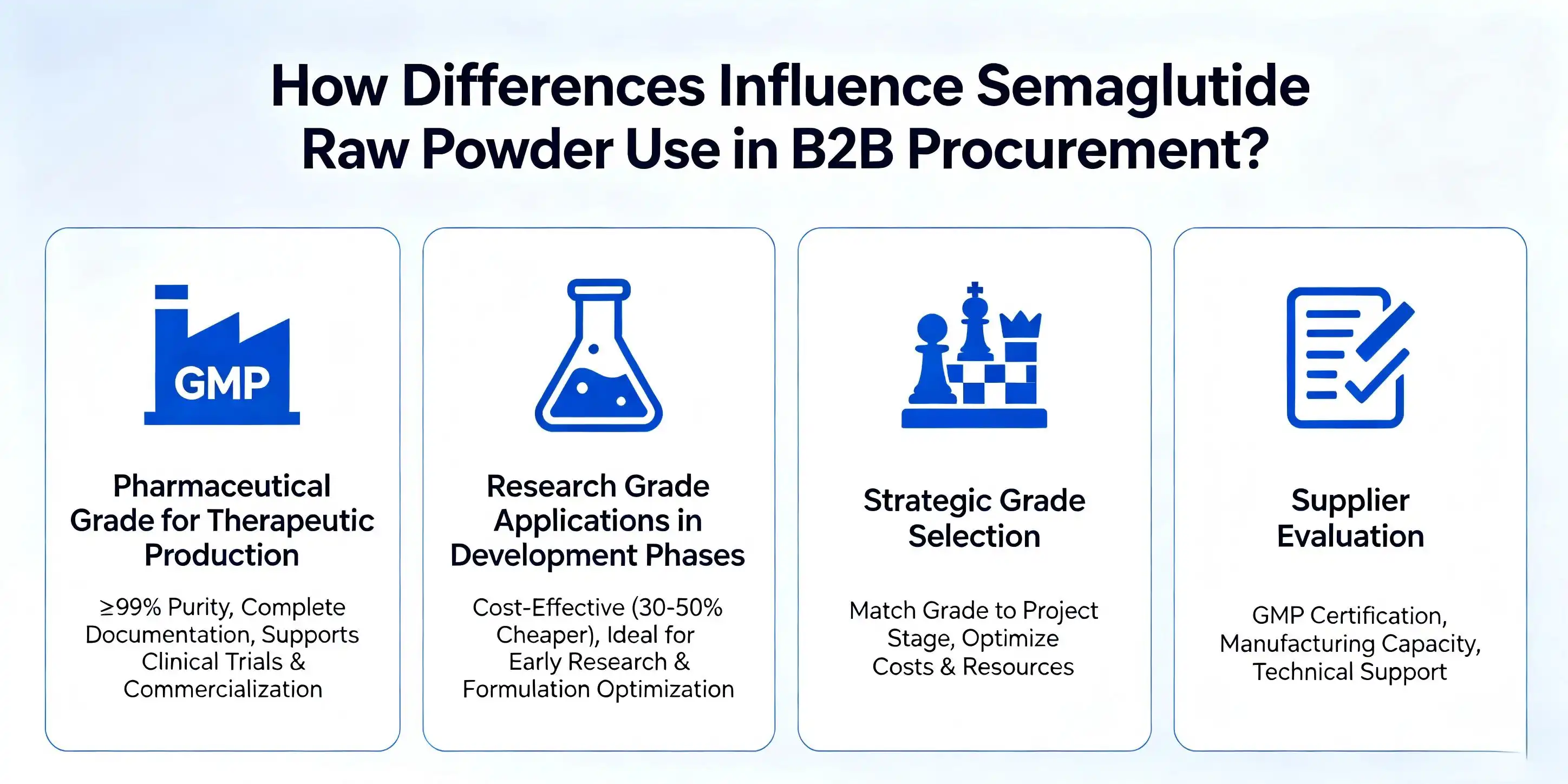
Pharmaceutical Grade Semaglutide for Therapeutic Production
The base for making controlled medicinal products is pharmaceutical grade semaglutide raw powder (CAS 910463-68-2). The strict standards needed to make clinical study materials and market drugs are met by this material. The chemical structure needs to be carefully made and cleaned up to make sure it always works biologically. It has an aminoisobutyric acid change at position 8 and a C-18 fatty acid modification at position 26.
Solid-phase peptide synthesis under controlled conditions is used to make pharmaceutical-grade semaglutide. This is followed by several steps of separation, such as preparative HPLC. As part of quality control testing, the peptide sequence is checked using mass spectrometry, the purity is confirmed using analytical HPLC, and the biological activity is tested using GLP-1 receptor binding tests. Stability testing under ICH circumstances gives information on the shelf life, usually showing that the product is stable for two years when kept at 2 to 8°C. This complete quality package helps with regulatory applications to the FDA and EMA, which makes clinical research and commercial production possible.
When buying pharmaceutical-grade materials, procurement teams look at a supplier's qualifications first, such as GMP licensing, a history of regulatory inspections, and the ability to provide technical support. As useful as the material itself is, being able to provide reference standards, analytical method transfer, and legal paperwork becomes even more so for businesses that have to deal with complicated approval processes.
Research Grade Applications in Development Phases
Research-grade semaglutide is very important for early-stage research, formula optimization, and method evaluation for analyses. Research and development teams use this stuff to study how things work, to see how well they bind to receptors, and to do basic tests of how well they work. Research grade material is often 30–50% cheaper than pharmaceutical grade, which makes it a good choice for exploratory work that doesn't need regulation paperwork right away.
During the proof-of-concept stages, formulation scientists working on new transportation methods or combination goods can use research-grade materials to help them. It takes a lot of material to test solubility factors, excipient compatibility, and stability under different circumstances. Using research-grade peptides during these stages of creation saves money and gives important synthesis information. Once the parameters for the mixture are set and clinical testing starts, the material changes to pharmaceutical grade.
Analytical labs that make method validation packages also use research-grade materials for system fit tests, specificity studies, and robustness reviews. This method saves pharmaceutical-grade materials for final validation tests and making reference standards. This way, resources are used most efficiently throughout the creation process.
Strategic Grade Selection for Procurement Optimization
A good buying plan matches the grade of the materials to the stage of the project and the rules that need to be followed. Research-grade materials are used for early finding and formulation development. This saves money during high-consumption exploratory stages. As projects move closer to clinical trials, they are bought from pharmaceutical-grade providers. These suppliers are then contacted and supply deals are made that support the long-term needs of manufacturing.
With this step-by-step method, buying teams need to keep working with sellers at both quality levels. As projects move forward, the factors used to judge suppliers change from just looking at cost during the study phase to looking at regulatory compliance, manufacturing capability, and supply chain reliability as well. By knowing the differences between these grades, procurement managers can balance short-term cost concerns with long-term strategy goals. This way, they can make sure that materials are always available and that quality standards are met throughout the lifecycle of a product.
Comparative Analysis: Pharmaceutical Grade vs Research Grade Peptides in Semaglutide Procurement
When people are looking at semaglutide raw powder suppliers, they can compare them in an organized way across important buying factors. This study shows the trade-offs that exist between cost, quality, and compliance with regulations that determine the best buying methods.
Purity Benchmarks and Biological Effectiveness
Pharmaceutical-grade semaglutide always has purity levels above 99%, as shown by HPLC, and all impurity profiles are fully described and managed. Individual impurities stay below 0.1%, and linked peptide sequences, such as deletion peptides, shortened forms, and diastereomers, are found and measured. This amount of purity makes sure that the drug's biological activity, pharmacokinetics, and clinical results are always the same. Biological activity testing shows that the GLP-1 receptor binds well and that functional tests are consistent from batch to batch.
Research grade versions usually get between 95% and 98% purity, which is good enough for lab use where small changes in composition don't affect the truth of the experiment. Characterizing impurities might only look at the main parts, and biological activity testing might use references from other studies instead of functional tests that are specific to the batch. This grade level gives enough confidence for mechanism studies and formulation screening while lowering the cost of materials.
In controlled settings, the molecular effects of these differences in purity become important. In clinical situations, impurities can cause immune reactions, bring biological activity that wasn't expected, or change the stability of the substance. These risks are reduced by pharmaceutical grade standards, which include detailed descriptions and strict controls. This is why higher prices are necessary for uses where quality directly affects patient safety and product effectiveness.
Commercial Factors: Pricing and Availability
The way prices are set for each grade shows how much money was spent on manufacturing and the quality infrastructure behind it. Pharmaceutical grade semaglutide costs a lot; it can be anywhere from $800 to $1,500 per gram, based on the size of the order, where the source is located, and the paperwork that needs to be done. This price includes the costs of GMP production, thorough testing, infrastructure for regulatory compliance, and quality assurance.
For the same amount of material, research grade material costs between $400 and $800 per gram, which is a big savings. This price difference is possible because of the lower testing load, simpler documentation standards, and non-GMP production setting. Volume discounts are available for larger amounts, especially for study projects that have been around for a while and know how much they will use.
When thinking about availability, you should not only think about price, but also wait times, minimum order amounts, and how reliable the supply is. Pharmaceutical grade suppliers usually need longer lead times (4–8 weeks) to make room for group production and testing procedures. To cover the costs of setting up the factory, the minimum order quantity may begin at 10 to 50 grams. Most providers of research grade goods have shorter lead times (1-3 weeks) and lower minimum orders (1–10 grams), which makes them more flexible for smaller research projects.
Dependability in the supply chain changes by type of seller. Well-known companies that make pharmaceutical-grade products keep extra stock on hand, plan for business stability, and run multiple factories to make sure there is a steady supply. Research grade providers may only have a small inventory and only make things in one place. This creates supply chain vulnerabilities that buying teams need to think about when they decide where to buy things.
Supplier Certification and Documentation Requirements
Evaluation of suppliers includes more than just product specs. It also looks at the supplier's organization's skills and compliance with regulations. Pharmaceutical grade suppliers offer complete paperwork packages that include GMP certificates, reports of regulatory inspections, ISO 9001 and ISO 13485 quality management system certifications, and REACH and RoHS environmental compliance evidence. This level of detail in the paperwork backs up regulatory submissions and passes quality checks done by pharmaceutical companies and regulatory bodies.
Suppliers of research grade materials have a smaller range of certifications. Standard paperwork includes things like basic business licenses, general quality management practices, and COAs that are specific to a product. Even though trustworthy research providers follow professional standards, they aren't always suitable for regulated production tasks because they don't have GMP certification or a past of regulatory audits.
Documentation needs have a direct effect on how buying works and how long it takes to qualify suppliers. Before they are approved, pharmaceutical grade providers have to go through a lot of checks, such as reviewing documents, inspecting the site, and evaluating the quality system. This approval process could take three to six months, but it builds trust in the supply chain and makes sure that regulations are followed. Research grade suppliers need less rigorous qualification, which speeds up the onboarding process but gives less guarantee about the quality's stability over time.
Ensuring Quality and Compliance When Purchasing Semaglutide Raw Powder
The success of procurement relies on carefully reviewing suppliers, making sure the quality is high, and following the right handling procedures that keep the purity of the semaglutide raw powder throughout the supply chain.
Supplier Credential Verification
Verification of credentials is the first step in a thorough review of a seller. Pharmaceutical grade providers should show up with up-to-date GMP certificates from reputable organizations like the FDA, EMA, PMDA, or similar national organizations. Check the GMP certification's scope to make sure it covers making peptides and not just making chemicals in general. Ask for copies of recent inspection reports from regulatory bodies and watch how providers fix problems that were found.
Quality management system standards (ISO 9001) show that a company is dedicated to using uniform methods and always making things better. Industry-specific qualifications, like ISO 13485 for medical devices, show that you have the right kind of knowledge for a certain job. Safety and environmental certifications (ISO 14001, ISO 45001) show that responsible factory practices are becoming more and more important in business social responsibility systems.
Check how well a provider can make things by sending them facility surveys that ask about their analytical instruments, quality control labs, tools, and technical staff qualifications. Site checks let you see for yourself how things are made, how well quality control is working, and how the company works as a whole. Video facility trips and virtual talks with technical staff are useful ways to find out about a supplier's skills and dependability, even when checks are done from afar.
Storage Conditions and Handling Protocols
The security of semaglutide raw powder relies on how it is stored and handled at every step of the supply chain. Material that is intended for use in medicines needs to be kept at 2 to 8°C in containers that are sealed and kept away from light and moisture. Changes in temperature during shipping can damage the integrity of peptides, so it's important to have proven cold chain operations. Suppliers should provide temperature tracking data from the shipment, showing that the temperature was kept constant from the factory to the spot where it was received.
When something is received, it should be inspected to make sure the package is intact, the temperature monitor numbers are correct, and the item looks good. The material should be moved right away to approved cold storage that keeps the temperature between 2 and 8°C and keeps an eye on it all the time. Controlling humidity stops moisture uptake, which can start processes that lead to degradation. Protecting sensitive amino acid residues from light through dark containers or amber glass stops photodegradation.
Handling practices keep the quality of materials and lower the chance of contamination. Dispensing should only happen in controlled settings with clean, dry tools. As little time as possible should be spent at room temperature during weighing and moving. Reseal containers properly right away after using them, and if you can, purge them with dry nitrogen to cut down on air exposure. These ways of handling materials keep the same level of performance throughout their entire lifetime and increase the time they can be used.
Regulatory Framework and Safety Considerations
Understanding the legal systems that apply helps with buying and using things in a way that is proper. Pharmaceutical grade semaglutide is used as an active ingredient in making drugs. It is subject to strict rules that require suppliers to be registered, batches to be tested before they are released, and lots of paperwork. Different places have different rules about cosmetic applications. For example, the EU Cosmetics Regulation is very different from the US FDA's cosmetic regulations, which affects what can be used and how it must be labeled.
When you buy research-grade materials for your lab, you don't have to follow as many of the rules that apply to commercial manufacturing. However, you still have to follow lab safety rules, chemical handling practices, and institutional biosafety standards. The purpose of the purchase should be made clear in the paperwork so that the legal classification matches the real use and the expectations of the seller.
Safety data sheets (SDS) tell you everything you need to know about how to handle chemicals safely, give first aid, and get rid of them properly. Carefully read the SDS material and make sure that the lab staff gets the right training on how to handle things safely. Even though peptides are usually less dangerous than many chemical products, the right safety gear (lab coat, gloves, and safety glasses) should be worn when handling them to avoid skin contact and breathing them in.
Strategic Procurement: How to Choose the Right Grade and Supplier for Your Needs?
To get the best deals on peptides, you need to carefully look at what the application needs, what the provider can do, and long-term strategy factors that go beyond just cutting costs.
Matching Peptide Grades to Specific Applications
The right quality grades are determined by the needs of the application. Pharmaceutical grade peptides with full GMP paperwork and regulatory compliance are needed to make clinical study materials and commercial drugs. Companies working on new medicines or biosimilars can't skimp on quality—regulatory approval depends on proof of good manufacturing control and consistent products, which can only be done with pharmaceutical grade materials.
The creation of cosmetic formulations is in the middle. High-end products that work well stress the benefits of pharmaceutical-grade peptides in clinical trials, backing up marketing claims with strong quality data. The higher material cost is justified by the expensive branding, and more and more people expect pharmaceutical-grade ingredients in high-end skin care products. During development, mass-market cosmetics may use research-grade peptides. For commercial production, the peptides may be changed to pharmaceutical grade based on the brand's messaging and its regulation strategy.
Academic research and early-stage biotechnology businesses that are doing mechanistic studies, screening tests, and formulation feasibility reviews should use research grade materials in the right way. The lower costs make it possible to plan bigger experiments and do more tests during times with limited resources. When study results move closer to clinical development, they are upgraded to pharmaceutical grade. This makes sure that quality investments are in line with project maturity and funds availability. For example, when using semaglutide raw powder in early-stage research, it's crucial to balance cost-efficiency with the quality requirements of the study to ensure valid results.
Evaluating Supplier Certifications and Capabilities
When choosing a supplier, it's not just about the product specs; it's also about the organization's ability to support long-term relationships. Manufacturing capacity tells you if your providers can increase production as your needs change from small amounts (grams) for research to large amounts (kilograms) for clinical trials and finally to large amounts (multi-kilogram batches) for commercial production. Before you commit to a long-term relationship with a provider, you should talk to them about capacity planning and make sure they understand wait times, minimum batch sizes, and scale-up limits.
The ability to provide technical help sets strategic partners apart from commodity providers. Suppliers who help with developing testing methods, custom chemistry, and formulation support are more valuable than just providing materials. This professional cooperation is especially helpful when making new changes to peptides, finding the best ways to make them, or fixing problems with their safety. When choosing partners for complicated projects, look at the expert staff qualifications, publication records, and custom synthesis experience of the suppliers.
Transparency and openness in the supply chain have a big effect on how well buying works. Suppliers you can trust will let you know ahead of time about production plans, possible delays, and quality problems. They make their policies on group rejects, rework processes, and handling deviations clear. Ask current customers for references and rate how quick the seller is during the quotation phase. Early interactions can tell you a lot about the quality of service and how well the partnership will work in the future.
Pricing Models and Cost Optimization Strategies
Understanding how peptide prices work helps you negotiate and plan your spending well. Prices change depending on how much you order, and you can save a lot of money by buying more. For study grade, the minimum order quantity (MOQ) is usually 1 gram. For pharmaceutical grade, it's usually 10–50 grams. At 100, 500, and kilogram amounts, the cost per gram drops by a lot. Long-term needs should be planned for by procurement teams, who should compare the costs and benefits of bigger orders with lower unit costs, keeping stocking costs low, and the length of time that materials can be stored.
Payment terms affect how you handle your cash flow and your relationships with suppliers. Standard terms include a 30% fee and the rest of the payment due before the shipment. However, repeat buyers can talk about net-30 or net-60 payment terms. Letters of credit protect both the buyer and the seller's interests when they place big foreign orders. Talk to your seller about payment options when you're negotiating with them, especially if you're buying in bulk and need orders spread out over a longer period of time.
Multi-batch buy deals save money and help you keep track of your inventory and cash flow. By committing to yearly purchases of certain amounts (for example, 500 grams shipped in five 100-gram packages), you can lock in good prices, spread out your cash outlays, and avoid having too much inventory. Price protection terms, guaranteed wait times, and priority allocation during supply shortages are common parts of these deals. To protect against supply disruptions and keep costs stable across budget cycles, you should negotiate agreement terms that cover things like "force majeure," "quality dispute resolution," and "renewal conditions."
Conclusion
Pharmaceutical grade peptides are different from research grade peptides in important ways that affect how they are bought, how they are used, and how well projects work in areas like drug development, cosmetic creation, and scientific research. Pharmaceutical grade materials offer the quality control, legal paperwork, and consistent production that are needed for therapeutic uses and high-end cosmetics. This is why they are priced higher because they have a complete quality infrastructure. For exploratory research, formulation creation, and basic testing where regulatory standards are not as strict, research grade peptides are a cost-effective option. A good procurement process matches the right material type to the job, the stage of the project, and the available budget, and it also builds relationships with suppliers that support long-term strategy goals. By knowing these differences, procurement experts can make the best use of resources, lower supply chain risks, and make sure that the quality of materials supports the success of projects from the beginning of research to mass production. For example, when working with semaglutide raw powder, it's important to choose the appropriate grade based on the intended application to ensure both cost-efficiency and quality.
FAQ
Q1: Can research grade semaglutide be used in clinical trials?
A: There isn't enough regulatory paperwork and quality control guidelines for research grade semaglutide to be used in clinical trials. The materials used in clinical trials must be made in a way that meets Good Manufacturing Practice (GMP), include full impurity analysis, and come with batch release testing paperwork that meets FDA or EMA rules. Using research-grade materials in clinical studies is against the rules and could lead to trial results being thrown out or the approval of a drug being delayed.
Q2: How do I verify supplier certifications for pharmaceutical grade peptides?
A: Ask for pictures of GMP certificates and call the granting authorities directly to make sure they are real. Look over the most recent inspection records from the government and make a note of any problems or findings. Check the quality systems, manufacturing methods, and analytical skills of your suppliers through checks. Check the registration state of the seller with the appropriate government agencies (FDA Establishment Identifier, EU Eudralex database). Ask for customer recommendations and talk to current clients about their experiences with qualification and how reliable the supplier is.
Q3: What storage conditions preserve semaglutide stability?
A: Keep semaglutide raw powder between 2 and 8°C in containers that are tightly covered and out of the light and moisture. With temperature tracking and alarm devices, you can keep your cold storage stable. Cut down on temperature changes during handling by limiting the time the product is exposed to air. To keep humidity levels low, put desiccants in storage cases. Use dark or orange containers to keep light out. Pharmaceutical grade semaglutide stays stable for two years after it was made as long as it is stored properly.
Partner with Xi'an Yihui for Certified Pharmaceutical-Grade Semaglutide Raw Powder
Xi'an Yihui Bio-technology Co., Ltd. offers pharmaceutical-grade semaglutide raw powder meeting stringent GMP standards and legal requirements essential for making medicines and high-end cosmetics. Our semaglutide raw powder (CAS 910463-68-2) is ≥99% pure and comes with full quality paperwork, such as a Certificate of Analysis (COA), data on stability, and legal support materials. We have been serving customers in over 100 countries for 13 years and offer reasonable prices and a reliable supply. Our minimum order quantity (MOQ) is as low as 1 gram, and we can produce up to 5,000 grams of product every month.
We also keep a lot of products in stock, so we can serve quickly. Our ISO, Halal, and Kosher certifications show that we are dedicated to quality greatness. Our professional technical team is available 24/7 to help customers with analysis questions, regulatory advice, and custom synthesis needs. Whether you need materials for clinical studies, making drugs for sale, or advanced cosmetic uses, Xi'an Yihui can give you the quality guarantee and supply reliability your projects need. You can email our buying experts at sales@yihuipharm.com to ask for samples, talk about bulk prices, or find out how our semaglutide raw powder supplier can help you reach your development and manufacturing goals.
References
1. Lau, J.L. and Dunn, M.K. (2018). "Therapeutic peptides: Historical perspectives, current development trends, and future directions," Bioorganic & Medicinal Chemistry, 26(10), pp. 2700-2707.
2. Kaspar, A.A. and Reichert, J.M. (2013). "Future directions for peptide therapeutics development," Drug Discovery Today, 18(17-18), pp. 807-817.
3. Fosgerau, K. and Hoffmann, T. (2015). "Peptide therapeutics: current status and future directions," Drug Discovery Today, 20(1), pp. 122-128.
4. Drucker, D.J. (2020). "Advances in oral peptide therapeutics," Nature Reviews Drug Discovery, 19(4), pp. 277-289.
5. Vlieghe, P., Lisowski, V., Martinez, J., and Khrestchatisky, M. (2010). "Synthetic therapeutic peptides: science and market," Drug Discovery Today, 15(1-2), pp. 40-56.
6. Buckley, S.T., Bækdal, T.A., Vegge, A., Maarbjerg, S.J., et al. (2018). "Transcellular stomach absorption of a derivatized glucagon-like peptide-1 receptor agonist," Science Translational Medicine, 10(467).

Send Inquiry
Related Industry Knowledge