
What is the chemical composition of semaglutide raw powder?
Semaglutide raw powder (CAS: 910463-68-2) is a synthetic 31-amino acid peptide with the molecular formula C₁₈₇H₂₉₁N₄₅O₅₉ and a molar mass of approximately 4,113.64 g/mol. It belongs to the GLP-1 receptor agonist class, engineered with a C18 fatty diacid side chain at lysine-26 to extend its plasma half-life to roughly 165 hours. For pharmaceutical companies, CRO/CDMO firms, and research institutions sourcing bulk peptide APIs, knowing its exact chemical architecture is the first step toward confident procurement and downstream formulation success.
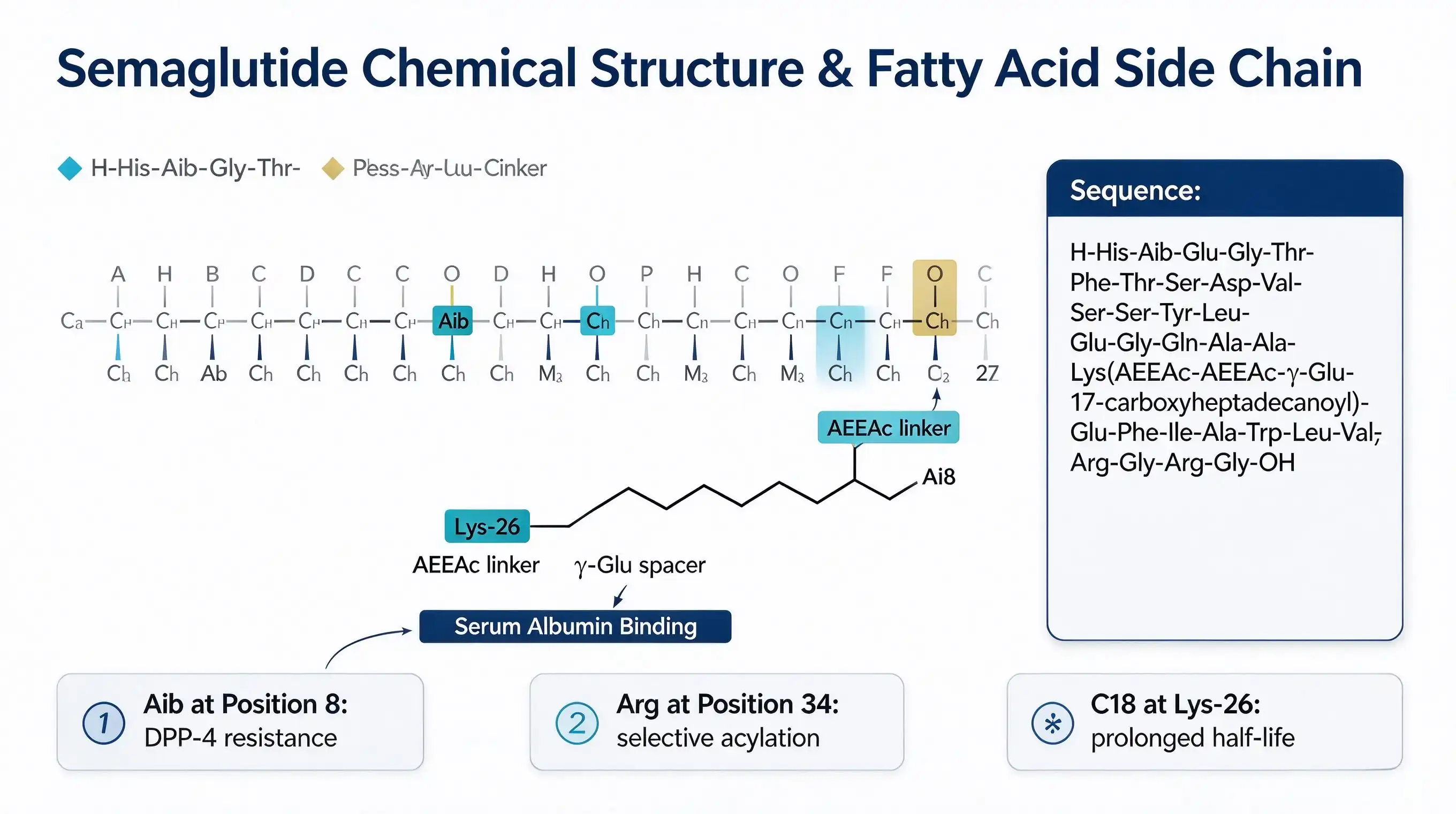
Understanding the Chemical Composition of Semaglutide Raw Powder
Amino Acid Sequence and Structural Identity
The full sequence reads: H-His-Aib-Glu-Gly-Thr-Phe-Thr-Ser-Asp-Val-Ser-Ser-Tyr-Leu-Glu-Gly-Gln-Ala-Ala-Lys(AEEAc-AEEAc-γ-Glu-17-carboxyheptadecanoyl)-Glu-Phe-Ile-Ala-Trp-Leu-Val-Arg-Gly-Arg-Gly-OH. Two changes were made on purpose to make it different from native GLP-1: an α-aminoisobutyric acid (Aib) substitution at position 8 stops DPP-4 enzymes from cutting it, and an Arg substitution at position 34 allows selective acylation. These are not random traits; they are the chemical choices that make the molecule last so long as a medicine.
Fatty Acid Side Chain and Albumin Binding
The C18 fatty acid chain at Lys-26 is linked to serum albumin by two AEEAc linkers and a β-glutamic acid spacer. This allows the binding to happen back and forth without forming a covalent bond. This binding makes it much harder for the kidneys to get rid of the drug and expose it to proteases. For formulation engineers, this property tells them directly how the bulk peptide will behave when it is reconstituted and when designing the final drug product. Knowing this connection also helps quality teams find possible impurities linked to acylation while testing batches.
Molecular Weight and Physicochemical Properties
It has a molar mass of 4,113.64 g/mol and looks like a white to off-white powder that can absorb water. It dissolves badly in neutral water but easily in slightly alkaline water buffers, showing that its solubility depends on pH. For pharmaceutical-grade materials, they need to be at least 99% pure by RP-HPLC and have no more than 0.5% total flaws. You have to follow these factors because they tell you if a batch is ready for clinical formulation or just for early study use.
How Semaglutide Raw Powder Works — Mechanism of Action Explained
GLP-1 Receptor Activation and Glucose Regulation
Semaglutide binds specifically to GLP-1 receptors on beta cells in the pancreas. This causes glucose-dependent insulin release while stopping glucagon release. Because the reaction depends on glucose, insulin flow only goes up when blood sugar is high. This lowers the risk of hypoglycemia. For R&D teams working on diabetes medicines, this receptor specificity depends on the peptide's full sequence—any truncation or racemization of the sequence during preparation makes binding affinity much worse.
Why Chemical Composition Integrity Affects Efficacy?
Even small impurities in semaglutide raw powder, like D-amino acid isomers or deletion sequences, can make it harder for receptors to bind or raise the risk of an immune response. This is the reason why purchasing departments at CRO and CDMO companies always need CoA paperwork that says the single-impurity levels are less than 0.5%. The precise chemical make-up of this GLP-1 agonist is linked to its biological activity. A lot that is 97% pure and has impurity profiles that have not been checked is not just "slightly lower quality"; it can have very different chemical effects.
Raw Powder vs. Finished Injectable Forms
The bulk API form gives you more freedom with your formulations than finished pen injectors. Based on the design of the study, R&D labs and combining makers can change the concentration levels, buffer conditions, and transportation systems. Because it can be changed in so many ways, the raw peptide form is the best starting point for studies on metabolic syndrome, weight control, and new ways to give drugs. On the other hand, injectable finished forms are designed to work best with a single delivery method and dose.
Quality and Purity Considerations
Industry Standards That Matter
Pharmaceutical procurement teams should demand that suppliers show GMP-compliant manufacturing, RP-HPLC purity testing by a third party, and CoA documentation that is specific to each batch. For any substance meant for IND-stage research or clinical supply, it is expected that the synthesis documentation will be in line with both the FDA and the EMA. For bulk semaglutide peptide, quality standards include purity of at least 99%, single impurity of no more than 0.5%, and solvent levels that are within the limits set by ICH Q3C. It is normal practice to ask for these papers up front; it is not a way to gain power in a negotiation.
Synthetic Purity vs. Recombinant Origins
Solid-phase peptide synthesis (SPPS) or recombinant DNA technology can be used to make semaglutide. Because SPPS gives you more control over side-chain changes, especially the C18 acylation step at Lys-26, it is the best way to make a large amount of high-purity stock. At the acylation stage, recombinant approaches add more complexity. When purchasing managers are looking at different sources, it is a good idea for them to ask how the fatty acid change is carried out and proven.
Impurity Profiling and Batch Consistency
Companies that want to build stable supply chains for semaglutide raw powder must make sure that batch-to-batch uniformity is a must. Des-acyl semaglutide, related peptide fragments, and oxidized methionine analogs are important impurities to keep an eye on. Quality guarantee is much better from suppliers who give you details on impurity trends across multiple batches, not just one CoA. This level of openness sets a manufacturing partner apart from a simple seller of goods.
Storage, Stability, and Handling
Temperature and Humidity Requirements
The peptide API absorbs water quickly and easily, which speeds up the process of clumping together and breaking down chemically. For short-term use, it's best to store it at 2–8°C and at -20°C for long-term stocking. If kept in the right conditions, it has a proven shelf life of two years. When a facility receives a large package, it should move the goods to controlled cold storage within two hours and keep track of any changes in temperature.
Packaging and Transit Integrity
There are usually 1g, 5g, 10g, and 50g packaging options, and the best ones are amber glass vials or nitrogen-purged foil pouches. For pharmaceutical-grade peptide transport, it is standard to use cold-chain validated shipping with data loggers. Distributors who handle international logistics should make sure that the time it takes to clear customs doesn't leave shipments out in the open for long periods of time.
Reconstitution and Handling Protocols
When reconstituting, workers should use sterile water or the right phosphate buffer at a physiological pH and avoid rough mixing that can make peptides stick together. Handling should happen in a clean room with low humidity. For study purposes, single-use aliquots made under GLP conditions lower the risk of degradation between uses and help make sure that data can be used again and again.
Procurement Insights: Sourcing with Chemical Composition in Mind
Evaluating Supplier Documentation
Suppliers you can trust for semaglutide raw powder give you a full technical report with every lot: RP-HPLC chromatogram, mass spectrometry proof of molecular weight, residual solvent data, and, if needed, sterility/endotoxin test reports are all part of the COA. Regulatory and quality risks are added to your supply chain by trading companies that send only part of the paperwork. Always ask for the quality papers from the original production site and never summaries from a third party.
Before putting in an order, every buying team should ask for these important papers:
- Certificate of Analysis (CoA): Confirms purity ≥99%, single impurity ≤0.5%, and correct molecular formula C₁₈₇H₂₉₁N₄₅O₅₉.
- Mass Spectrometry Report: Validates molecular weight at approximately 4,113.64 g/mol and confirms acylation profile.
- Residual Solvent Analysis: Verifies ICH Q3C compliance, particularly for DMF and acetonitrile used in SPPS.
- Stability Data: Demonstrates confirmed two-year shelf life under cold-chain conditions.
Protecting these files before they are bought is not extra work for the company; it's the first way they check the quality of new APIs coming in.
Pricing Dynamics and MOQ Considerations
Level of purity and difficulty of production have a direct effect on the price per gram. It costs less for research-grade material that is ≥98% than for pharmaceutical-grade material that is ≥99% and has full impurity profiling. MOQ usually starts at 1g for testing samples, and prices go down from 10g and up for larger orders. To get a good idea of the total cost of ownership, procurement managers who are making annualized supply plans should ask for tiered pricing schedules.
Regulatory and Cross-Border Compliance
When sending large peptide APIs to another country, they need to follow the rules for HS code classification, import license requirements in that country, and cold-chain paperwork standards. For buyers in the U.S., suppliers should be ready to support DUNS registration, show proof of country of origin, and make sure that no DEA-scheduled restricted synthesis precursors are present.
Conclusion
Semaglutide raw powder works as a medicine because of its 31-amino acid sequence, Aib modification, and C18 fatty acid chain. These parts make it a long-acting GLP-1 receptor agonist instead of a short-lived peptide fragment. For people who buy things for businesses, knowing about these chemical details directly leads to better seller evaluation, stronger quality talks, and more defended regulatory positions. There are real ways to tell the difference between a reliable source and one that isn't: purity levels of 99% or higher, confirmed impurity profiles, proper cold-chain handling, and clear paperwork.
FAQ
Q1: How does semaglutide differ chemically from liraglutide?
A: Both are GLP-1 analogs, but semaglutide carries an Aib substitution at position 8 and a C18 fatty diacid chain via a longer linker, compared to liraglutide's C16 fatty acid at Lys-26. These structural differences give semaglutide a longer half-life (~165 hours vs. ~13 hours) and higher GLP-1 receptor affinity.
Q2: What purity level is required for pharmaceutical research use?
A: Pharmaceutical-grade bulk peptide requires purity ≥99% by RP-HPLC, with single impurities below 0.5%. Research-grade material typically meets ≥98%. The difference matters when data reproducibility and regulatory submission documentation are involved.
Q3: How is synthesis quality verified before purchase?
A: Request the CoA, mass spectrometry confirmation, and RP-HPLC chromatogram directly from the manufacturer. Batch-specific residual solvent data and, where applicable, endotoxin test results should accompany any order intended for injectable formulation research.
Q4: Can the raw powder be used directly in formulation?
A: The bulk API requires formulation into a final dosage form — it is not administered directly. Formulation engineers typically work with buffered aqueous solutions, and oral formulations require absorption enhancers such as SNAC to achieve bioavailability.
Partner with Xi'an Yihui for Verified Semaglutide Raw Powder Supply
Since 2010, Xi'an Yihui Bio-technology Co., Ltd. has sold pharmaceutical-grade peptide APIs to companies in the US, Europe, Japan, and South Korea. We make semaglutide raw powder (CAS: 910463-68-2) that is ≥99% pure and comes with a full COA, MS confirmation, and cold-chain shipping support. We are a reliable source of semaglutide raw powder, with ISO certification, a monthly supply capacity of 5,000g, and samples available upon request. We help procurement teams from their first question to their next sale. To get a price right away, email us at sales@yihuipharm.com.
References
1. Lau, J., et al. "Discovery of the Once-Weekly Glucagon-Like Peptide-1 (GLP-1) Analogue Semaglutide." Journal of Medicinal Chemistry, 2015.
2. Marso, S. P., et al. "Semaglutide and Cardiovascular Outcomes in Patients with Type 2 Diabetes." New England Journal of Medicine, 2016.
3. Wilding, J. P. H., et al. "Once-Weekly Semaglutide in Adults with Overweight or Obesity." New England Journal of Medicine, 2021.
4. Knudsen, L. B., & Lau, J. "The Discovery and Development of Liraglutide and Semaglutide." Frontiers in Endocrinology, 2019.
5. Ryan, D. H., & Yockey, S. R. "Weight Loss and Improvement in Comorbidity: Differences at 5%, 10%, 15%, and Over." Current Obesity Reports, 2017.
6. Rosenstock, J., et al. "Efficacy and Safety of a Phase 3 Trial of Oral Semaglutide vs. Subcutaneous Semaglutide and Placebo in the Treatment of Type 2 Diabetes." Diabetes Care, 2019.

Send Inquiry
You may like
Related Industry Knowledge