
What is terlipressin powder used for?
Terlipressin powder is a synthetic vasopressin analogue used primarily in critical care medicine. As an active pharmaceutical ingredient (API), it plays a central role in managing hepatorenal syndrome (HRS) and acute esophageal variceal bleeding. Acting as a prodrug, it converts enzymatically in the body to lysine-vasopressin, producing sustained splanchnic vasoconstriction. Its extended half-life of approximately six hours makes it a preferred choice over native vasopressin in clinical formulations. For B2B procurement professionals, CRO/CDMO companies, and pharmaceutical manufacturers, understanding its applications directly informs sourcing decisions and formulation planning.
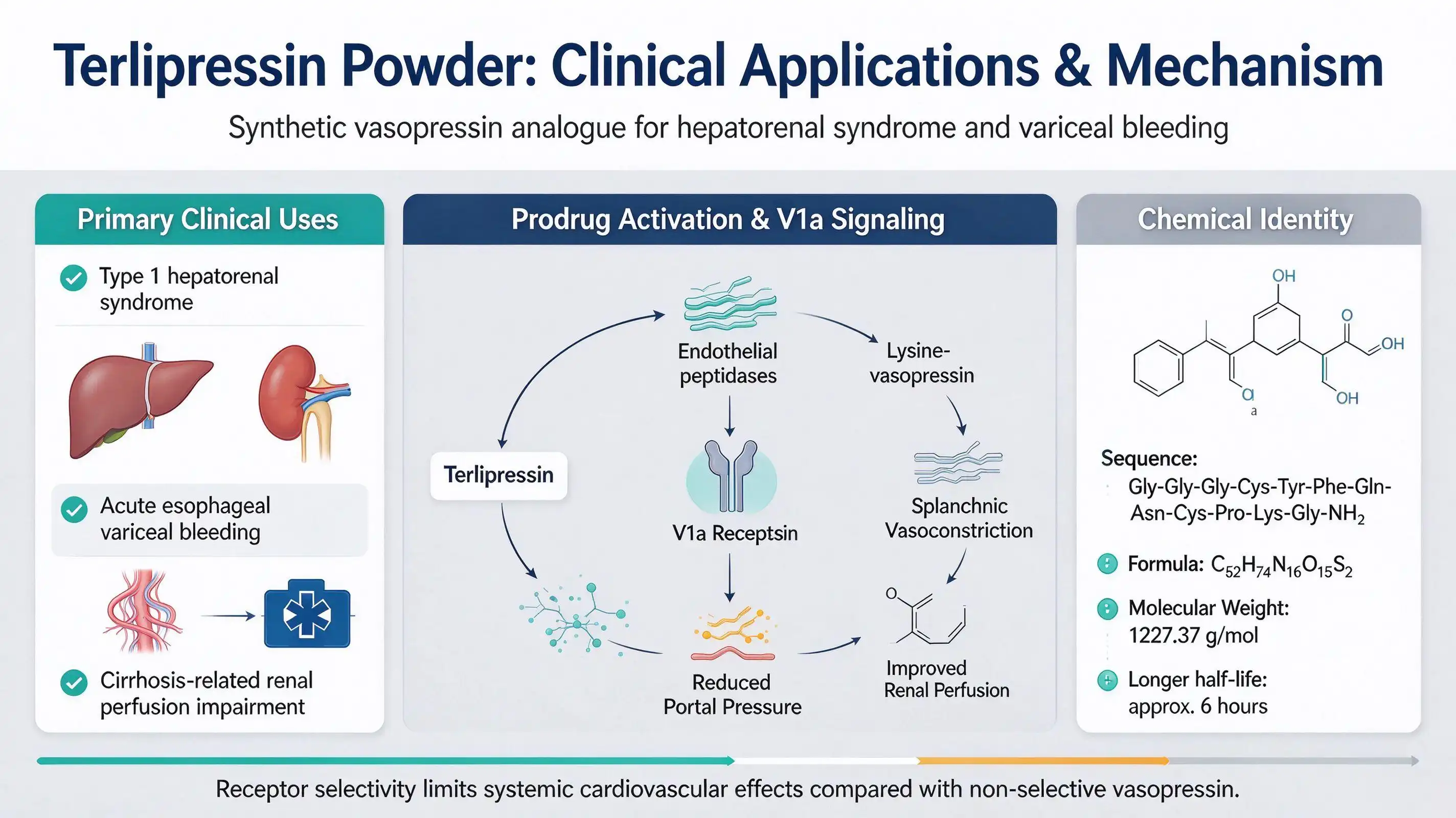
Understanding Terlipressin Powder: Uses and Mechanism
Primary Clinical Applications
Terlipressin acetate powder is used for two very important reasons in medical medicine. First, it is the first drug for Type 1 Hepatorenal Syndrome (HRS-1). In this case, it improves renal circulation by lowering splanchnic vasodilation in people who have cirrhosis. Second, it is often made into clean injectables for the quick treatment of bleeding esophageal varices, where lowering portal vein pressure quickly can save a person's life. A lot of randomized controlled studies have been done on this vasoactive peptide, making it one of the most scientifically proven ones that can be used to make medicines.
Mechanism of Action
Terlipressin is a prodrug that has the sequence Gly-Gly-Gly-Cys-Tyr-Phe-Gln-Asn-Cys-Pro-Lys-Gly-NH₂. Endothelial peptidases cut it apart using enzymes to release lysine-vasopressin. This active metabolite binds to V1a receptors on vascular smooth muscle, which narrows the blood vessels in the splanchnic circulation. Unlike norepinephrine, this receptor selectivity limits systemic cardiovascular side effects. This means that patients with poor hemodynamics can use it. Its molecular formula is C₅₂H₇₄N₁₆O₁₅S₂, and its molecular weight is 1227.37 g/mol.
Storage, Dosage, and Administration Parameters
Pharmaceutical companies must handle terlipressin powder in the right way at all times. To keep the purity of the peptide, storage must be kept at -20°C in a dry, sealed environment. When used in clinical settings, doses for variceal bleeding are usually between 1 and 2 mg given intravenously every four to six hours. For HRS-1, terlipressin and albumin infusion are often used together in treatment plans. To make sure that bioactivity stays the same during the preparation process, procurement teams should check that API batches meet moisture control standards (Karl Fischer ≤10.0%) and peptide content (N% ≥80.0%).
Terlipressin Powder vs. Alternatives: Making Informed Procurement Decisions
Terlipressin vs. Vasopressin
Native vasopressin has a short half-life of 10 to 35 minutes, which means that it needs to be continuously infused into a vein in a medical setting. Terlipressin, on the other hand, has a biological half-life of about six hours, which means that bolus doses can be given at different times. In ICUs, this makes care much easier and lowers the risk of medication mistakes. In terms of manufacturing, the longer duration of action also means that less API is needed per treatment course. This can change how buyers and formulators at hospital pharmacies figure out how much to buy in bulk.
Terlipressin vs. Octreotide
Octreotide is a chemical that works like somatostatin and lowers portal pressure by stopping the release of glucagon. Many people use octreotide in procedures to stop variceal bleeding, but several meta-analyses show that terlipressin has better mortality rates in HRS-1 treatment. A 2010 review article in Gut showed that terlipressin was statistically significantly better at stopping HRS-1 than a placebo. This difference is important for procurement managers who are looking at API sourcing based on clinical outcome data when putting products on hospital formularies or for export markets.
Generic vs. Brand-Name Considerations
There is a well-known brand called Glypressin (Ferring Pharmaceuticals) in the market, but now you can get high-purity generic terlipressin acetate powder from ISO-certified makers that meets the same pharmacopeial standards. Finding research-grade or pharmaceutical-grade bulk API from a reputable supplier with full documentation, such as COA, MSDS, and batch testing records, is the best way for CRO/CDMO companies and generic drug manufacturers to cut costs without sacrificing quality.
Clinical Evidence and Safety Profile of Terlipressin Powder
Key Clinical Trial Data
Published in the New England Journal of Medicine in 2021, the CONFIRM trial showed that terlipressin powder significantly improved HRS-1 reversal rates compared to placebo (29% vs. 16%, p=0.006) in cirrhotic patients. This led to FDA approval in the US under the brand name Terlivaz. This was a big step toward terlipressin's acceptance in the North American market. From 2022 on, US-based pharmaceutical distributors and hospital groups will want to buy a lot more of it.
Safety Profile and Contraindications
The safety profile of terlipressin needs to be carefully thought through. Some of the most common side effects are stomach cramps, diarrhea, and skin bleeding at injection sites. Cardiovascular events like hyponatremia, myocardial ischemia, and breathing failure have been recorded, mostly in people who already had heart problems. On the FDA label, there is a warning about the risk of respiratory failure in people whose serum creatinine level is above 5 mg/dL at baseline. The teams in charge of purchasing and quality assurance should make sure that these risk factors are fully explained to clinical users in all product documents, such as the MSDS and COA.
Regulatory Compliance Requirements
For pharmaceutical production, getting terlipressin acetate takes a lot of paperwork to make sure everything is done right. At the very least, sellers must show reports of analysis that show the HPLC is pure (>98%), there is no more than one impurity (>1.0%), and the MS (ESI) data matches the molecular profile. To get into the US market, you need to know about FDA DMF filings. Buyers in Europe need to think about EMA compliance. QA/RA managers need batch-to-batch consistency when they are looking for a new API source. Suppliers with ISO 9001 and ISO 14001 certifications and SGS test reports can provide this.
Procurement Insights: How to Source Terlipressin Powder Globally?
Supplier Evaluation Criteria
There is more to choosing a terlipressin powder supplier than just looking at prices. Analytical testing infrastructure, such as HPLC and mass spectrometry equipment, should be looked at by buyers, along with the supplier's ability to provide full traceability documentation. As usual, a good provider should give you a COA, an MSDS, information on the amino acid composition, and exact rotation values (-95.0° to -105.0°, c=1, 1% HAc). It is essential that there is stability from batch to batch, especially for CROs doing studies at multiple sites or CDMOs making lyophilized injectables on a large scale.
Before making a deal with a seller, buyers should make sure they meet these basic requirements:
- Purity (HPLC): ≥98.0% minimum, with single impurity capped at 1.0% max
- Peptide Content: N% ≥80.0% to confirm active peptide concentration per gram
- Acetate Content: ≤15.0% by HPIC, relevant for accurate dosing calculations
- Water Content: ≤10.0% by Karl Fischer, critical for stability during transit and storage
- Mass Balance: 95.0–105.0% to confirm material accountability across the batch
All of these requirements together tell us if an API batch is good for advanced study uses or clean injectable formulations.
Packaging, Logistics, and MOQ
Terlipressin acetate powder can be shipped all over the world in three different types of bags: 1g/bag for lab and research use, 100g/bag for developing formulas on a medium scale, and 1kg/bag for mass production. The MOQ starts at 1g, which means that study institutions that need small amounts but don't want to commit to big purchases can still get it. -20°C conditions must be kept in storage while it's in travel. People who want to buy things for the US or European markets should make sure that the seller has experience with cold-chain logistics and can show proof that the package is safe.
Building Long-Term Supply Relationships
When a drug company finds a good peptide API supplier, it's expensive to switch to someone else. Re-validation takes a lot of time and resources from the licensing body. This is why procurement managers and R&D teams are putting more and more emphasis on building long-term relationships with suppliers who offer stable inventory, clear pricing, and quick technical support. A provider that can make custom peptides in addition to standard terlipressin acetate is more useful for businesses that are building up their peptide processes.
Conclusion
With support from clinical trials and FDA approval, terlipressin powder holds a distinct place in the world of critical care drugs. Finding a high-purity API with a lot of documentation is the first step in any successful manufacturing program for drug companies, CRO/CDMOs, and research institutes. Every purchase decision should be based on four quality standards: HPLC purity of 98% or higher, controlled moisture, accurate peptide content, and full compliance documentation. The outcome depends on the quality of the starting API, no matter if it's for research into hepatorenal syndrome, making a new treatment for variceal bleeding, or studying advanced septic shock.
FAQ
Q1: What purity grade is required for pharmaceutical formulation of terlipressin?
A: For sterile injectable mixtures, terlipressin acetate that meets pharmaceutical standards must have an HPLC purity of at least 98%, a single impurity of no more than 1%, and levels of bacterial endotoxin that meet parenteral standards. Material that is research-grade and has a 99% test is good for lab studies. Before qualifying a lot, you should always ask for a full COA that confirms these details.
Q2: Can terlipressin acetate powder be purchased in small quantities for research?
A: Yes. The MOQ is 1g, and you can choose between 1g, 100g, or 1kg per bag for packaging. Universities and study centers can get small amounts for cardiovascular studies, HRS research, or peptide drug creation without having to commit to large amounts.
Q3: What storage conditions are required during international shipping?
A: Terlipressin acetate powder needs to be kept and moved at -20°C in a dry, sealed container. Buyers should make sure that their supplier can handle cold-chain logistics and can provide shipping documents that show the temperature was maintained during transit.
Q4: Is terlipressin powder available for export to the United States and Europe?
A: Yes, verified suppliers with ISO 9001 certification and batches that have been tested by SGS can send goods to the US and EU. It's important for buyers to make sure that the supplier can provide the necessary COA, MSDS, and MS (ESI) data for customs and regulatory review in the target country.
Partner With Xi'an Yihui for Reliable Terlipressin Powder Supply
Since 2010, Xi'an Yihui Bio-technology Co., Ltd. has sold medical peptides and APIs that are very pure to customers in over 100 countries. Our terlipressin powder (CAS 14636-12-5) is made in a way that is approved by both ISO 9001 and ISO 14001, and we include full paperwork packages and batch reports that have been checked by SGS. As a reliable company that makes terlipressin powder, we offer flexible packaging from 1g to 1kg, ready-to-ship products, and dedicated technical support. To get a sample or bulk quote right away, email our team at sales@yihuipharm.com.
References
1. Gluud, L. L., Kjaer, M. S., & Christensen, E. (2006). Terlipressin for hepatorenal syndrome. Cochrane Database of Systematic Reviews.
2. Neri, S., Pulvirenti, D., Malaguarnera, M., et al. (2008). Terlipressin and albumin in patients with cirrhosis and Type 1 hepatorenal syndrome. Digestive Diseases and Sciences.
3. Boyer, T. D., Sanyal, A. J., Garcia-Tsao, G., et al. (2021). Terlipressin plus albumin is superior to albumin alone in improving renal function in patients with cirrhosis and HRS-1. New England Journal of Medicine.
4. Seo, Y. S., & Shah, V. H. (2012). The role of vasoconstrictor therapy in the management of portal hypertension complications. Alimentary Pharmacology & Therapeutics.
5. Moreau, R., & Lebrec, D. (2003). The use of vasoconstrictors in patients with cirrhosis: type 1 HRS and beyond. Hepatology.
6. Escorsell, A., & Bosch, J. (2002). Terlipressin in the treatment of acute variceal bleeding: a randomized controlled trial. Journal of Hepatology.

Send Inquiry
You may like
Related Industry Knowledge