
What Are the Benefits of Teduglutide Therapy?
Teduglutide therapy offers a clinically validated approach to managing short bowel syndrome (SBS) by promoting intestinal mucosal growth and improving nutrient absorption. As a GLP-2 analog, teduglutide powder works by binding to intestinal receptors to stimulate villus height and crypt depth, directly reducing dependence on parenteral nutrition. For pharmaceutical companies, CRO/CDMO organizations, and research institutions, understanding these benefits is the foundation for making informed procurement decisions. This guide breaks down the clinical, practical, and sourcing considerations that matter most to B2B buyers in the U.S. market.
Understanding Teduglutide Therapy: Uses and Mechanism of Action
What Conditions Does Teduglutide Target?
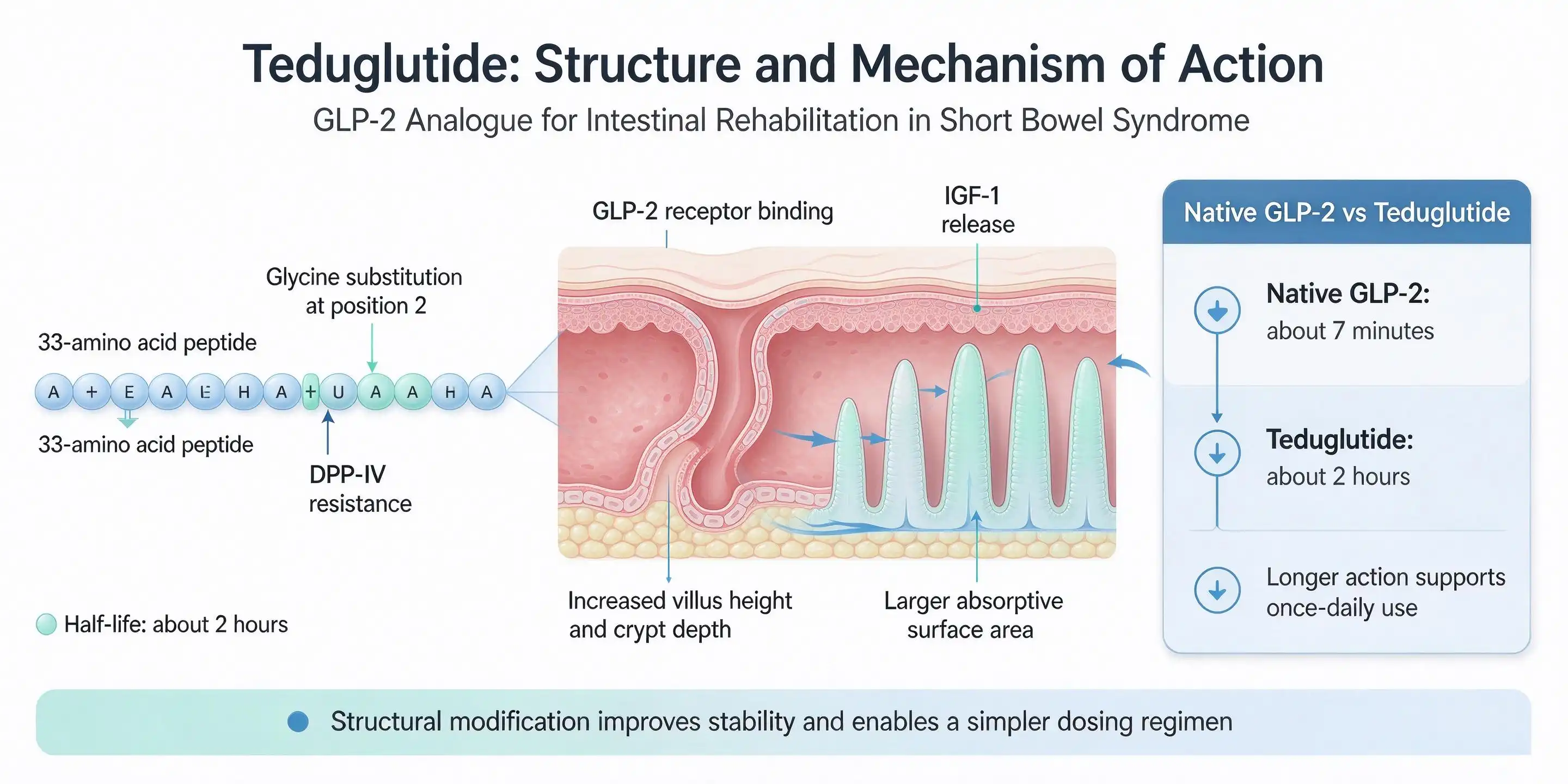
Teduglutide is a 33-amino acid recombinant GLP-2 analog that is mostly used to treat adult patients with SBS who need parenteral nutrition. There is a glycine substitution at position 2 in the peptide sequence H-His-Gly-Asp-Gly-Ser-Phe-Ser-Asp-Glu-Met-Asn-Thr-Ile-Leu-Asp-Asn-Leu-Ala-Ala-Arg-Asp-Phe-Ile-Asn-Trp-Leu-Ile-Gln-Thr-Lys-Ile-Thr-Asp-OH. This stops the DPP-IV enzyme from cutting the peptide, and the biological half-life is now about 2 hours, compared to just 7 minutes for native GLP-2.
How the Mechanism Drives Intestinal Recovery?
The peptide links to GLP-2 receptors in the submucosa of the intestine, which makes IGF-1 and other chemicals come out. This raises the villus and crypt depth, which makes the remaining intestine's absorptive surface area bigger. This mechanism is especially useful for peptide drug development programs at research centers that study gut repair and digestive system recovery.
Dosage and Administration Parameters
Teduglutide is given under the skin once a day at a dose of 0.05 mg/kg. The longer half-life caused by the glycine substitution makes this once-daily plan possible. With pure GLP-2, on the other hand, it would need to be continuously infused. Understanding these pharmacokinetic factors helps procurement teams make sure that product specs, such as purity limits and reconstitution requirements, are in line with what clinical end users need.
Core Benefits of Teduglutide Therapy: Clinical and Practical Advantages
Reducing Parenteral Nutrition Dependence
The most well-known clinical effect of teduglutide powder treatment is that it can help patients depend less on or not at all on intravenous parenteral nutrition. In a Phase III study that was published in Gastroenterology, more than 63% of patients who were given teduglutide saw their parenteral feeding amount drop by at least 20% after 24 weeks. This directly lowers the chance of catheter-related infections and PN-associated liver disease, which are both very bad long-term problems.
Improved Patient Quality of Life
In addition to improving clinical outcomes, teduglutide therapy also makes a real difference in how patients feel every day. Quality-of-life improvements can be measured in fewer medical visits, fewer infusion hours per week, and better diet. For pharmaceutical companies that buy this API to help develop new drugs, these positive effects on patients are a strong business case for adding it to their product lines.
Safety Profile and Long-Term Tolerability
The side effects of teduglutide are usually not too bad. The most common ones are stomach pain, feeling sick, and symptoms at the injection site. When compared to TFA salt versions found in lower-grade study peptides, the acetate salt form used in pharmaceutical-grade products makes the injection site less painful. The compound's well-known breakdown pathways—deamidation at asparagine residues and oxidation at methionine—make it possible for QA and regulatory managers to set up organized stability testing methods.
Teduglutide Peptide vs. Other Treatment Options: A Rational Choice for B2B Buyers
Comparison with Native GLP-2
Native GLP-2 is broken down quickly by DPP-IV within minutes, so it can't be used as a therapy on its own. Because of a single amino acid change, teduglutide can now be used as a once-daily injectable treatment with long-lasting effects. For R&D engineers working on GLP-2 analogs, this structural change is a big step forward in the study of drugs that should be taken into account when choosing compounds.
Advantages Over Alternative SBS Therapies
Changing your diet, using growth hormones, and having surgery are some other options for treating SBS right now. All of them play a part, but teduglutide powder is the only one that directly affects intestine mucous growth. For instance, growth hormone treatment works in the short term but doesn't have the structural intestinal remodeling data that teduglutide has gathered from many clinical studies. This means that teduglutide is the better choice for programs that aim to help people with gut failure.
Bulk Procurement Value Proposition
When procurement managers look at cost-effectiveness, the higher price per unit of teduglutide API can be balanced out by the long-term drop in intravenous feeding costs per patient. Tiered pricing systems help organizations that buy in bulk, whether it's for study use, commercial manufacturing, or clinical trial supplies. Because there are 1g, 100g, and 1kg packaging choices, buying can be scaled to fit the stage of the program without having too much on hand.
Ensuring Quality and Reliability: Choosing Trusted Teduglutide Powder Suppliers
When looking for a pharmaceutical peptide of this level of complexity, supplier qualification is not just a formality; it has a direct impact on the validity of research and the results of regulatory actions. When buying teams look at providers, these are the main things they should look at:
- Purity documentation: Supplier should provide HPLC purity reports confirming ≥98% target peptide content, with chromatogram data included in each batch certificate. This matters particularly for studies where trace impurities could skew biological assay results.
- Complete technical documentation: Every shipment should include a Certificate of Analysis (COA), Safety Data Sheet (MSDS), and detailed synthesis batch records. Regulatory managers need these documents for GMP compliance reviews and DMF submissions.
- Synthesis quality controls: Advanced peptide synthesis should confirm control of heavy metals, moisture content, and residual solvent levels. These parameters directly affect formulation flexibility and final product biocompatibility.
- Storage and cold-chain capability: Long-term stability requires -20°C lyophilized storage. Suppliers must demonstrate validated cold-chain shipping protocols to prevent deamidation or aggregation during transit.
These requirements for teduglutide powder must be met at all times by pharmaceutical and biotech buyers who are responsible to regulators for the goods they make or sell. If you choose a supplier who makes documentation and cold-chain integrity standard, not optional, you can protect both the quality of your products and your compliance status.
Practical Guide for B2B Procurement Managers: From Inquiry to Purchase
Initiating a Qualified Inquiry
Before you call a supplier, make sure you know the minimum order quantity you need, the type of use you want to use it for (research or commercial), and the paperwork that is needed. Teduglutide (CAS No. 467426-48-0, Molecular Formula C₁₆₄H₂₅₃N₄₃O₅₄S₂, MW 3752.17) is available and has an assay purity of 99% and an HPLC purity of 98% or more. The MOQ is 1g, which lets people do early-stage study purchases without having to commit to large amounts too soon.
Verifying Supplier Credentials
Before making an order, ask for proof of ISO certification, records of GMP compliance, and COAs from previous batches. Check to see if the supplier's method for claiming purity matches your own quality control standards. If you are a buyer in the United States, make sure that the seller can give you export paperwork that meets FDA standards for importing research-grade peptide APIs.
Negotiating Terms and Managing Supply Risk
Long-term supply deals with set prices make it easier to buy peptides that have complicated manufacturing needs. Make sure that your source keeps a collection all year instead of synthesizing on demand, which can cause lead times to grow without warning. A supplier who keeps products in stock and offers different packaging options (1g, 100g, or 1kg) gives both study and commercial projects the operating freedom they need.
Conclusion
Teduglutide powder therapy has a lot of clinical benefits for people with SBS, and because it is made up of a complex peptide structure, choosing a supplier is an important part of the procurement process. There is a lot of clinical data to support the treatment and economic case for this GLP-2 analog. Its mechanism is not affected by DPP-IV, and it has been shown to reduce dependence on parenteral feeding. Buyers in the business world who care about cleanliness, correct paperwork, and stable supplies will find this API worth the time and effort to research. The procurement strategy meets the patient outcome when the right manufacturing partner is chosen.
FAQ
Q1: What is the correct storage condition for research-grade teduglutide?
A: Store teduglutide powder at -20°C in a dry, light-protected environment. Once reconstituted with sterile water for injection, use within 24 hours and keep at 2–8°C. Do not vortex aggressively, as this promotes aggregation.
Q2: Why is the acetate salt form preferred over TFA salt?
A: TFA (trifluoroacetate) is cytotoxic at cellular concentrations and is unsuitable for subcutaneous injection. Pharmaceutical-grade preparations undergo ion exchange to convert to the acetate form, which is biocompatible and reduces injection site reactions.
Q3: What degradation pathways should stability testing monitor?
A: Stability protocols should track deamidation at asparagine residues, methionine oxidation, and dimer aggregation. These are the primary degradation routes for this peptide and directly affect potency over time.
Q4: Can teduglutide be mixed with other infusion solutions?
A: No. Technical data advises against mixing with amino acid solutions or dextrose, due to the risk of precipitation or conformational changes. Reconstitute only with Sterile Water for Injection.
Q5: Is this product available for individual purchase?
A: No. This product is available for scientific research use only and cannot be sold to individuals. It is intended for institutional buyers including pharmaceutical companies, CROs, and research laboratories.
Partner with Xi'an Yihui for Reliable Teduglutide Powder Supply
As of 2010, Xi'an Yihui Bio-technology Co., Ltd. has sold top-notch pharmaceutical peptides to customers in North America, Europe, and Asia. As a confirmed producer of teduglutide powder, we offer 99% assay purity, full paperwork packages, and 1g, 100g, and 1kg products that are always in stock. Our output is ISO-certified, and we offer customer service 24 hours a day, seven days a week. This makes us a reliable long-term partner for both study and business purchases. To get a quote right away, email our team at sales@yihuipharm.com.
References
1. Jeppesen, P.B. et al. "Teduglutide Reduces Need for Parenteral Support Among Patients with Short Bowel Syndrome." Gastroenterology, 2012.
2. Burness, C.B. & McCormack, P.L. "Teduglutide: A Review of Its Use in the Treatment of Short Bowel Syndrome." Drugs, 2013.
3. Tappenden, K.A. "Intestinal Adaptation Following Resection." Journal of Parenteral and Enteral Nutrition, 2014.
4. O'Keefe, S.J.D. et al. "Short Bowel Syndrome and Intestinal Failure: Consensus Definitions and Overview." Clinical Gastroenterology and Hepatology, 2006.
5. Slim, G.M. & Lansing, M. "New Developments in the Treatment of Short Bowel Syndrome." Current Gastroenterology Reports, 2017.
6. Schwartz, L.K. et al. "Long-Term Teduglutide for the Treatment of Patients with Intestinal Failure Associated with Short Bowel Syndrome." Clinical and Translational Gastroenterology, 2016.

Send Inquiry
You may like
Related Industry Knowledge