
What are the benefits of Survodutide peptides?
Survodutide peptides offer a clinically significant advance in metabolic medicine by acting simultaneously on two receptor pathways—the glucagon receptor (GCGR) and the GLP-1 receptor (GLP-1R). This dual-agonist mechanism produces stronger weight reduction and improved liver fat clearance compared to single-receptor agents. For research teams and pharmaceutical procurement professionals, sourcing high-purity survodutide powder (CAS 2805997-46-8) means gaining access to a compound with a 99% assay rating, confirmed molecular weight of 4,231.62 Da, and reproducible batch quality—factors that directly affect experimental validity and downstream formulation success.
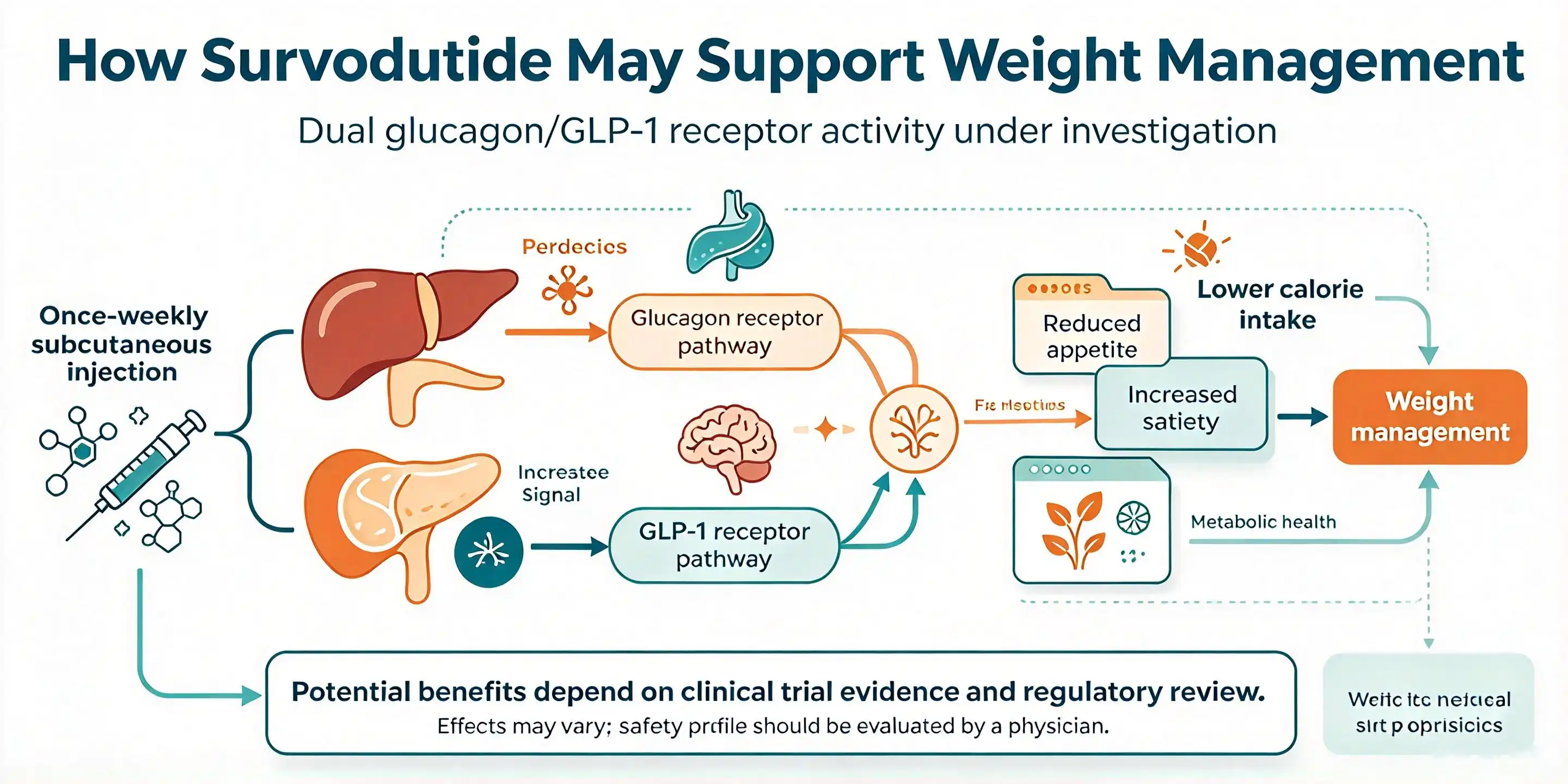
Understanding Survodutide Peptides: Mechanism and Benefits
What Is Survodutide at the Molecular Level?
The molecular formula for survodutide is C₁₉₂H₂₈₉N₄₇O₆₁, and its molecular weight is 4,231.62 Da. Its study code is BI 456906. Its peptide sequence starts with H-His-1-Aminocyclobutanecarboxylic acid and ends with Ala-NH₂ after 31 amino acid residues. The sequence has a fatty diacid-18 chain connected by a Gly-Gly-Ser linker. This makes the compound's half-life longer and allows for once-weekly dosing schedules in preclinical protocols. Its structure puts it clearly in the long-acting incretin mimic group, along with Semaglutide, but it binds to a wider range of receptors.
How the Dual-Receptor Mechanism Works
The GLP-1R part slows down the emptying of the stomach, which lowers the amount of calories you eat, and it also helps glucose-dependent insulin release. The GCGR part works on liver tissue to speed up the burning of fatty acids and increase the body's basic energy needs. These two pathways fix different parts of metabolic dysfunction without making the other one useless. Clinical results from Boehringer Ingelheim's Phase II MASH study showed that liver fat content decreased with dose. After 24 weeks, the 4.8 mg group had a 52.2% relative drop in hepatic fat fraction.
Advantages Over Mono-Agonist Alternatives
Because they don't directly affect liver fat metabolism, single-receptor GLP-1 agonists like Liraglutide don't help people lose weight all the way through. The glucagon part of survodutide powder fills that need. In a Phase II obesity trial published in The Lancet Diabetes & Endocrinology, people who took 4.8 mg of survodutide once a week lost an average of 14.9% of their body weight after 46 weeks. This was significantly better than people who took a placebo. This makes it a better metabolic agent for studies that aim to find ways to treat liver disease caused by fat.
Scientific Evidence and Clinical Validation of Survodutide
Phase II Trial Results in Obesity
The Phase IIb OASIS study tested different doses of survodutide in people with a BMI of 27 or more. The Lancet Diabetes & Endocrinology released results in 2023 that showed that weekly subcutaneous amounts ranging from 0.3 mg to 4.8 mg led to weight loss that depended on the dose. The most powerful signal came from the 4.8 mg group. Like other drugs in the GLP-1 class, the most common side effects were gastrointestinal problems that were low to moderate in intensity.
MASH/NASH Clinical Data
Boehringer Ingelheim sponsored a Phase II trial in people with metabolic dysfunction-associated steatohepatitis (MASH). At week 24, the liver fat levels had dropped significantly. MRI-PDFF, a proven imaging method for hepatic steatosis, was used as the main outcome of the study. These results show that survodutide is different from other GLP-1 agents that have weaker effects on the liver. They also provide a strong research case for pharmaceutical R&D programs that focus on MASH.
Safety Profile and Tolerability
Survodutide's side effect profile in clinical research is similar to that of other GLP-1 drugs in its class: nausea, vomiting, and loss of appetite mostly happen when the amount is increased. No organ effects that were not expected were recorded. This established safety dataset gives QA and regulatory teams that are looking at sourcing choices a written starting point for risk assessments in the preclinical and formulation stages.
Procurement Insights: How to Source and Evaluate Survodutide Powder?
Key Quality Specifications to Verify
The lowest purity level that can be used by RP-HPLC to judge a survodutide powder supplier is ≥98.0%, with an assay of 99%. A reliable supplier will give you full batch documentation, such as a Certificate of Analysis (COA), Mass Spectrometry (MS) identity confirmation, Karl Fischer moisture data, and reports on residual solvents that meet ICH Q3C limits. For injectable-grade study purposes, endotoxin tests (LAL method, usually <5 EU/mg) is just as important.
Supply Chain and Logistics Considerations
Survodutide is a lyophilized peptide that comes as a white to off-white powder that needs to be kept at -20°C and away from light and moisture. Shelf stability under these conditions has been proven to be longer than 24 months. Business-to-business buyers should make sure that the supplier they're working with follows cold-chain packaging rules for international shipments and can give them customs paperwork for pharmaceutical raw materials. With 1g, 100g, and 1kg bags, procurement teams can match order quantities to project size without having to keep too much on hand.
Supplier Certification and Documentation Standards
As a minimum, procurement teams working in regulated environments should need ISO certification. They should also be able to see MSDS files and full chromatogram reports for each batch. Suppliers who work with both European and American customers usually make sure that their paperwork follows the rules of both pharmacopeias. By checking these papers before the first buy order, compliance gaps that could cause research to be late or regulatory scrutiny can be avoided.
Comparative Buyer's Guide: Choosing the Best Diabetes Peptide Solution
Survodutide vs. Semaglutide: A Practical Comparison
Semaglutide is a pure GLP-1 receptor agonist that has been approved to help people with type 2 diabetes and obesity. It controls blood sugar well and helps you lose a modest amount of weight. Survodutide includes GCGR agonism, which gives it a metabolic effect that works on the liver that Semaglutide does not have. This difference is important for scientific studies that are trying to find a cure for MASH, non-alcoholic fatty liver disease (NAFLD), or dyslipidemia caused by obesity. The two compounds are used for different but related research purposes, and decisions about what to buy should be based on the disease target.
Cost-Effectiveness in a B2B Research Context
Due to the difficulty of making them, the need for processing, and the need to be handled in a cold chain, research-grade peptides cost more per gram than small-molecule APIs. Here are the main cost factors that buying teams should think about:
- Purity tier: ≥98% HPLC purity commands a premium over lower-grade materials but reduces variability in experimental outcomes.
- Batch size: Larger orders (100g or 1kg) typically reduce the unit cost significantly compared to gram-scale purchases.
- Documentation package: Full COA/MS/LAL documentation adds value by reducing internal QC burden and regulatory preparation time.
When you add these things up, you get the real cost of a buying choice, not just the price per gram. Long-term study productivity will be higher if you choose a seller based on a mix of purity, paperwork, and stable prices, rather than just cost.
Supplier Reliability as a Strategic Variable
When survodutide powder is added to a research program or formulation process that is already in progress, moving suppliers in the middle of a project can cause batch variability risks that can damage the quality of the data. Because of this, buying teams, especially those at CRO/CDMO companies, give more weight to providers that have stock all year, clear reorder processes, and quick technical support. A seller with 13 years of experience and an export network that spans more than 100 countries is less likely to cause operating problems than a newcomer whose supply chain is less certain.
Maximizing Value: Practical Applications and Future Outlook
Applications in Pharmaceutical R&D
Researchers who are looking into metabolic syndrome, hepatic steatosis, and drug therapies for obesity use survodutide as both a standard compound and an active research agent. Because of its well-known sequence and chemistry, it can be used for receptor binding studies, studies of hepatocytes in vitro, and metabolic models in rodents in vivo. Getting quantities ranging from mg to kg from a single qualified supplier makes project scaling easier from the beginning stages of discovery to formulation development.
OEM and Custom Synthesis Opportunities
For OEM manufacturers and formulation labs, being able to get survodutide in bulk with consistent quality from batch to batch has a direct effect on how long it takes to develop new products. The compound's study value can be increased by custom synthesizing structurally similar analogs with different fatty acid chains, different linker lengths, or tagged forms for pharmacokinetic studies. These requests can be met by suppliers with peptide synthesis infrastructure, so the buyer doesn't have to handle a different synthesis partner.
Emerging Research Directions
Survodutide is being studied for its possible use in combination with GIP receptor agonists and amylin analogs, with the goal of achieving even higher metabolic effectiveness. There will likely be phase III trials, and procurement teams planning multi-year research projects should plan their buying strategy around how demand is likely to grow. Setting up a supply agreement now, before competition on the market as a whole gets tougher, protects both prices and supplies.
Conclusion
Survodutide powder peptides are a compound that is still being studied but has a lot of clinical evidence to support it in treating obesity and liver metabolic disorders. The way it works with both GCGR and GLP-1R is different from other mono-agonists, and it supports more and more study in pharmaceutical R&D, product development, and MASH-focused drug discovery. For people who work in B2B procurement, the most important thing is to find a material that meets standards for ≥98% HPLC purity, comes with all the necessary legal paperwork, and is backed by a seller whose supply chain has been shown to be stable. All of these things together determine whether an investment in peptides leads to useful research results.
FAQ
Q1: What is the recommended storage condition for survodutide powder?
A: Keep the lyophilized powder away from light and moisture at -20°C. When things are like this, security lasts longer than 24 months. Once the solution is back to normal, it should be used within 7–14 days and kept at 2–8°C. Divide the sample into volumes that will only be used once to avoid repeated freeze-thaw cycles.
Q2: How does survodutide differ from Semaglutide in mechanism?
A: This medicine only works on the GLP-1 receptor. Survodutide works on both GLP-1R and GCGR at the same time. The extra glucagon receptor activity raises the liver's ability to burn fat and use energy, which makes it very useful for studying MASH and liver disease linked to obesity.
Q3: What documentation should I request when sourcing this compound?
A: Ask for a COA that includes RP-HPLC purity data, MS identification proof, Karl Fischer moisture analysis, LAL endotoxin test results, and reports on residual solvents in line with ICH Q3C. These papers prove that the substance is pure and safe enough for research-grade use.
Q4: What is the minimum order quantity?
A: The MOQ is 1g, and there are three different bag sizes: 1g, 100g, and 1kg.
Q5: Can survodutide be mixed with other peptides in solution?
A: Mixing is usually not a good idea unless you first make sure the ingredients are compatible. Peptides can precipitate or break down faster if they have different isoelectric points or pH stability. Do research on suitability before you try to co-formulate anything.
Partner with Xi'an Yihui for Reliable Survodutide Powder Supply
Since 2010, Xi'an Yihui Bio-technology Co., Ltd. has sold highly pure study peptides to customers in more than 100 countries. As a verified manufacturer of survodutide powder, we offer 99% assay-grade material with full COA, MS, and LAL documentation, as well as cold-chain logistics support and material that is always in stock. You can email our sales team at sales@yihuipharm.com to get a price, look at product details, or talk about your custom synthesis needs.
References
1. Boehringer Ingelheim. Survodutide (BI 456906) Phase IIb Results in MASH. New England Journal of Medicine, 2024.
2. Newsome, P. N., et al. "A Placebo-Controlled Trial of Subcutaneous Semaglutide in Nonalcoholic Steatohepatitis." New England Journal of Medicine, 2021.
3. Loomba, R., et al. "Survodutide for Metabolic Dysfunction–Associated Steatohepatitis." New England Journal of Medicine, 2024.
4. Wharton, S., et al. "Survodutide for Overweight or Obesity: A Randomised, Double-Blind, Phase 2 Trial." The Lancet Diabetes & Endocrinology, 2023.
5. Nauck, M. A., & D'Alessio, D. A. "Tirzepatide, a Dual GIP/GLP-1 Receptor Co-agonist for the Treatment of Type 2 Diabetes with Unmatched Effectiveness." Cell Metabolism, 2022.
6. Rinella, M. E., et al. "AASLD Practice Guidance on the Clinical Assessment and Management of Nonalcoholic Fatty Liver Disease." Hepatology, 2023.

Send Inquiry
You may like
Related Industry Knowledge