
Teriparatide for Osteoporosis: How It Rebuilds Bone and Reduces Fractures
Teriparatide is one of the few therapies that actively rebuilds bone rather than simply slowing its loss. As a recombinant fragment of human parathyroid hormone (PTH 1–34), the teriparatide API works by directly stimulating osteoblast activity—the cells responsible for generating new bone tissue. Clinical trials have confirmed that it reduces vertebral fracture risk by up to 65% and non-vertebral fractures by approximately 53%. For pharmaceutical companies, CRO/CDMO firms, and research institutions sourcing bone anabolic peptides, understanding how this molecule functions and how to source it responsibly is essential.
Understanding Teriparatide and Its Role in Osteoporosis Treatment
Molecular Structure and Synthesis
Its CAS number is 52232-67-4, and it is a 34-amino acid linear peptide. Its molecular formula is C₁₈₁H₂₉₁N₅₅O₅₁S₂, and its molecular weight is 4117.72 g/mol. Ile-Gln-Leu-Met-His-Asn-Leu-Gly-Lys-His-Leu-Asn-Ser-Met-Glu-Arg-Val-Glu-Trp-Leu-Arg-Lys-Lys-Leu-Gln-Asp-Val-His-Asn-Phe-OH is its sequence, and it matches the biologically active N-terminal domain of native PTH. It is better to use the acetate salt form because it can balance better and work better with common medicinal ingredients like mannitol and m-cresol.
Mechanism of Action: Bone Anabolism
Teriparatide works the opposite way of antiresorptive drugs like bisphosphonates. When injected under the skin on a regular basis, it turns on PTH1 receptors on osteoblasts, which speeds up the production of bone matrix and raises bone mineral density. This is what makes recombinant PTH therapy different from most osteoporosis drugs, which only stop bone breakdown. This makes it a better choice for people with severe osteoporosis or a high risk of breaking a bone.
Pharmacokinetics and Dosage Form
Teriparatide hits its highest level in the blood within 30 minutes of being injected under the skin, and its half-life is about an hour. This quick start-up and short-lasting feature is exactly what causes its specific bone-building effect. For study purposes, the lyophilized powder form (off-white to white) is stable and easy to mix back together. To keep the bioactivity, it needs to be stored at -20°C in a dry, light-protected place, especially at the Methionine residues at positions 8 and 18, which are easily oxidized.
Comparative Analysis: Teriparatide vs Other Osteoporosis Treatments
Teriparatide vs Abaloparatide
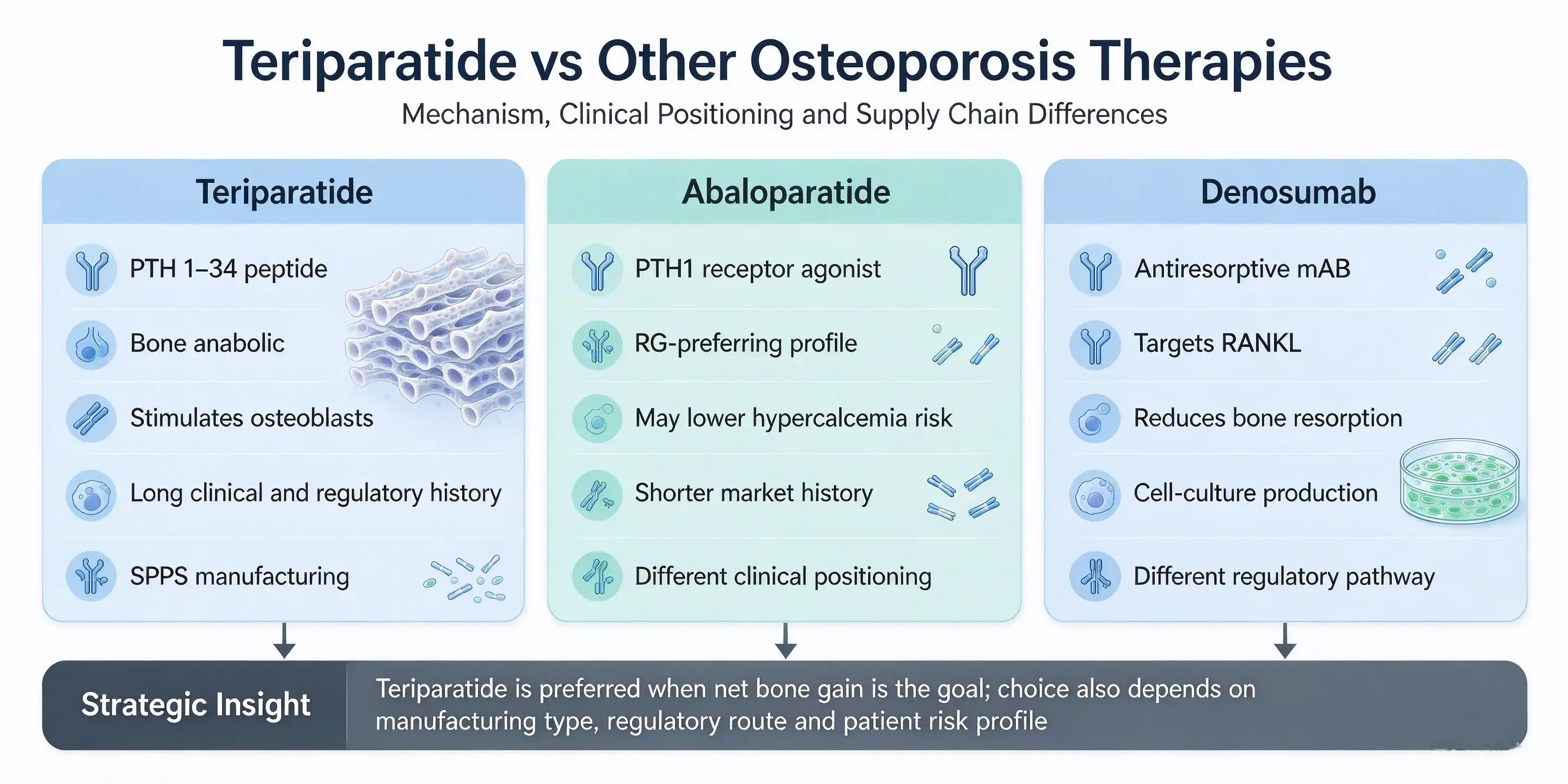
Both molecules aim for the PTH1 receptor, but abaloparatide prefers the RG shape, which may lower the risk of hypercalcemia. Teriparatide has been used in medicine for more than twenty years, and the landmark FPT (Fracture Prevention Trial) has strong data on how well it reduces fractures. Teriparatide has been approved by regulators for a longer time, which means that buying teams can be more sure that it will be accepted by the global market.
Teriparatide vs Denosumab
Denosumab is a type of antiresorptive monoclonal antibody that targets RANKL. This means that it stops bone breakdown instead of making new bone. It works for people who can't handle bisphosphonates. Teriparatide API, on the other hand, is the best choice when the goal is net bone gain. Teriparatide is a peptide that is made using solid-phase peptide synthesis (SPPS), while denosumab is a protein that needs to be made in a cell culture, so they have different regulatory and supply chain needs.
API Purity, Stability, and Regulatory Standing
API quality measures are a must for business-to-business buyers. Teriparatide for research purposes and teriparatide for pharmaceutical use both need to be HPLC pure ≥98% and have the stability of the sequence proven by mass spectrometry. Endotoxin levels must be less than 10 EU/mg and moisture content must be less than 5% (by Karl Fischer titration) in order to meet USP and EP monographs. It is much easier to add suppliers to a supply chain that follows the rules if they can provide a COA, an MSDS, and written stable data.
Procurement Guide for Teriparatide API: Best Practices and Market Insights
Sourcing Protocols and MOQ Considerations
To get teriparatide peptide in bulk, the order volume and quality documentation need to match up. With a minimum order number as low as 1g, research schools and early-stage development teams can test the quality of the material before going big. With 1g/bag, 100g/bag, and 1kg/bag packaging choices, you can meet the needs of both small-scale study projects and large-scale production. Procurement managers should always ask for a certificate of analysis (COA), batch-specific HPLC data, and sequence proof records from a provider before making a decision.
Regulatory Compliance and Shipping
When buying peptide APIs from other countries, you have to deal with export control classifications, import licenses, and the rules that are specific to each country. For pharmaceutical-grade purchases, you need GMP-aligned paperwork like DMF filings and third-party audit reports. People who want to bring goods into the United States should check to see if there are any FDA import alerts and make sure that the seller follows 21 CFR Part 211 rules. Regulatory risk is greatly reduced when you work with a provider that keeps their ISO certification and can provide traceability paperwork.
Vendor Evaluation and Long-Term Supply Chain
The best decisions about what to buy are ones that take more than price into account. A trustworthy teriparatide API provider should be able to show stability from batch to batch, quick technical help, and the ability to increase production without lowering purity standards. Long-term supply deals with makers that have been checked out lower the chance of supply problems and price changes. Before making a commitment, it's a good idea to look at a supplier's track record with clients from controlled markets like Europe, North America, Japan, and South Korea.
Stability, Safety, and Storage: Ensuring Quality Throughout the Supply Chain
Temperature and Handling Requirements
Teriparatide acetate needs to be kept at -20°C in a dry, dark place so that it doesn't break down. When there is a lot of moisture or heat, methionine residues at positions 8 and 18 are more likely to oxidize, while asparagine residues are more likely to deamidate. It is necessary to handle the cold chain during foreign shipping in order to keep the potency of the peptides and meet pharmacopeial standards.
Safety Profile and Impurity Limits
The safety profile of teriparatide is well known based on published clinical and experimental studies. Mild sickness and short-term high calcium levels are common side effects of medicinal use. For research purposes, reversed-phase HPLC (RP-HPLC) impurity profiling checks for diastereomers and truncated sequences that might make it harder to repeat the experiment. Standard quality control checks that any reasonable provider should do and record are endotoxin testing with the LAL assay (<10 EU/mg) and Karl Fischer moisture analysis (<5%).
Quality Control Standards
Tough quality control for the teriparatide API peptide includes RP-HPLC purity profiling, mass spectrometry for sequence confirmation, and a cell-based cAMP stimulation assay to make sure the peptide works. All of these tests show that the peptide works the way it should in research or manufacturing processes further down the line. If a procurement team or QA manager wants to qualify a new seller, they should make sure that these papers are included.
Future Outlook: Trends and Innovations in Teriparatide API Development
Advances in Synthesis and Purification
As SPPS technology keeps getting better, it makes it possible to make 34-mer peptides like teriparatide with higher rates, fewer truncation leftovers, and lower costs. As chromatographic purification gets better, it's easier to get assay purity levels of 99% or higher on a business level. This makes it cheaper for OEM makers and generic pharmaceutical companies to make medicines.
Alternative Delivery Routes and Emerging Applications
As possible alternatives to daily subcutaneous injections, researchers are looking into transdermal patches, oral peptide formulations, and microneedle delivery systems. If any of these methods are proven to work in humans, there will be a huge demand for high-purity teriparatide peptide raw material. Researchers are looking at PTH 1–34 in areas other than osteoporosis, such as bone regrowth, injury healing, and even periodontology. This means that there may be a bigger market for this peptide.
Market Growth and Strategic Sourcing Opportunities
As the world's population ages and more people learn about bone health, the market for osteoporosis drugs is expected to grow to over $16 billion by 2030. It will be easier for procurement professionals and OEM clients to meet that demand if they sign supply agreements with qualified manufacturers now. There are real steps that separate reactive buying from strategic sourcing, such as early seller qualification, regulatory alignment, and capacity planning.
Conclusion
Teriparatide API is different from other osteoporosis medicines because it builds bone instead of just keeping the bone that is already there. It is one of the most clinically reliable bone anabolic peptides because it has been shown to reduce the risk of fracture, work in a clear way, and have been approved by regulators. Pharmaceutical companies, study centers, and procurement teams must get high-purity teriparatide acetate from a qualified, legal source. This is important for both science and business. The right supplier relationship gives you not only the materials you need, but also paperwork, expert help, and a steady supply of those materials. This is everything a responsible R&D or manufacturing operation needs.
FAQ
Q1: What is the purity of teriparatide acetate from Xi'an Yihui?
A: Our teriparatide acetate (CAS 52232-67-4) is checked by HPLC and is ≥98% pure, with an assay of 99%. Mass spectrometry checks the purity of the sequence, and a cell-based cAMP stimulation test checks the bioactivity.
Q2: What is the minimum order quantity for teriparatide API?
A: The minimum order quantity is 1g, and it can be packed in 1g bags, 100g bags, or 1kg bags. This lets you do both small-scale sampling for research and larger-scale commercial purchases, depending on the needs of your project.
Q3: What are the correct storage conditions for teriparatide acetate?
A: Keep at -20°C in a dry place away from light. The peptide is easily oxidized at Methionine residues and deamidated when it's humid outside. To keep the strength, the cold chain must be handled correctly during shipping and storage.
Q4: What documentation is available for regulatory compliance?
A: We offer COA, MSDS, and HPLC data that is specific to each batch. To support GMP and regulatory files, you can ask for more information, such as endotoxin test results (LAL assay, <10 EU/mg) and moisture content data (Karl Fischer, <5%).
Q5: Is teriparatide API available for individual purchase?
A: No, this item can only be used for scientific research and is only sold to businesses, research institutions, labs, and other qualified B2B buyers. People are not who we sell to.
Partner with Xi'an Yihui for Reliable Teriparatide API Supply
Since 2010, Xi'an Yihui Bio-technology Co., Ltd. has sold fine chemicals and highly pure peptide APIs to customers in the US, Europe, Japan, and South Korea. As a teriparatide API supplier, we can offer research-grade teriparatide acetate (CAS 52232-67-4) that is ≥98% pure by HPLC, 99% pure by assay, has a minimum order quantity of 1g, and can be shipped right away from stock. We are certified as ISO, Halal, and Kosher, and we offer full paperwork, such as COA and MSDS. You can get a quote right now by emailing sales@yihuipharm.com.
References
1. Neer, R. M., et al. "Effect of Parathyroid Hormone (1–34) on Fractures and Bone Mineral Density in Postmenopausal Women with Osteoporosis." New England Journal of Medicine, 2001.
2. Dempster, D. W., et al. "Anabolic Actions of Parathyroid Hormone on Bone." Endocrine Reviews, 1993.
3. Black, D. M., & Rosen, C. J. "Clinical Practice: Postmenopausal Osteoporosis." New England Journal of Medicine, 2016.
4. Hodsman, A. B., et al. "Parathyroid Hormone and Teriparatide for the Treatment of Osteoporosis: A Review of the Evidence and Suggested Guidelines for Its Use." Endocrine Reviews, 2005.
5. Miller, P. D., et al. "Effect of Abaloparatide vs Placebo on New Vertebral Fractures in Postmenopausal Women with Osteoporosis." JAMA, 2016.
6. Vahle, J. L., et al. "Skeletal Changes in Rats Given Daily Subcutaneous Injections of Recombinant Human Parathyroid Hormone (1–34) for 2 Years and Their Relevance to Human Safety." Toxicologic Pathology, 2002.

Send Inquiry
You may like
Related Industry Knowledge