
Retatrutide vs Tirzepatide: The Triple Agonist Difference
A big change is happening in the way metabolic disorders are treated around the world. As the numbers of people with diabetes and obesity rise, the need for new treatments has never been greater. The Triple agonist peptide Retatrutide is one of the most exciting new discoveries. It is a next-generation metabolic regulator that goes beyond what Tirzepatide could do. Both drugs work on several hormone receptors at the same time, but Retatrutide's addition of activating glucagon receptors is a big change in how it works. This difference is very important for pharmaceutical businesses, CRO/CDMO companies, and research schools that want to make products that stand out. When procurement managers and research and development teams understand these differences, they can make smart sourcing choices that meet legal needs, effectiveness goals, and market positioning goals.
Understanding the Triple Agonist Peptides: Retatrutide and Tirzepatide
Mechanism of Action Distinctions
Tirzepatide works as a dual agonist, meaning it binds to and activates both GLP-1 and GIP receptors. This makes it much easier to balance blood sugar and lose weight. This two-part system does a good job of controlling both insulin release and hunger. This method is improved by Retatrutide, which works by blocking glucagon receptors and activating GLP-1 and GIP. When three receptors are activated, a new metabolic profile is made that changes pathways in fat metabolism and energy use that weren't possible with dual agonists alone. The glucagon part especially boosts the metabolism and oxidation of fatty acids in the liver, which gets around the therapeutic halt that comes with dual-agonist combinations. This change in how things work is very important for research teams that are making the next wave of treatments for obesity and NASH.
Pharmacological Profile Comparison
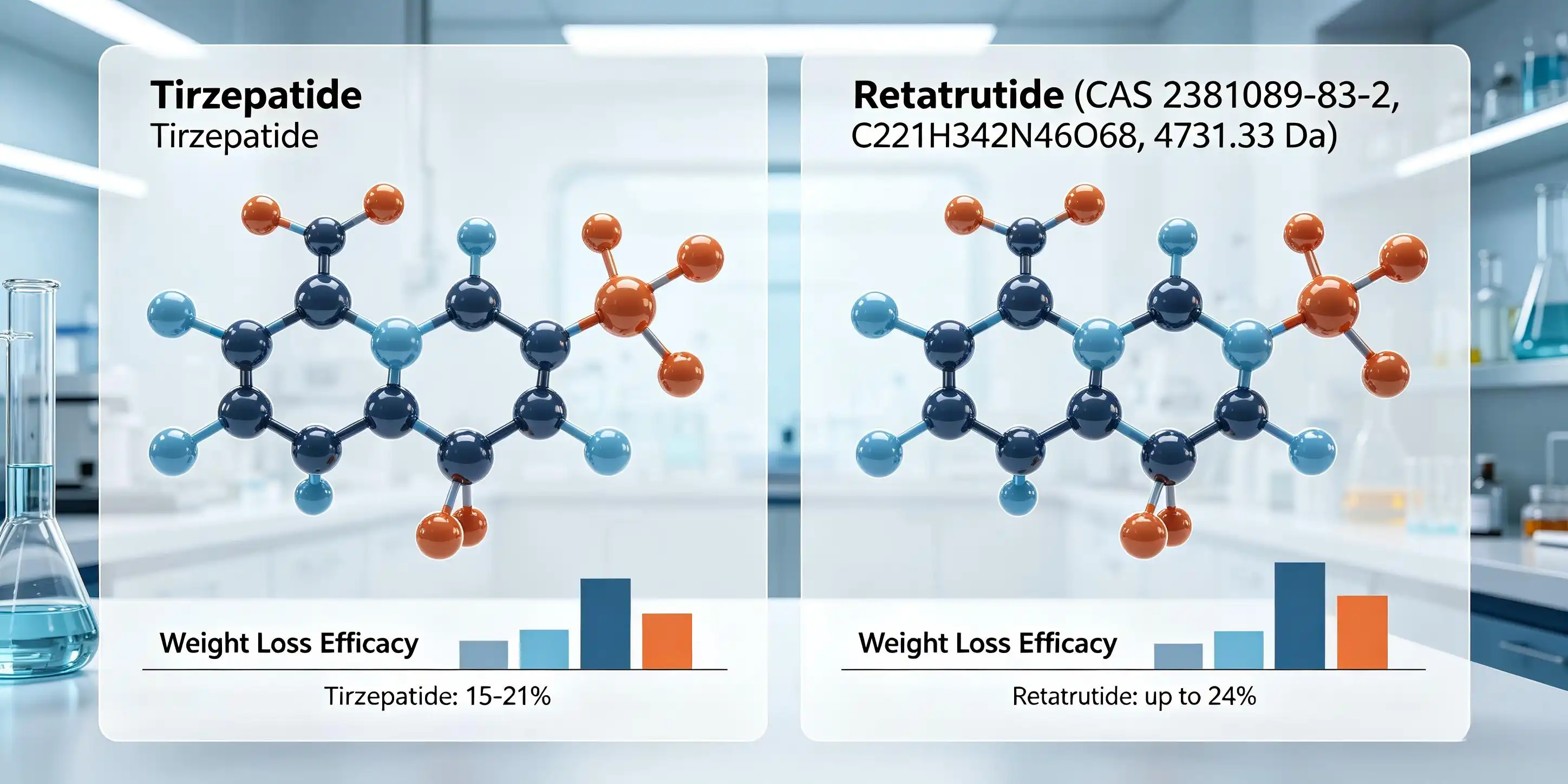
Retatrutide has a complicated 34-amino acid sequence that is intended to bind to receptors most efficiently across three pathways. This is shown by its molecular structure (CAS 2381089-83-2, molecular formula C221H342N46O68). With a molecular weight of 4731.33 Da, it is very stable when stored in a controlled environment. In phase 2 studies, people who took Retatrutide lost up to 24% of their body weight over 48 weeks, which was more than the 15–21% loss that people who took Tirzepatide experienced in the same time frame.
Tirzepatide has a well-known clinical description and is approved by the FDA to treat type 2 diabetes. This is used as a standard to show that it works. However, Retatrutide's extra glucagon agonism may provide better metabolic flexibility. This is especially important for formulation scientists working on combination treatments or researching NASH uses where lipid metabolism is a key factor.
Clinical Development Status
Tirzepatide has been through a lot of Phase 3 studies and has been approved by regulators in a number of markets. This gives buying teams the benefit of already existing safety data and manufacturing examples. Retatrutide is still in the later stages of clinical testing, with Phase 3 studies still going on. The timeline for growth changes things like the supply chain, the paperwork needed by regulators, and the laws about intellectual property. When drug companies look at these peptides, they have to weigh the safety of Tirzepatide against the chance that Retatrutide will give them a competitive edge once it is available to the public. Getting research-grade Retatrutide early on helps businesses make formulations and do preclinical studies that put them ahead of the curve when they enter the market.
Comparative Analysis: Retatrutide vs Tirzepatide Efficacy and Safety
Weight Reduction Efficacy
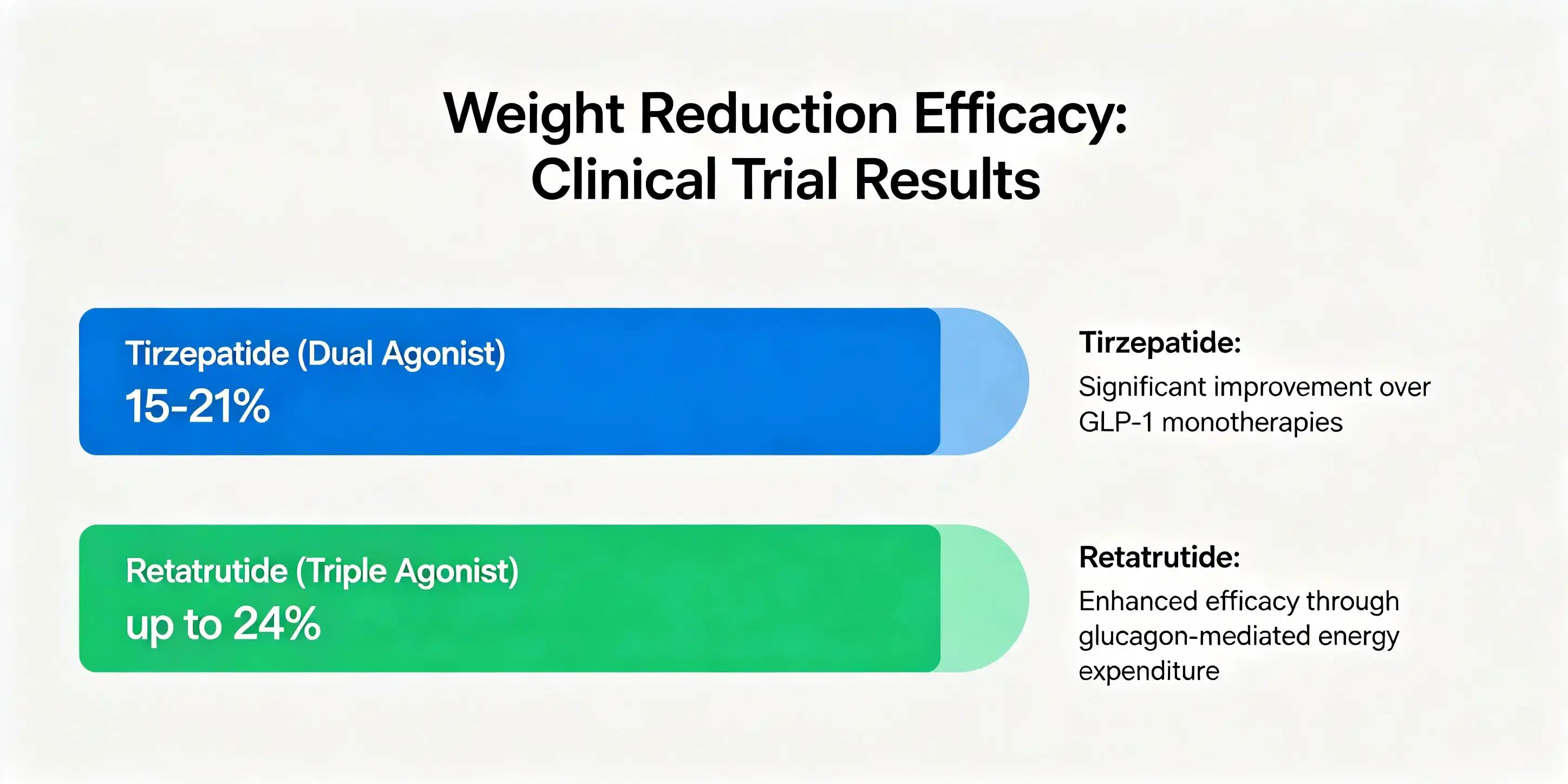
The results of clinical trials show that these peptides cause weight loss in different ways and at different rates. Tirzepatide's dual-agonist mechanism consistently reduces weight by 15–21% across different dosing schedules, which is a big improvement over standard GLP-1 monotherapies. In Phase 2 tests, Retatrutide's triple-agonist method led to weight loss of up to 24%, and some groups continued to lose weight past the points where Tirzepatide effects usually stop. This improved effectiveness comes from glucagon-mediated increases in energy usage that work with appetite reduction. This could help drug companies make their products stand out in markets that are already very crowded with obesity products. Even though the difference is small in terms of percentages, it has clinically important effects that affect prescriber choices and payment talks.
Glycemic Control Capabilities
Both peptides effectively lower HbA1c levels, with Tirzepatide showing 1.8 to 2.4% drops from the starting point in key studies. Retatrutide has similar effects on blood sugar levels, and early data suggests that the effects are about the same in terms of size. The benefit of Retatrutide is not that it better controls glucose levels, but that it does this while also making weight loss more effective through three different mechanisms.
This combination profile meets two important treatment goals that many diabetes people need. When quality managers look at these molecules, they should know that because the process is more complicated, they may need stricter purity standards and more thorough analytical testing methods to make sure that all batches of the molecules have the same receptor activation profiles.
Safety Profile Considerations
As with the GLP-1 mechanism class effect, gastrointestinal adverse events are still the biggest safety concern for both peptides. The safety database for Tirzepatide shows that the rates of nausea, vomiting, and diarrhea are managed when doses are increased according to normal guidelines. The current studies for Triple agonist peptide Retatrutide have shown similar tolerability profiles. However, the glucagon component raises theoretical worries about glucose levels rising in some groups.
Different risk management methods are used. For example, because glucagon changes the metabolism, Retatrutide patients who already have liver problems need more careful tracking. When putting together proposals, regulatory affairs teams need to take these details into account. Both molecules seem to have good safety ratings for cardiovascular systems, which is a very important thing for buying teams that work in therapeutic areas that focus on cardiovascular systems.
Procurement Insights: Where and How to Buy Retatrutide and Tirzepatide Peptides
Supplier Qualification Criteria
To find suppliers of research-grade peptides, you have to go above and beyond the normal steps for buying chemicals. To be qualified, producers must show they know how to make peptides and have proof that their products are HPLC pure (>98%) and have a peptide content of >80%. These standards make sure that the biological activity stays the same. GMP certification is still needed for pharmaceutical uses, and ISO certification gives research institutions basic quality guarantee. Suppliers should give full analytical paperwork, such as a Certificate of Analysis with thorough chromatogram data, an MSDS, and impurity profiles that are unique to each run.
Due to the complexity of multi-agonist peptides, it is very important to check the sequence carefully. Even small changes like one amino acid can have big effects on how the receptor binds to it. As these peptides need to be stored between 2 and 8°C throughout the delivery network, procurement managers should make sure that providers use controlled cold chain logistics.
Regulatory Documentation Requirements
Getting peptides from one country to another means navigating complicated legal systems. Export paperwork needs to have the right HS codes for research peptides, end-user certificates proving they will only be used for research, and, if needed, country-specific import permits. Pharmaceutical firms that are working on commercial formulations need providers that can give them Drug Master Files or other regulatory support documents that are similar. The different regulatory statuses of approved Tirzepatide and experimental Retatrutide have a big impact on the process of getting them.
When buying Tirzepatide to make a generic version, it's important to keep an eye on patents and possible freedom-to-operate issues. Getting Retatrutide for research reasons is regulated by rules for study chemicals and usually needs proof of an institutional review. Working with providers who know about pharmaceutical logistics makes sure that shipping methods are legal and that you get the right help with customs clearance.
Pricing and Supply Chain Dynamics
The price of a peptide depends on how hard it is to make, how pure it needs to be, and how much of it you buy. Due to difficulties in making them, research-grade multi-agonist peptides are currently selling for a lot more than they should. Buying in bulk usually saves you 15–30% on the price of orders that are measured in kilograms instead of grams. Stability in the supply chain is very important for businesses that are moving formulas through the development stages. When suppliers keep goods all year, research doesn't have to wait, and regular batch purchases can be made for long-term stability studies.
When it comes to lead times, different suppliers have very different times. For example, known manufacturers with dedicated peptide production plants can fill orders within days, while contract synthesizers may need weeks. To avoid being too dependent on a single seller, procurement teams should build ties with a number of qualified sources. This is especially important for important development projects.
Strategic Decision-Making: Choosing Between Retatrutide and Tirzepatide for Your Business Needs
Market Positioning Considerations
The fact that Tirzepatide is already on the market brings both possibilities and problems. Generic makers can use clinical data that has been proven to work and established reimbursement routes. However, patent landscapes are complicated and need to be carefully navigated. The molecule's success proves the multi-agonist method, which makes it easier to educate the market. Triple agonist peptide Retatrutide represents a chance for businesses that want to be the first to market with next-generation metabolic treatments to stand out.
Because it is still being studied, new formulations can be made without worrying about instant generic competition. Peptides that show metabolic benefits are becoming more popular in body shape and skin health products, and they are also being used in cosmetics. Medical beauty companies may find Retatrutide's better weight loss profile especially useful for making high-quality goods with a focus on effectiveness.
Application-Specific Suitability
Pharmaceutical R&D teams working on managing diabetes may find that Tirzepatide's proven safety and effectiveness make it a better choice for launching a product soon. People who want to treat obesity as a main issue, especially serious obesity that needs the most help, should look at Retatrutide's better weight loss potential. NASH is a very good area for using Retatrutide because glucagon's effects on fat metabolism directly affect how the disease works.
Researchers studying metabolic pathways can use both molecules to their advantage. Tirzepatide is a well-known comparison, and Retatrutide lets them look into how glucagon affects multi-receptor signaling. CRO/CDMO companies should think about keeping the ability to work with both peptides so they can meet the needs of a wide range of clients at all stages of development.

Future Market Trajectory
Analysts in the industry think that the markets for metabolic peptides will continue to grow until 2030. This is because more people are getting diseases and more people are accepting injectable treatments. Tirzepatide's economic success has shown that multi-agonist methods work, which has made investors want to buy next-generation molecules. Based on the progress made in Phase 3, Retatrutide is expected to hit the market within two to three years, provided that the trials go well. Buying early lets you work on formulations and intellectual property before they go on sale.
This can be done for delivery methods, combination medicines, or expanding the list of indications. Companies that build relationships with suppliers and learn how to make things now will be able to take advantage of market opportunities when governmental approvals come through. Given the huge unmet medical need in metabolic diseases, the competitive situation points to room for a number of different goods.
Building Trust and Ensuring Quality: Brand Reliability and Supplier Partnerships
Manufacturing Quality Standards
The quality of peptide production has a direct effect on the uniformity of batches and biological activity. Solid-phase peptide synthesis and strict processing steps used in advanced production methods make sure that the sequence is correct and there are few impurities. Heavy metal levels must stay below what is considered safe, especially in pharmacy settings where long-term contact is important. Moisture content control stops things from breaking down while they are being shipped or stored.
The behavior of formulations and how they dissolve are affected by the particle size distribution. Validated analytical methods and thorough testing processes from suppliers are the basis for quality assurance needed for controlled product development. As formulations move through the clinical stages and material similarity must be proven, batch-to-batch uniformity becomes more and more important. Triple agonist peptide Retatrutide, like any complex peptide active ingredient, requires particular attention to these factors to ensure consistent performance and regulatory compliance.
Documentation and Technical Support
Professional sellers are different from basic chemical vendors because they have full analytical paperwork. A Certificate of Analysis should be sent with every package. This should include HPLC chromatograms, mass spectrometry data showing molecular weight, peptide content measurement, and impurity profiling. The MSDS paperwork makes sure that the right steps are taken for safety reasons.
Suppliers who offer expert advice services are very helpful, especially when it comes to solving problems with formulation or finding the best storage conditions. Having access to regulatory support documentation speeds up applications and makes audits easier. It's impossible to say enough about the link between a supplier's technical knowledge and how efficiently they do business. Suppliers who understand the needs of pharmaceutical development will provide paperwork that meets legal requirements before they are asked to.
Long-Term Partnership Value
Metabolic peptide creation takes years, from the start of study to when the product is sold. Suppliers who can keep track of their stock well, provide regular quality, and respond quickly to customer service requests become very useful partners along this trip. Being able to go from milligrams for study to kilograms for business use while keeping the same quality standards means that you don't have to worry about switching suppliers in the middle of development.
Professional export knowledge makes sure that international processes run smoothly, which is important for global clinical trials and business launches in multiple markets. Anti-corrosion packaging, proper cold chain management, and full customs paperwork all show that operations are sophisticated enough to keep the purity of the product safe. Companies that build ties with their suppliers instead of buying peptides as a product gain a competitive edge through reliable supply chains and working together on technical issues.
Conclusion
There are more differences between Triple agonist peptide Retatrutide and Tirzepatide than just differences in how they work. There are also strategy differences in product development, regulatory routes, and market positioning. Tirzepatide has a well-known profile that offers quick opportunities with proven effectiveness. On the other hand, Retatrutide's triple-agonist mechanism offers unique opportunities for companies wanting to work with experimental molecules.
When making procurement choices, people have to weigh the needs for effectiveness against legal deadlines, the dependability of the supply chain, and business goals. Both peptides have strict requirements for suppliers, including proof of purity, proper paperwork, and GMP compliance. As the number of people with metabolic diseases rises around the world, these novel peptides are important tools for making new medicines. Companies that make strategic buying decisions today will be better prepared to compete in the market tomorrow.
FAQ
What is the primary difference between Retatrutide and Tirzepatide?
Tirzepatide works as a dual agonist, activating both GLP-1 and GIP receptors. Retatrutide adds glucagon receptor agonism, making a triple-agonist system. This extra route improves energy use and lipid metabolism in addition to Tirzepatide's benefits on controlling glucose and hunger.
How should research-grade peptides be stored?
Both peptides need to be kept at 2–8°C in cool, dry places that are away from light and moisture. When stored correctly, the structure and cellular activity stay the same throughout the shelf life, which usually lasts between 12 and 24 months in ideal circumstances.
What documentation should suppliers provide?
Full-service providers give Certificates of Analysis that include HPLC purity data, peptide content measurement, chromatograms, mass spectrometry confirmation, MSDS, and impurity profiles that are unique to each batch. For pharmaceutical uses, you need more GMP paperwork and regulatory support files.
Can these peptides be purchased for commercial product development?
Materials that are good for research are used for things like recipe development and preclinical tests. To make a commercial product, you need to work with GMP-certified makers who can give you pharmaceutical-grade materials along with all the necessary legal paperwork.
Partner with Xi'an Yihui for Premium Triple Agonist Peptide Retatrutide
Xi'an Yihui Bio-technology Co., Ltd. is a trustworthy company that can provide you with Triple agonist peptide Retatrutide. They have been making APIs for 13 years and are also good at making advanced peptides. Our research-grade Retatrutide (CAS 2381089-83-2) is ≥98.0% pure by HPLC and ≥80.0% peptide content, which meets the high standards needed for pharmaceutical R&D. Every package comes with full analytical paperwork, such as a COA, an MSDS, and thorough chromatograms that can help you with your quality control. We keep inventory all year, so we can quickly fill your orders whether they are for study purposes or in large quantities for long-term projects.
Our professional export team handles all aspects of foreign operations with ease, using legal shipping methods, professional packaging that is sealed, and full customs clearance help. We know what the world rules are for pharmaceutical materials because we serve companies in Europe, the United States, Japan, and South Korea. Get in touch with our technical team at sales@yihuipharm.com to talk about your specific needs and experience the supply chain dependability that has made us the partner of choice for new pharmaceutical companies that are working to advance research into metabolic diseases.
References
1. Jastreboff AM, et al. "Tirzepatide Once Weekly for the Treatment of Obesity." New England Journal of Medicine, 2022.
2. Rosenstock J, et al. "Retatrutide, a GIP, GLP-1 and Glucagon Receptor Agonist, for People with Type 2 Diabetes: A Randomised, Double-Blind, Placebo and Active-Controlled, Parallel-Group, Phase 2 Trial." Lancet, 2023.
3. Nauck MA, D'Alessio DA. "Tirzepatide, a Dual GIP/GLP-1 Receptor Co-agonist for the Treatment of Type 2 Diabetes with Unmatched Effectiveness." Cardiovascular Diabetology, 2022.
4. Frias JP, et al. "The Sustained Effects of a Dual GIP/GLP-1 Receptor Agonist on Metabolic Control and Body Weight." Diabetes Care, 2021.
5. Thomas MK, et al. "Dual GIP and GLP-1 Receptor Agonist for the Treatment of Type 2 Diabetes: Small Molecule and Peptide Approaches." Diabetes, Obesity and Metabolism, 2022.
6. Samms RJ, et al. "How May GIP Enhance the Therapeutic Efficacy of GLP-1?" Trends in Endocrinology and Metabolism, 2020.

Send Inquiry


Related Industry Knowledge
- The Role of Camostat Mesilate in Pancreatitis Treatment
- What Are the Benefits of Levomefolate Calcium for Pregnancy?
- What Are the Benefits of Omaveloxolone (RTA-408)?
- What is DL-alpha-Ketoisoleucine calcium used for?
- Is Ascorbyl Palmitate Safe?
- Is Ascorbyl Palmitate Toxic?
- Is vitamin k1 good for you?
- Can dapsone cause cancer?
- What are the side effects of phosphatidylserine?
- What Ingredients Can Burn Belly Fat?