
Palmitoyl Tripeptides-8 powder: Benefits, Uses, and More
Palmitoyl tripeptide-8 powder (CAS: 936544-53-5) is a synthetic signal peptide gaining serious traction across cosmetic formulation, medical aesthetics, and skin-sensitive product development. It works by modulating inflammatory mediators in the skin, specifically targeting substance P pathways to reduce redness, sensitivity, and barrier disruption. For B2B buyers—whether you are a skincare brand, OEM manufacturer, or procurement manager—understanding this ingredient's mechanism, application range, and sourcing standards can sharpen your product strategy and supply chain decisions considerably.
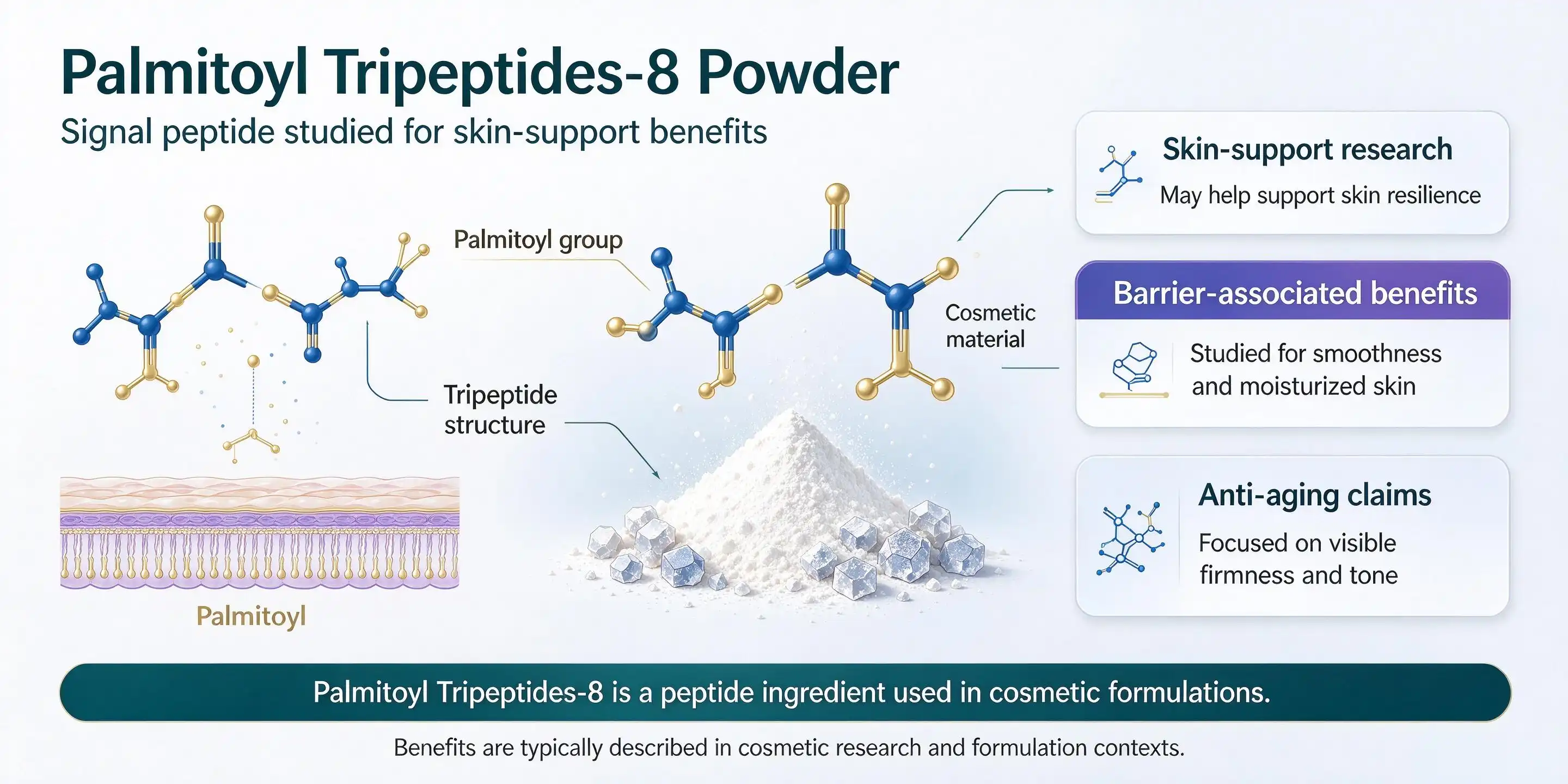
Understanding Palmitoyl Tripeptide-8: Composition, Mechanism, and Benefits
One chain of palmitoyl fatty acids is joined to a set of three amino acids to make palmitoyl tripeptide-8. Because it sticks to fat, the molecule can pass through the stratum corneum and into healthy skin layers. There, it can send molecular messages to the right places. Much less than the 500 Da absorption barrier is the molecular weight. It means that skin absorption is a real strength and not just something that is said to sell something.
How It Targets Inflammatory Pathways
Substance P is a neuropeptide that makes skin more sensitive and reactive and starts a chain of inflammation. The peptide stops substance P from being released. Researchers have looked into this mechanism and found that it works well to keep the skin from getting too red and overreacting to things like UV light, pollution, and changes in temperature.
Core Skin Benefits Backed by Science
You can divide the benefits of formulation study and source testing into four main groups:
- Anti-inflammatory action: The peptide calms irritated skin by interrupting substance P signaling, which directly reduces localized inflammation and discomfort without pharmaceutical-grade intervention.
- Reduced skin reactivity: It desensitizes nerve-mediated responses to external stressors, making it particularly effective in products designed for reactive or rosacea-prone skin types.
- Improved skin barrier function: Regular exposure strengthens the epidermal barrier, reducing transepidermal water loss (TEWL) and improving resistance to irritants commonly found in daily environments.
- Anti-aging texture improvement: By calming chronic micro-inflammation—a recognized driver of photoaging—it supports smoother skin tone and reduced appearance of fine lines over time.
Overall, palmitoyl tripeptide-8 powder helps even out skin tone and lessens the look of fine lines and wrinkles over time by lowering chronic micro-inflammation, which is known to lead to photoaging.
Comparing Palmitoyl Tripeptide-8 with Other Peptide Actives
When formulators know how this ingredient fits in with other widely used actives, they can make better decisions about how to mix it.
Palmitoyl Tripeptide-8 vs. Copper Peptide (GHK-Cu)
Collagen and wounds can heal faster with the help of copper peptides. Palmitoyl Tripeptide-8 is especially good at dealing with neurogenic inflammation. When you put them all together, they cover pathways that fix things and help control how sensitive they are. Because of this, they work well together as healing goods after surgery.
Palmitoyl Tripeptide-8 vs. Retinol
People with sensitive skin may find retinol unpleasant, even though it speeds up the turnover of cells. Because Palmitoyl Tripeptide-8 slows this reaction directly, formulation engineers often mix the two to make the best product that is both useful and safe for people to use. The mix has been in a number of expensive serums made to help sensitive and aging skin.
Synthetic Stability vs. Natural Extract Alternatives
The performance of synthetic palmitoyl peptides like palmitoyl tripeptide-8 powder, on the other hand, is consistent from batch to batch, they are pure, and they work reliably in complex emulsion systems. This is important for OEM makers who are making more products. A natural anti-inflammatory made from plant matter can have different parts depending on the harvest, but a man-made peptide that is ≥98% HPLC pure does not have that problem.
Procurement Guide: Sourcing Palmitoyl Tripeptide-8 Powder for Your Business
Making sure you get the right ingredients affects everything else, like how consistent the recipe is, how quickly you file the necessary paperwork, and how long the product lasts.
Certifications That Matter for Global Markets
Companies that sell to customers in the US, EU, and Asia should choose sellers who are certified by ISO9001, ISO22000, HACCP, HALAL, and KOSHER. Yuan Xiaohui holds all five of them. When a seller is being evaluated, they have to show production papers that are in line with GMP, a COA, and an MSDS for any uses that are related to cosmetics or drugs.
Logistics and Delivery Reality
Items that are ready to ship are kept by Xi'an Yihui in a nearby warehouse. Items can be delivered in one to three days. You can ship with DHL, FedEx, TNT, EMS, sea freight, or air freight. All of these options can handle both small R&D orders and large business volumes. Up to 50,000 grams can be supplied every month, so brand launches and production cycles with a lot of demand don't have to worry about wait times.
Integrating Palmitoyl Tripeptide-8 Powder into Your Product Line
A lot of people are interested in anti-aging serums, sensitive skin care, and healing goods after surgery in the US. Palmitoyl tripeptide-8 powder works well with formulation strategies that aim for these market groups.
Recommended Formulation Contexts
About 0.001% to 0.01% by weight is the range of amounts used in makeup. When the pH level is between 4.0 and 7.0, the ingredient works. It also stays stable in water-based emulsions and can be mixed with niacinamide, ceramides, hyaluronic acid, and signal peptide partners such as Palmitoyl Tripeptide-1 or Palmitoyl Tripeptide-5. It is called Palmitoyl Tripeptide-8 in the INCI list, and it can be used in both cosmetics and chemicals.
Market Positioning for Brand Owners and Distributors
With this ingredient, companies that sell cosmetics or skin care items for doctors can prove what they say in a way that can be tested. Some words like "clinically-targeted sensitivity relief" are used to describe the substance P blocking process, which is very appealing to people who buy dermatology products in shops and from pros. Because of this, the ingredient is different from other "soothing" actives, which helps retailers keep their profit margins in B2B markets across borders.
Staying Ahead of Peptide Market Trends
The beauty peptides market is estimated to be worth more than USD 1.2 billion by 2028. There will be a lot of growth in the neurogenic inflammation modulators field. By adding tried-and-true ingredients like this one early on, brands are ahead of the curve instead of behind it.
Conclusion
Palmitoyl tripeptide-8 powder addresses a specific and growing need in formulations: reducing neurogenic skin inflammation while promoting the barrier and anti-aging objectives of contemporary skincare. Because it works clearly, meets high quality standards, and uses common active ingredients, it's a good choice for companies in the pharmaceutical, medical esthetics, and cosmetic ingredient industries. For procurement and formulation teams looking for new actives, adding this raw material is a low-risk, high-reward move. It has scientific backing, paperwork ready for regulatory review, and a stable supply chain.
FAQ
Q1: Is it safe for all skin types, including reactive skin?
A: Yes. It's mostly used on skin that is sensitive or reacts badly. Because it stops substance P from being released, it lessens irritation instead of causing it. This means that it can be used on skin that has rosacea or has recently had surgery.
Q2: What is the recommended usage concentration?
A: It is usually added at a rate of 0.001% to 0.01% of the total weight of the paint. To measure the action in this range, there is no loss and no risk of over-formulation.
Q3: What is the shelf life and ideal storage condition?
A: It's said to last for two years. Keep the powder out of direct sunlight and in a dry, closed container between 2 and 8°C. Do not freeze and thaw.
Q4: Is it compatible with retinol or niacinamide?
A: Yes. It works well with retinol because it calms down the redness that retinol causes. When mixed, niacinamide and ceramide stay stable and work well with each other. It is possible to get a COA, an MSDS, and full specification sheets from Xi'an Yihui. The item meets all the requirements for ISO9001, ISO22000, HACCP, HALAL, and KOSHER. You can pay with T/T, LC, or DA.
Q5: What documents are available for regulatory review?
A: Xi'an Yihui provides COA, MSDS, and full specification sheets. The product meets ISO9001, ISO22000, HACCP, HALAL, and KOSHER standards. Payment terms include T/T, LC, and DA.
Request a Sample or Bulk Quote from Xi'an Yihui
People in over 100 countries have bought beauty peptide chemicals from Xi'an Yihui Bio-technology Co., Ltd. since 2010. We make reliable palmitoyl tripeptide-8 powder and can send out ≥98% pure powder within 1–3 days from stock. Every month, we can make 50,000 grams of powder. If you need a research-grade sample or a business large order, you can email our team at sales@yihuipharm.com to get full specs and start a sourcing conversation.
References
1. Lintner, K., & Peschard, O. (2000). Biologically active peptides: From a laboratory bench curiosity to a functional skin care product. International Journal of Cosmetic Science, 22(3), 207–218.
2. Katayama, K., Armendariz-Borunda, J., Raghow, R., Kang, A. H., & Seyer, J. M. (1993). A pentapeptide from type I procollagen promotes extracellular matrix production. Journal of Biological Chemistry, 268(14), 9941–9944.
3. Blanes-Mira, C., Clemente, J., Jodas, G., Gil, A., Fernández-Ballester, G., Ponsati, B., & Ferrer-Montiel, A. (2002). A synthetic hexapeptide (Argireline) with antiwrinkle activity. International Journal of Cosmetic Science, 24(5), 303–310.
4. Draelos, Z. D. (2011). The biology of hair care. Dermatologic Clinics, 29(4), 621–632.
5. Schagen, S. K. (2017). Topical peptide treatments with effective anti-aging results. Cosmetics, 4(2), 16.
6. Lodén, M. (2003). Role of topical emollients and moisturizers in the treatment of dry skin barrier disorders. American Journal of Clinical Dermatology, 4(11), 771–788.

Send Inquiry
You may like
Related Industry Knowledge