
Mazdutide vs Survodutide | Weight Loss Peptide Comparison
In a Mazdutide vs Survodutide weight loss peptide comparison, both molecules are once-weekly GLP-1/glucagon dual agonists, yet they differ in origin, development history, and published data. GLP-1 peptide Mazdutide (IBI362) is an oxyntomodulin analog, while Survodutide (BI 456906) comes from Boehringer Ingelheim. Trial design, dose, and analysis population differ, so no headline number proves one molecule is better. For US laboratories and B2B buyers, the right choice depends on the research question, batch documentation, and supply stability. I wrote this guide to help you compare both peptides and source research-grade material with clarity.
Mazdutide vs Survodutide: Mechanism and Development Status
Where Each Molecule Stands Today
Material labelling and handling depend on development state. Mazdutide (IBI362 or LY3305677) was developed at Eli Lilly and licensed to Innovent Biologics. China's authority authorised it for obese individuals in June 2025. Zealand Pharma created Survodutide, which Boehringer Ingelheim develops. With phase 3 obese SYNCHRONISE trials and MASH research, it remains experimental. At the time of writing, neither peptide had FDA clearance for US marketing. I buy these molecules as research material, not completed drugs, thus labels must say research use exclusively.
How the GLP-1 and Glucagon Pathways Work
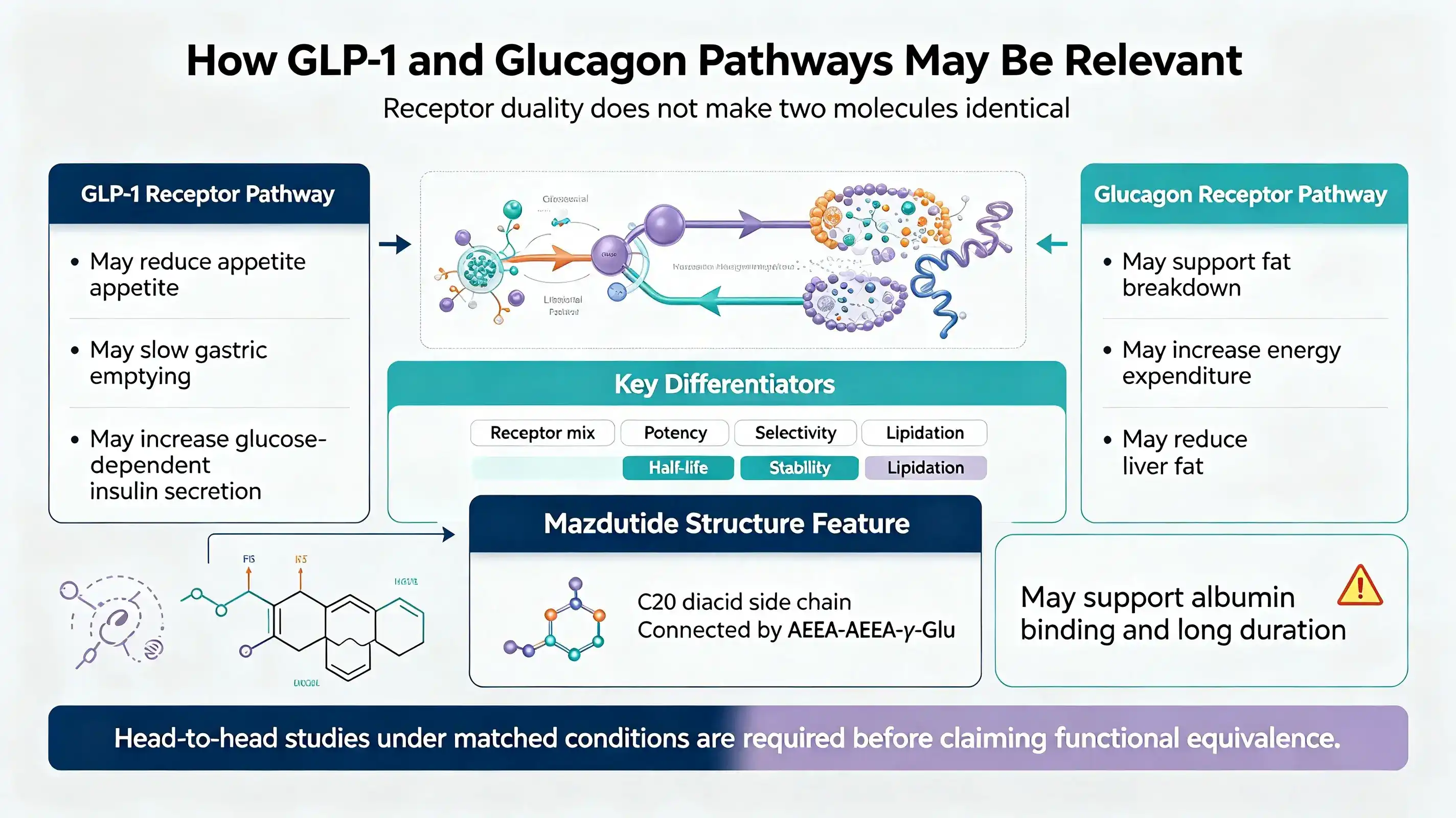
Both peptides activate 2 receptors. GLP-1 receptors reduce hunger, decrease stomach emptying, and increase insulin production when glucose levels are high. Early investigations found that glucagon receptor (GCG) signalling broke down fat, increased energy usage, and reduced liver fat. Together, these solutions reduce food waste and increase energy utilisation. Using one agonist might cause weight reduction plateaus. This may help. To examine combination receptor pharmacology in metabolic models, scientists employ GLP-1 peptide Mazdutide, a long-acting oxyntomodulin analogue.
What Receptor Duality Does Not Prove
Two molecules cannot be the same just because they share two targets. A test's results may be affected by receptor mix, strength, selectivity, half-life, and stability. Only side-by-side experiments under matched settings can indicate that peptides weighted toward glucagon activity and GLP-1 may behave differently in an energy consumption model. Lipidation matters. The Mazdutide sequence has a C20 diacid side chain connected by AEEA-AEEA-γ-Glu, promoting albumin binding and long-lasting effects. Teams should review receptor data for each batch before comparing pharmacology and avoid designating a winner based on mechanism alone.
Weight-Loss and Metabolic Research Evidence
Reading Body-Weight Results Carefully
Without context, headline percentages mislead. Treatment duration, dosage escalation, participant features, endpoint criteria, and analysis population affect the number. The Lancet Diabetes & Endocrinology survodutide phase 2 obesity study revealed varying weight-loss numbers depending on whether all randomised individuals were counted or just those who continued on medication. For GLP-1 peptide Mazdutide, the New England Journal of Medicine GLORY-1 study in Chinese adults recruited a varied demographic every time. Ask each study four questions: It ran how long? Those who joined? Which estimand was used? Many discontinued treatment?
Evidence Gaps to Track
Both compounds have unanswered questions. We need further evidence on long-term safety, weight reduction following therapy, body composition changes, and outcomes beyond the examined groups. Since nausea and other gastrointestinal symptoms are prevalent with GLP-1-based medications, tolerability and cessation must be considered. Liver study offers another perspective. The New England Journal of Medicine published a phase 2 survodutide experiment in MASH in 2024, and Mazdutide's impact on hepatic fat is still being studied. ClinicalTrials.gov and current peer-reviewed articles should be checked before each project since fresh data arrives.
How They Compare with Semaglutide and Tirzepatide
Profiles are different when different mixtures of receptors are used in experiments, and trial results rarely transfer between molecules. In the STEP 1 trial, semaglutide 2.4 mg produced a mean 14.9% weight loss over 68 weeks versus 2.4% with placebo. In SURMOUNT-1, tirzepatide 15 mg reached 20.9% over 72 weeks versus 3.1% in SURMOUNT. Because those studies were shorter, had different participants, and used different methods, I treat the numbers as context, not as a ranking.
| Peptide | Receptors | Status |
|---|---|---|
| Semaglutide | GLP-1 | Approved |
| Tirzepatide | GLP-1/GIP | Approved |
| Mazdutide | GLP-1/GCG | Approved in China; research material elsewhere |
| Survodutide | GLP-1/GCG | Investigational |
Each of these peptides still needs identity, purity, and assay documentation before lab use.
How to Choose Between Mazdutide and Survodutide for Research
Start with the Research Question
Selection starts with application, not brand. Assays for receptor binding and cell-based signalling must be identified and potent. Pharmacokinetic investigations need steady, well-characterized batches. Because switching batches midway introduces unpredictability, obesity and liver models require constant supplies throughout the trial. For method development and validation, analytical teams require reference-grade material. Before requesting quotations, write out endpoint, species or cell system, dosage range, and quantity. This short brief helps a provider match grade and format and prevents batch variances.
Match the Product Format
Formats serve different purposes. Lyophilized Mazdutide peptide powder suits assay work and formulation screening, because you control reconstitution. Analytical standards fit method validation, where known content matters most. Bulk material fits long programs that consume many grams. Custom synthesis fits projects that need a modified sequence or a labeled analog, and you should state those needs in your inquiry. Xi'an Yihui offers Mazdutide in 1 g, 100 g, and 1 kg bags with a 1 g minimum order, so a lab can start with a small sample and scale up after the first results look right.
Use Both in Comparative Studies
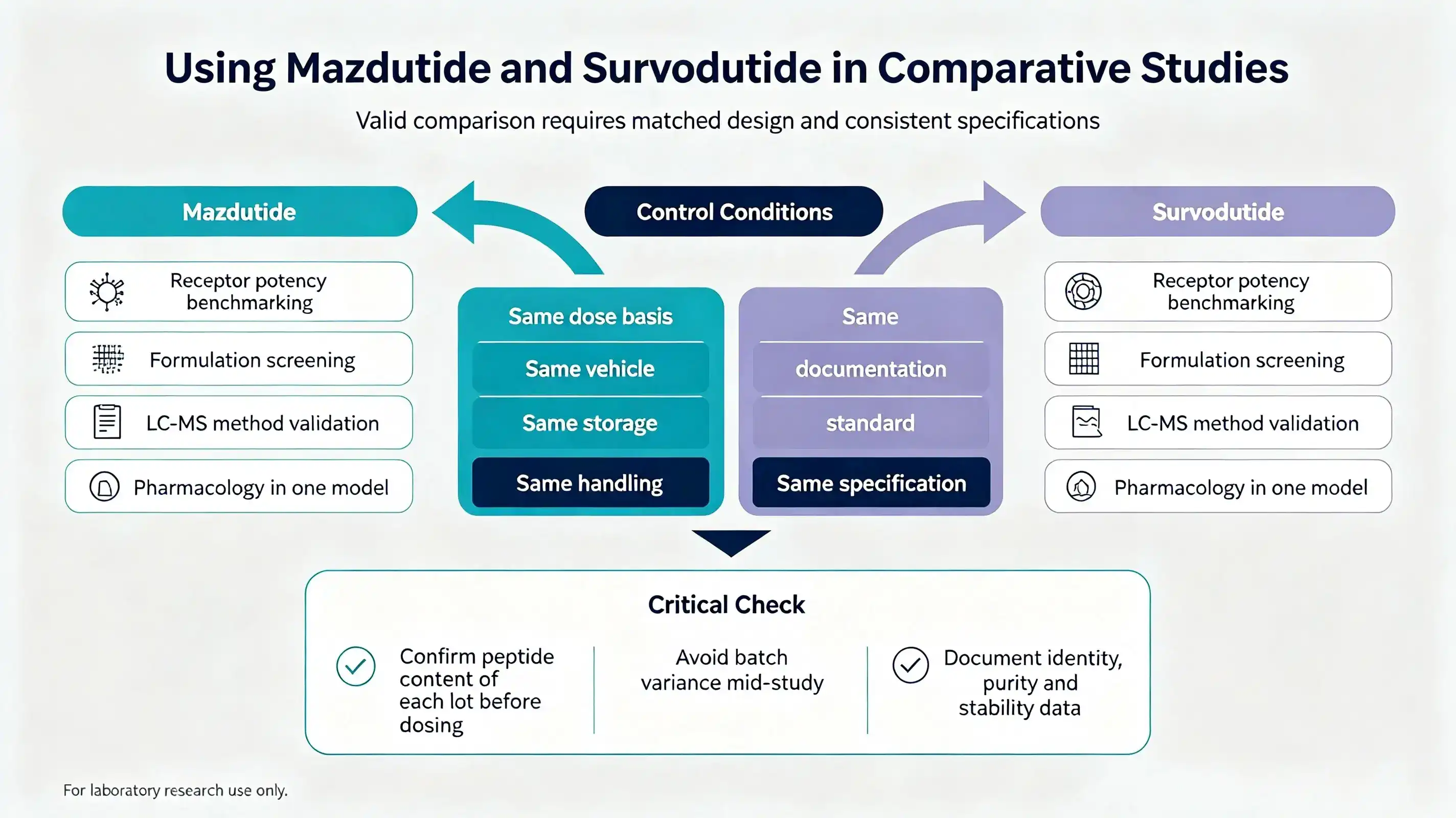
Some projects benefit from running both peptides side by side, including GLP-1 peptide Mazdutide. Benchmarking receptor potency, screening formulations, validating an LC-MS method, and comparing pharmacology in one animal model all call for a matched design. Keep dose basis, vehicle, storage, and handling identical for each compound, and apply one documentation standard to both lots. The comparison stays valid only if both materials meet the same specification. I suggest confirming the content basis of each lot before dosing, since a mismatch in peptide content can shift a dose-response curve without anyone noticing.
Quality Requirements for Weight Loss Peptides
Identity and Purity Testing
Research peptides must first verify their identity. Molecular-weight confirmation by mass spectrometry, sequence or structural information, and chromatographic identification verification are the foundation. Impurity profiling reveals deletion sequences and degradation products after HPLC reports purity. These impurities affect receptor function in long lipidated peptides like Mazdutide while structural alterations are minor. Our Mazdutide specification requires 98.0% HPLC purity and 99% assay. Request your lot's chromatogram and mass spectrum, not a general specification page.
Purity Is Not the Same as Assay
Buyers often mix up two numbers. HPLC purity is an area percentage: it shows how much of the detected signal belongs to the target peptide. Assay, or content, reflects how much active peptide sits in the weighed powder after water, counterions, and other non-peptide mass are counted. Two lots can show the same HPLC purity yet differ in content, which changes your actual dose. Write both values into your purchase specification and your lab record. Also request a Certificate of Analysis, a specification sheet, traceability details, storage instructions, and research-use-only labeling for each batch.
Storage, Shipping, and Handling Checks
Peptides can degrade quietly. Store lyophilized Mazdutide at -20°C, protected from light, and keep it sealed until use. Repeated freeze-thaw cycles and long periods after reconstitution can affect stability, so aliquot after dissolving and run an in-use stability check for your own buffer and timeline. At receiving, inspect the packaging, record the lot number and arrival condition, compare the label with the COA, and quarantine any lot that fails a check until QA reviews it. A short written checklist covering identity, purity, assay, storage, and documents keeps approvals consistent across multiple labs.
Supplier Evaluation and Procurement for Global B2B Buyers
Questions to Ask Before You Order
A good quotation request saves weeks. Ask about HPLC purity, assay basis, analytical reports, minimum order quantity, lead time, packaging, and batch-to-batch matching. Ask how the supplier ships temperature-sensitive material and which export documents travel with the shipment. Then compare total landed cost, not unit price alone: add freight, customs handling, replacement terms, and the cost of a failed batch. US buyers should also confirm that the supplier understands research-use-only labeling and does not sell to individuals. A supplier that answers these points in writing before the first order usually handles problems the same way later.
Common Mistakes When Buying Weight Loss Peptides
Several errors appear again and again when sourcing GLP-1 peptide Mazdutide. Teams treat Mazdutide and Survodutide as interchangeable because both are dual agonists. They compare clinical outcomes without reading the study design. They pick a supplier on price alone and later discover missing documents. They confuse research-grade material with an approved drug product, which creates compliance risk. A quieter mistake is ignoring shipping and storage conditions until the box arrives warm. Each error is avoidable with lot-specific documentation, controlled receiving, validated handling, and a clear intended-use statement on every purchase order.
Mazdutide Specifications from Xi'an Yihui
Xi'an Yihui has served international buyers since 2010 and sells to more than 100 countries, with ISO, Halal, and Kosher certifications. Here are the specifications for our GLP-1 peptide Mazdutide:
| Item | Specification |
|---|---|
| Product name | Mazdutide |
| CAS number | 2259884-03-0 |
| Molecular formula | C₂₀₇H₃₁₇N₄₅O₆₅ |
| Molecular weight | 4476.00 Da |
| Purity (HPLC) | ≥98.0% |
| Assay | 99% |
| Sequence | His-Aib-Gln-Gly-Thr-Phe-Thr-Ser-Asp-Tyr-Ser-Lys-Tyr-Leu-Asp-Glu-Lys-Lys-Ala-Lys-(AEEA-AEEA-γ-Glu-diacid-C20)-Glu-Phe-Val-Glu-Trp-Leu-Leu-Glu-Gly-Gly-Pro-Ser-Ser-Gly-NH₂ |
| Appearance | White to off-white lyophilized powder |
| MOQ | 1 g |
| Package | 1 g/bag, 100 g/bag, 1 kg/bag |
| Storage | -20°C, protected from light |
| Delivery | In stock, immediate shipment |
| Usage | Scientific research only; no sales to individuals |
These details let your QA team check the material against your own specification before you place an order.
Conclusion
Mazdutide and Survodutide are once-weekly GLP-1/glucagon dual agonists with different development histories, regulatory statuses, and published data, and GLP-1 peptide Mazdutide has its own unique profile. Every outcome is influenced by receptor balance, potency, stability, trial design, and analytic population, not mechanism. Comparisons between semaglutide and tirzepatide provide background but not a rating. The best research tool relies on the experimental question, product format, and lot-specific evidence. Data reproducibility depends on identity, HPLC purity, test, storage, and traceability. Supplier assessment must incorporate paperwork, landed cost, and supply continuity, not just unit pricing.
FAQ
Are Mazdutide and Survodutide the same molecule?
No. Both target the GLP-1 and glucagon receptors, but they are separate peptides with different sequences, sponsors, and clinical programs.
Can I pick a winner from published weight-loss data?
Not at all. It is not possible to say which study is the clear winner because they are different in duration, population, dose, and analysis method. The only way to compare them fairly is if the experiments are matched.
How does Mazdutide differ from semaglutide and tirzepatide?
Semaglutide only works on GLP-1 receptors, but tirzepatide also works on GIP receptors. Mazdutide activates GLP-1 and glucagon receptors, which adds an energy-expenditure and liver-fat angle in preclinical work.
What documents should I request with research-grade Mazdutide?
Ask for a Certificate of Analysis, HPLC and mass spectrometry data, a specification sheet, storage instructions, and traceability records. Availability, packaging, and quantity depend on batch and intended use. Xi'an Yihui sells Mazdutide for scientific research only and cannot sell to individuals.
Request a Mazdutide Specification and Quotation from Xi'an Yihui
Xi'an Yihui supplies research teams with GLP-1 peptide Mazdutide, and as a GLP-1 peptide Mazdutide supplier, we ship 1 g, 100 g, and 1 kg bags from stock. Send sales@yihuipharm.com your desired amount, purity, the paperwork you need, and where you'd like the package sent. Our customer service team will prepare your quotation as soon as they can. Visit yihuipharm.com to find out more. Research use only; no sales to individuals.
References
1. New England Journal of Medicine (2025). Mazdutide in Chinese Adults with Obesity or Overweight (GLORY-1 trial).
2. The Lancet Diabetes & Endocrinology (2024). Glucagon and GLP-1 receptor dual agonist survodutide for obesity: a randomised, double-blind, placebo-controlled, dose-finding phase 2 trial.
3. New England Journal of Medicine (2024). A Phase 2 Randomized Trial of Survodutide in MASH and Fibrosis.
4. New England Journal of Medicine (2021). Once-Weekly Semaglutide in Adults with Overweight or Obesity (STEP 1).
5. New England Journal of Medicine (2022). Tirzepatide Once Weekly for the Treatment of Obesity (SURMOUNT-1).
6. Molecular Metabolism (2019). Glucagon-like peptide 1 (GLP-1).

Send Inquiry
You may like
Related Industry Knowledge