
Ipamorelin Dosage Guide: Optimal Protocols for Recovery and Muscle Growth
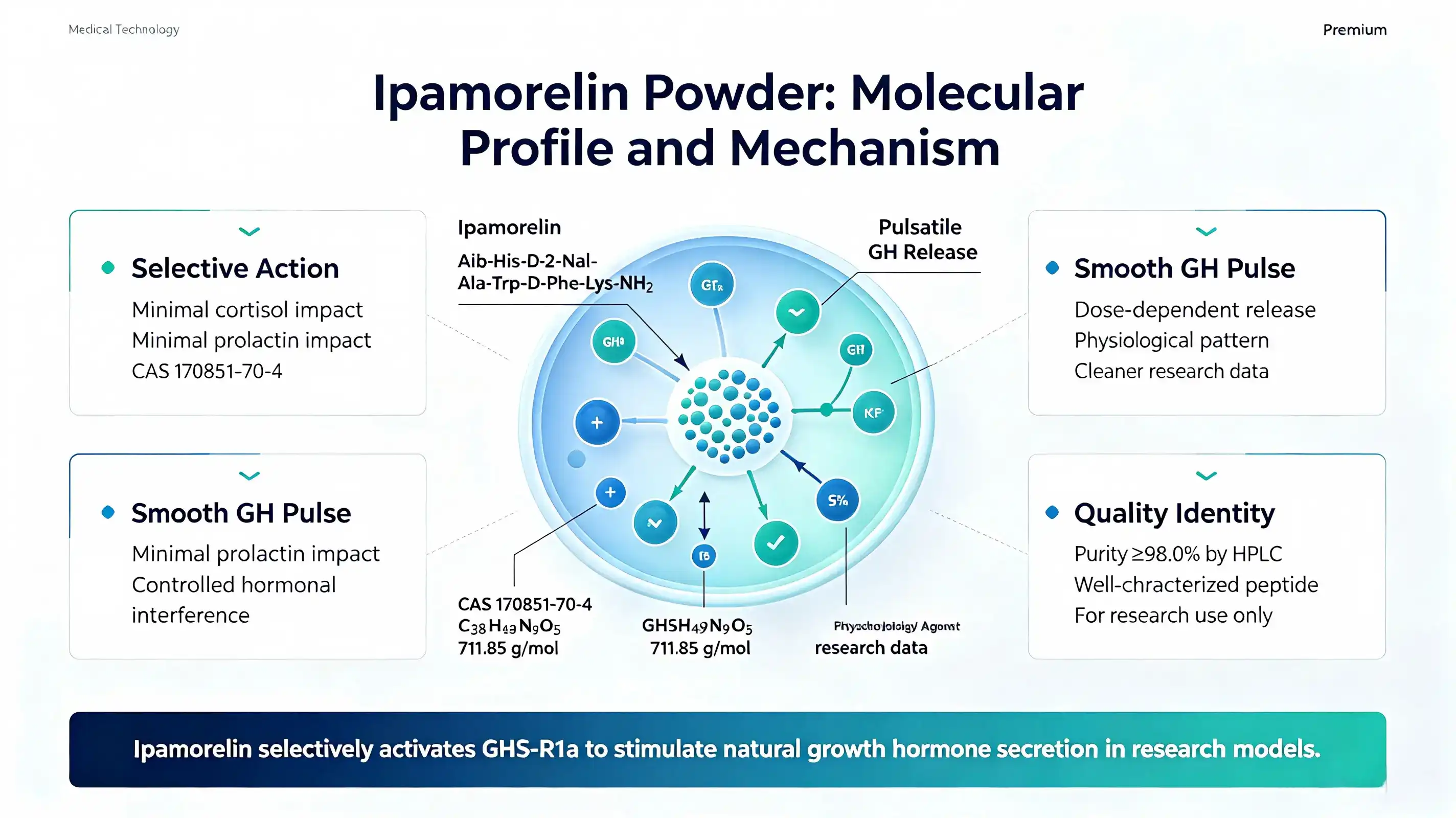
Ipamorelin powder (CAS 170851-70-4) is a selective pentapeptide growth hormone secretagogue used extensively in pharmaceutical research, metabolic studies, and muscle recovery investigations. With a molecular formula of C₃₈H₄₉N₉O₅ and a purity of ≥98.0% by HPLC, it offers researchers a precise, well-characterized compound for studying pulsatile GH release. Unlike older generation peptides, ipamorelin stimulates growth hormone secretion without meaningfully raising cortisol or prolactin levels. This guide presents current dosage protocols, a comparative breakdown against similar peptides, and practical sourcing guidance for B2B buyers across pharmaceutical, biotech, and clinical research sectors.
Understanding Ipamorelin Powder: Mechanism and Benefits
What Is Ipamorelin at the Molecular Level?
The chemical name for ipamorelin is Aib-His-D-2-Nal-Ala-Trp-D-Phe-Lys-NH₂, and its molecular weight is 711.85 g/mol. It works as a specific ghrelin receptor agonist, attaching to the GHS-R1a receptor on the anterior pituitary to produce natural GH. Because it is selective, it doesn't really affect adrenal pathways. This makes it a good choice for research models that need to control hormonal interference.
How It Compares to Earlier Secretagogues
Older GH-releasing peptides, such as GHRP-6, use hypothalamus ghrelin receptors to make you hungry. At normal research concentrations, ipamorelin doesn't have this effect on making you hungry. Studies that were published in the Journal of Endocrinology show that ipamorelin creates a smooth, dose-dependent GH pulse without the cortisol or ACTH jumps that are common with GHRP-2. Researchers can get better data and formulators can be more sure of what will happen because of this choice.
Research Benefits Across Therapeutic Areas
Ipamorelin is useful for many types of study because it can mimic normal pulsatile GH secretion. Metabolic studies that have been published show that it helps keep lean tissue and speeds up cell repair in preclinical models. Researchers studying anti-aging have seen higher levels of collagen synthesis markers in studies of rodents. On the other hand, researchers studying muscle healing have seen faster return to baseline in muscle protein turnover assays. Ipamorelin powder is a useful tool for research and development teams working in endocrinology, regenerative medicine, and sports science because of these well-known properties.
Optimal Dosage Protocols for Ipamorelin Powder
Standard Dose Ranges in Research Models
Based on published experimental and clinical research, the usual amount of ipamorelin given to humans is between 200 and 300 mcg. Some protocols go up to 300–500 mcg for certain uses, like recovering from surgery or doing a lot of research on metabolism. Dosing must be scaled correctly for laboratory research models based on the weight of the subject and the outcome being studied. Researchers should always use protocols that have been tested and shown to work with their target model.
Timing and Administration Frequency
Two times of delivery reliably show the highest GH pulse response: right after exercise and 30 to 60 minutes before bed. doses before bedtime matches the normal rise in GH at nite, while doses after a workout matches higher receptor sensitivity in skeletal muscle tissue. Most methods that have been published use one to two doses per day for 8 to 12 weeks of study rounds. To mix the lyophilized powder again, you can use sterile bacteriostatic water or phosphate-buffered saline (PBS), which keep the pH stable and the integrity of the peptides.
Safety Considerations and Known Side Effects
The side effects of ipamorelin aren't as bad as those of most GHS chemicals. People in studies say that higher doses give them temporary flushing or light headaches, which is thought to be because the GH pulse starts quickly. Sometimes, water retention is seen. At standard doses, there has been no significant change seen in cortisol, prolactin, or ACTH. This is a big plus for long-term study designs. Before adding any peptide compound to active protocols, researchers should look at their institution's safety rules and any relevant regulatory frameworks.
Comparative Analysis: Ipamorelin vs Other Peptides and HGH
Ipamorelin vs GHRP-6 and GHRP-2
GHRP-6 and GHRP-2 both cause GH to be released, but they also have clear side effects. Hypothalamic ghrelin communication is what makes GHRP-6 strongly increase hunger. Cortisol and prolactin levels rise when GHRP-2 is present. Ipamorelin powder doesn't have either of these effects, which makes it a better choice for research designs that need to change GH levels without affecting other hormones. This difference has a direct effect on the reliability of data that comes after for B2B buyers who are looking for peptides for endocrine study kits.
Ipamorelin vs CJC-1295 and Sermorelin
The mechanisms by which CJC-1295 and sermorelin work are different because they use the GHRH receptor pathway instead of the ghrelin receptor. Many researchers mix ipamorelin and CJC-1295 to get a better result on the intensity and length of GH pulses. This mix has been shown to work in several published pharmacology studies. Sermorelin's half-life is shorter and its binding to receptors is weaker than CJC-1295's. This makes it less useful for studies that want to look at long-term GH elevation. Ipamorelin is a good anchor molecule for these kinds of combination treatments because it has a clean receptor profile.
Ipamorelin vs Exogenous HGH
Recombinant human growth hormone (HGH) raises GH levels continuously and not in waves, which is different from how the body normally secretes GH. Clinical research has shown that this flat GH curve is linked to more side effects, such as edema, joint pain, and insulin resistance. Ipamorelin keeps pulsatile GH characteristics, which experts say is a better reflection of how things work in the body. This difference has direct effects on both safety profiling and regulation paperwork for formulation companies and clinical R&D teams that are making regenerative medicine programs.
Procuring Ipamorelin Powder: What B2B Buyers Need to Know
Evaluating Supplier Quality Standards
Quality documentation is a must when looking for peptide raw materials. A reliable source of ipamorelin powder must offer a full Certificate of Analysis (COA) that includes RP-HPLC purity data, an ESI-MS identification proof, and endotoxin test results for use in cell culture. It should be made clear which form of acetate is better than the TFA salt form, because TFA residues can be harmful to cells in sensitive biology tests. For pharmaceutical-grade buying, production must be ISO-certified and follow good manufacturing practices (GMP).
Before placing an order, procurement managers should check the following core pieces of documentation:
- COA with HPLC chromatogram: Confirms purity ≥98.0% and identifies any single impurity above 0.5%.
- ESI-MS report: Verifies molecular identity and screens for truncated sequences or synthesis byproducts.
- Endotoxin/bioburden testing report: Required for cell-culture and in vivo research applications.
- Salt form declaration: Acetate salt is preferred in most research applications due to lower cytotoxicity compared to TFA.
These papers keep the buyer's compliance record safe and the accuracy of research data sent further down the line. One very common mistake we see in the B2B peptide market is skipping this step of proof.
Packaging, Storage, and Logistics
Ipamorelin powder comes in 1g, 100g, and 1kg bags so that it can be bought in a variety of amounts. For long-term safety up to 24 months, storage at -20°C in a dry, sealed space is needed. In its lyophilized state, the substance stays stable at room temperature for two to four weeks, which means it can usually be shipped internationally without the need for a cold chain. The best way to handle larger orders is still through cold-chain logistics.
Pricing and Minimum Order Considerations
For research-grade ipamorelin, the minimum order quantity (MOQ) starts at 1g, which makes it easier to do initial feasibility studies without having to worry about money. For CRO teams and delivery platforms that handle bigger supply amounts, bulk prices for 100g and 1kg orders can save them a lot of money. Purity grade, synthesis complexity, and batch consistency are some of the things that affect how much a peptide costs, not just the cost of the raw materials.
Implementing Ipamorelin Therapy in Business and Clinical Settings
Application in Clinical Research Programs
Ipamorelin-based protocols have been used in GH deficiency studies and tissue repair studies by medical esthetics clinics, CRO companies, and university research departments. Because it has a clean hormonal profile, it is easy to include in IRB and regulatory reports. It has been used by CDMO clients as the main ingredient in research kits that study metabolic balance and sarcopenia models.
OEM and Distribution Integration
Ipamorelin is very consistent from batch to batch, which is good for trading companies and OEM formulators who are building product lines around GH research compounds. If they get it from a GMP-compliant manufacturer, formulators working on regenerative medicine research kits or anti-aging ingredient panels can be sure that it will work. Stability data and proof of purity make regulatory applications easier in the U.S., the EU, and Japan, among other important markets.
Regulatory Positioning Across Markets
Ipamorelin is only allowed for study use in the U.S.; it is not FDA-approved for use in medicine. Buyers should check with their government to see what rules apply to importing and handling goods. As part of their regulatory filings, suppliers should include MSDS documents and, if needed, DMF-referenced technical packages. Compliance risk is greatly reduced when you work with a seller that has experience in a number of different legal settings.
Conclusion
Ipamorelin powder has a well-known, selective way of stimulating GH. This makes it a good chemical for pharmaceutical researchers, formulation engineers, and clinical R&D teams. It is better than older peptides because it has less off-target hormonal activity, has been shown to work with pulsatile GH dynamics, and has good safety data. These factors make it a good choice for both initial study and large-scale purchase. A research program will either succeed or fail based on three things: correct dosing, confirmed purity, and legal sourcing. For business-to-business buyers, investing in a qualified, well-documented supplier is a must—it's how they always get good results.
FAQ
Q1: How long does it take to observe measurable results in research models?
A: Researchers usually see changes in muscle protein synthesis markers that are statistically significant within 4–6 weeks of constant treatment in preclinical muscle healing studies. For anti-aging and metabolic endpoints, it usually takes 8–12 weeks to get solid results.
Q2: What distinguishes ipamorelin from other GH-releasing peptides in a laboratory setting?
A: Its main difference is that it can only bind certain receptors. Unlike GHRP-6 or GHRP-2, ipamorelin doesn't significantly activate the cortisol or appetite pathways. This makes it easier to understand data in situations with a lot of variables.
Q3: Is the acetate or TFA salt form preferred for cell-culture work?
A: It is better to use the acetate salt form. This is confirmed by ion chromatography, and research literature consistently shows that these residues are less harmful to cells than TFA residues in assays.
Q4: What is the shelf life of lyophilized ipamorelin powder?
A: Lyophilized ipamorelin powder stays stable for up to 24 months when kept at -20°C in a dry, sealed container. When the weather is room temperature, steadiness lasts for about two to four weeks.
Q5: Can ipamorelin be combined with other secretagogues in research protocols?
A: Yes, CJC-1295 is the most widely paired compound in the scientific literature. When used together, the two peptides produce stronger GH pulse reactions than when used separately.
Request a Sample or Bulk Quote — Xi'an Yihui Ipamorelin Powder Supplier
Since 2010, Xi'an Yihui Bio-technology Co., Ltd. has sold research-grade peptides to customers in over 100 countries. Our ipamorelin powder is ≥98.0% pure according to HPLC, we have it in stock, and it comes with full COA, MSDS, and chromatogram documentation. We can package your order in a way that works for you, whether you need 1g for a test study or kilograms for ongoing research projects. Our quality is ISO-certified, so you can prove it. You can get a price or sample right now by emailing sales@yihuipharm.com.
References
1. Bowers, C. Y. et al. "Ipamorelin, a New Growth-Hormone-Releasing Peptide." Journal of Endocrinology, 1998.
2. Raun, K. et al. "Ipamorelin, the First Selective Growth Hormone Secretagogue." European Journal of Endocrinology, 1998.
3. Nass, R. et al. "Evidence for Acyl-Ghrelin Modulation of Growth Hormone Release in Humans." Journal of Clinical Endocrinology & Metabolism, 2008.
4. Sigalos, J. T., & Pastuszak, A. W. "The Safety and Efficacy of Growth Hormone Secretagogues." Sexual Medicine Reviews, 2018.
5. Møller, N., & Jørgensen, J. O. L. "Effects of Growth Hormone on Glucose, Lipid, and Protein Metabolism in Human Subjects." Endocrine Reviews, 2009.
6. Walker, R. F. "Sermorelin: A Better Approach to Management of Adult-Onset Growth Hormone Insufficiency?" Clinical Interventions in Aging, 2006.

Send Inquiry
You may like
Related Industry Knowledge