
How Nonapeptide-1 Helps Control Melanin & Prevent Pigmentation Relapse
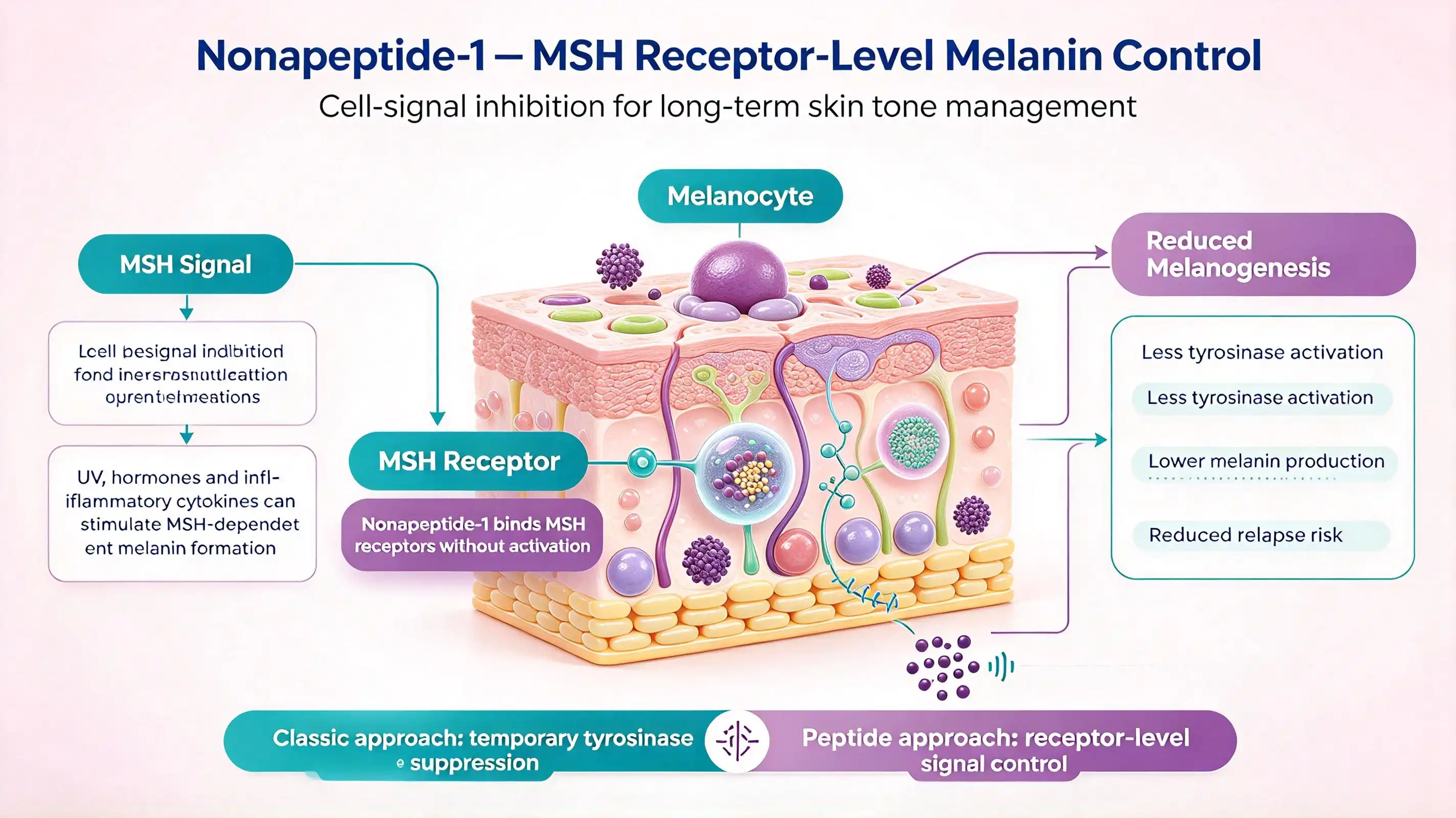
At the receptor level, Cosmetic peptide Nonapeptide-1 inhibits melanin formation. This ends painting and makes it less likely that the person will come back. Different from methods that only make the skin lighter on the surface, this peptide blocks the cell signals that cause melanogenesis. By keeping the production of melanin stable, it keeps the skin healthy and white for a long time. Nonapeptide-1 is very useful for high-end cosmetics that want to get rid of age spots and uneven skin tone because it works in this way.
Introduction
There are still a lot of hard things about medical skin care that are related to pigmentation. Melasma, which is caused by changes in hormones, and post-inflammatory hyperpigmentation, which is caused by acne, are always being looked for long-term solutions. A lot of the time, traditional bleaches only work for a short time before the color comes back within a few weeks of stopping use. Advanced peptide technology is being used more and more in the preparation business to get around these issues.
The Cosmetic peptide Nonapeptide-1 is a big step forward in reducing melanin because it gets to the root of the problem rather than just hiding it. B2B buyers, R&D formulators, and quality managers who are looking for ingredients for beauty lines that focus on usefulness need to know about this peptide's unique properties and how to get it. This is because they need to test their goods and make sure they follow the rules.
Understanding Nonapeptide-1 and Its Role in Melanin Control
The Science Behind Peptide-Based Melanin Regulation
It is made up of nine amino acids that are grouped in a way that stops melanogenesis at the level of the cells. On the other hand, Nonapeptides work on melanocyte-stimulating hormone (MSH) receptors instead of Tripeptide-1, which mostly involves copper to fix skin damage. There is an enzyme called tyrosinase that changes tyrosine into melanin. These receptors make it work. Cosmetic peptide Nonapeptide-1 binds to MSH receptors but doesn't turn them on, so it acts as a competitive suppressor. In addition to stopping the production of melanin, this does not change any other cellular processes.
Researchers have found that Cosmetic peptide Nonapeptide-1 works better than other tyrosinase inhibitors. Melanin levels drop noticeably after four to eight weeks of daily use, as shown in clinical tests. Due to its biomimetic shape, the peptide is very good at getting through the skin and being taken up by cells, which makes it more effective. This makes it a great ingredient for products that want to color the skin from the inside out instead of just the outside.
Molecular Properties and Technical Specifications
The molecular weight of Nonapeptide-1 is about 1206.5 Da, which is a good value for skin absorption. The formula for its molecules is C61H87N15O9S. When the peptide is made to cosmetic-grade standards, high-performance liquid chromatography (HPLC) can be used to make it more than 98% pure.
The net peptide content is usually above 80%, and the counter-ion levels are kept at a level that doesn't hurt the skin, according to lab results from good providers. The powder form looks like a lyophilized, off-white substance that soaks up water and needs to be kept carefully to stay stable.
Because it dissolves in water and stays steady at pH levels between 4.0 and 8.0, the peptide is easy to add to preparation steps that are mostly water. It can be used for many kinds of products because of this, from toners and serums to creams that are based on emulsions. Tests on bacterial endotoxin show that it is safe for mesotherapy-grade uses, with limits kept below 50 EU/mg to keep the immune system from reacting. These technical factors have a direct impact on how well the recipe works and how safe the end product is. This is why checking the specs should be your first step when you buy something.
Challenges in Pigmentation – Causes and Relapse Mechanisms
Why Pigmentation Returns After Treatment
Melanin is made as a defense against many things, like UV light, inflammation cytokines, and changes in hormone levels. The melanocytes in your skin can start melanogenesis all over again if these things happen again, even after the color has faded. Some common whitening agents, like hydroquinone or kojic acid, stop tyrosinase activity for a short time but don't stop the signals that start the production of melanin.
Most normal treatments only stop enzymes from working, which stops the production of melanin. This is what causes the return effect. Even after the drug stops, the MSH receptors will still work properly and respond to outside cues. When hormones like estrogen and progesterone change, melanocytes can work even when they are not in UV light. Post-inflammatory hyperpigmentation is often brought on by swelling after laser or chemical peel treatments. This happens because keratinocytes that are damaged release cytokines that begin melanogenesis as a way for the area to heal.
How Advanced Peptides Prevent Relapse
As long as there is enough of it in the skin, Cosmetic peptide Nonapeptide-1 firmly binds to MSH receptors, breaking this loop. This stopping action keeps activity signals from reaching melanocytes, even if there is a reason from outside the cell. Blocking at the receptor level gives you more power than blocking enzymes, which melanocytes can get around by making more tyrosinase. Studies have shown that peptide-based products reduce melanin for longer after treatment ends than arbutin or kojic acid with the same amount of treatment.
Since the peptide is safe, it can be used for a long time without the side effects of hydroquinone, such as discoloration or loss of color. Your immune system or wounds can still heal normally while it's being used, so it can be used on sensitive skin or to care for you after surgery. This mix of safety and efficiency makes it easy for medical beauty cosmetics brands to stand out in areas that are already very crowded.
Nonapeptide-1 vs Other Popular Cosmetic Peptides and Ingredients
Comparative Analysis with Other Peptides
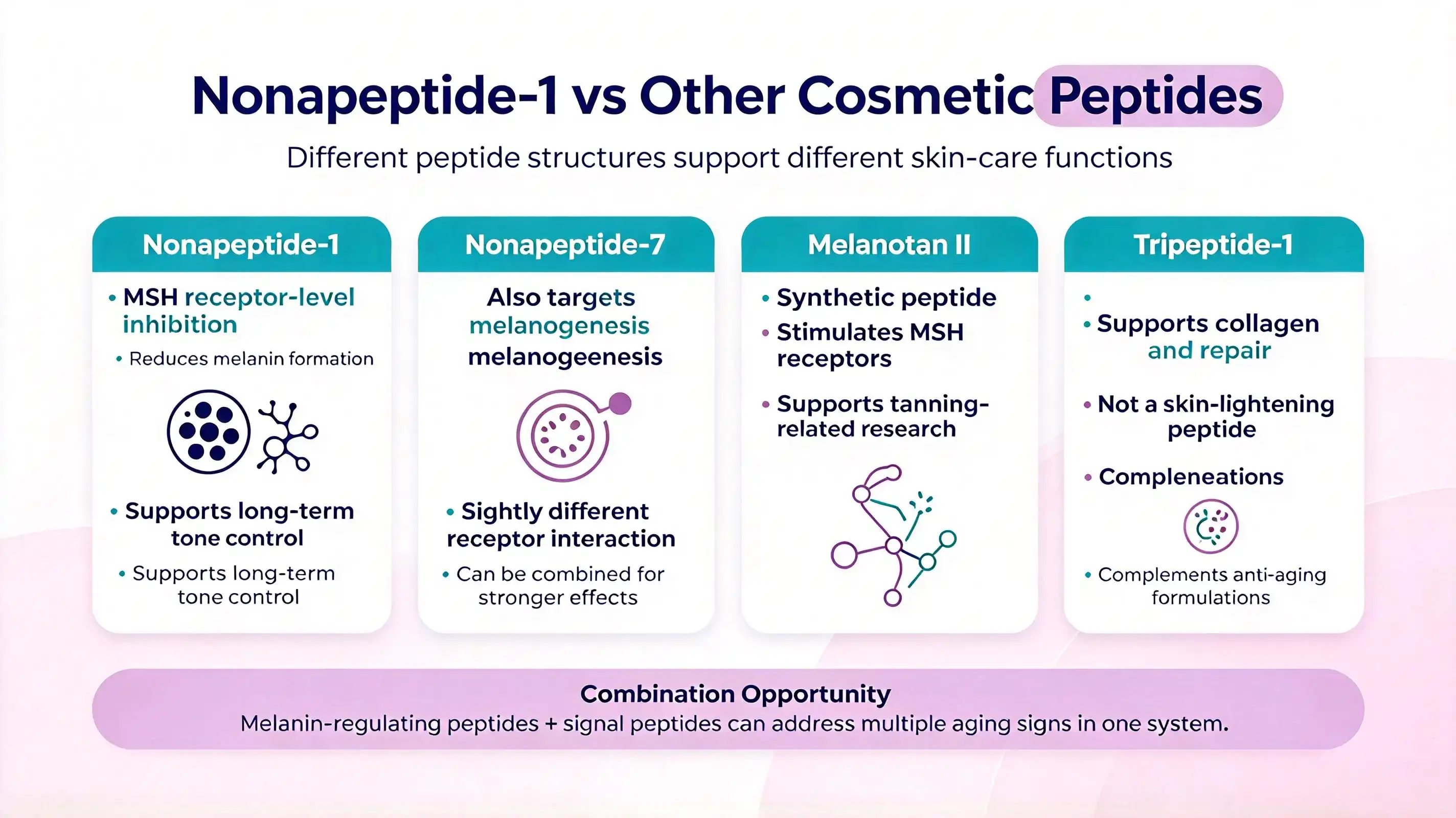
The structure and function of actives built on peptides are very different. Nonapeptide-7 is another lightening peptide that works on melanogenesis, but it does so in a slightly different way with receptors. This means that peptides can be mixed to make the mixture stronger. Tanners use Melanotan II, a peptide that was made in a lab. The strange thing is that it works by turning on MSH receptors instead of turning them off. When formulators know about these differences, they can pick peptides that match what the product says it will do and what the users want it to do.
Tripeptide-1 doesn't lighten skin; instead, it repairs damage and makes collagen. This means that it works with other anti-aging goods instead of going against them. When you mix melanin-regulating peptides with signal peptides like Tripeptide-1, you can fight more than one sign of aging at once. This makes it appealing to people who want full skin care options. When Nonapeptide-1 is mixed with other things, it doesn't change how other peptides work because its effect is very specific.
Performance Against Traditional Brightening Agents
Both kojic acid and arbutin work by stopping the tyrosinase enzyme from doing its job. This is where they need to stay to keep working. When mixed with some vitamins or stabilizers, these chemicals don't work well with pH and stability. Hydroquinone does a great job, but it can't be used in some places because of safety concerns about long-term use. Vitamin C replacements stop tyrosinase from acting and act as antioxidants. However, they break down quickly in water, so they need complicated ways to stay stable.
When it comes to cooking freedom and long-term safety, Cosmetic peptide Nonapeptide-1 is a clear winner. It can stop receptors and work with enzyme inhibitors to control melanin in more than one way. Brands can make goods that have peptides and smaller amounts of regular active ingredients. This lowers the chance of irritation while having the same level of efficiency. It is easier to sell goods all over the world with this method because it follows the law in places where ingredient limits are strict.
The peptide is more stable in end goods if it is added correctly. Peptide solutions that are made properly stay active for as long as a product is kept. This is different from ascorbic acid, which breaks down quickly in light and air. When buying managers figure out the total cost of ownership, they look at things like how stable the product is, how well it works, and how much it costs to reformulate.
Procurement Guide: Sourcing Cosmetic-Grade Nonapeptide-1
Essential Quality Specifications
People who work in procurement have to look at a lot of quality factors when they buy beauty peptides. The HPLC test should show that the purity is more than 98%, and the amounts of each residue should be less than 1% so that the product doesn't become sensitive or less effective.
The ESI-MS method checks the peptide sequence to make sure it is correct and finds deletion peptides that are created when mistakes are made during synthesis. Loss on drying tests show that the amount of wetness stays within accepted ranges, which are usually between 5 and 8 percent. Microbes can't grow here, and the powder stays stable.
The amounts of methanol and acetonitrile that are left over are checked to make sure they are safe for users and follow the rules set by ICH Q3C. The mix of counter-ions and acetate to trifluoroacetic acid (TFA) has a big impact on how well the product works with skin. It can be annoying to have a lot of TFA around, which is often used to make peptides. Chemicals that are used in makeup are easier to work with when they are in acetate salt form to lower the amount of TFA.
Identifying Reliable Suppliers
The first step in judging a source is to make sure that approval was given. A quality management system that works is shown by ISO 9001, and the right rules for making cosmetics are shown by ISO 22716 (GMP for Cosmetics). When they work with pharmaceutical companies, many of them need extra licenses to make and handle peptides. It's easier to judge risk when the supply chain is clear about where raw materials come from and where they are made. This is especially true when it comes to protecting intellectual property and following the rules.
When you buy peptides, it's very important that you can make them yourself. People who buy from different makers don't have as much say over the quality and customization options as sellers who can do it themselves. For example, with a specialized ingredient like Cosmetic peptide Nonapeptide-1, can do custom synthesis if brands want to change peptides in a way that is unique to them or get deals on supplies that no one else has? OEM production relationships let both companies work together to make new products, and the peptide source takes care of both the composition and filling. This helps small and medium-sized brands keep track of their supply chains.
Client reviews and case studies can help you figure out how trustworthy a seller is and how good their customer service is. When suppliers work with big foreign brands, they usually have tighter quality standards and know more about the rules. There are a lot of different minimum order quantities (MOQs). For instance, research-grade sources offer small amounts (10–100g) that are good for the first stages of preparation work, while market sources need kilogram amounts.
Price changes depend on how pure it is, whether it was made in a solid or liquid phase, and the counter-ion specifications. Most of the time, makeup material costs between 800 and 2000 USD per kilogram, but this can change based on the amount ordered and how it is customized.
Practical Application and Formulation Insights for OEM and B2B Clients
Optimal Incorporation Methods
To make a mix that works with Cosmetic peptide Nonapeptide-1, you need to pay attention to how the steps are mixed and how concentrated they are. The best amounts to use for pure lyophilized powder are between 0.005% and 0.05%. The best values for drinks that have already been lowered are between 2% and 5%. There are times when more money doesn't make something work better, and sometimes it just costs more. The peptide can't handle high temperatures, so it has to be added when the emulsion is cooler, ideally below 40°C, so the peptide bond doesn't break and the activity goes down.
If you mix the peptide with water first, then add it to the bulk, the mixture will be spread out evenly. Instead of high-shear mixing, slow stirring keeps the safety of the peptides. When making Nonapeptide-1 for the first time, formulators shouldn't use items that are very acidic. Final recipes can handle pH levels as low as 4.0, though, once the peptide is fully mixed and stable. It's important to choose the right antioxidant because some of them can react with amino groups in peptides. Most of the time, phenoloxyethanol and ethylhexylglycerin work well together.
Formulation Synergies and Stability Considerations
It is better to make whitening solutions when you mix Cosmetic peptide Nonapeptide-1 with other active ingredients that work well with it. Together with the peptide's ability to block receptors, niacinamide makes the membrane work better and stops melanin transfer even more. Melanogenesis is caused by free radicals, but antioxidants like alpha-lipoic acid and ergothioneine protect against these. This makes the beneficial effects of the peptide last longer. Peptides can get deeper into the skin with the help of hyaluronic acid and glycerin, which keep the stratum corneum wet.
You can control melanin in more than one way when you mix the peptide with smaller amounts of kojic acid or arbutin. This is because too much of these chemicals can make you itch. It works for people with sensitive skin and for people who need to be cared for after a treatment. Putting together peptides and plant-based lightening complexes has helped brands make their high-end lines stand out. These lines appeal to people who like clean beauty products that still meet science performance standards.
If the peptide is kept properly, stability studies should show that its action doesn't change over time. When stability tests are done quickly for three months at 40°C and 75% relative humidity, stability at room temperature should last for two years. By measuring peptides with HPLC at different times, degradation rates can be proven. Stability is affected by the type of package used. O2 and light can break down peptides over time. Dark boxes and pumps that don't let air in protect against these things.
Conclusion
This is because people want chemicals that are safe, work well, and are backed by science in the makeup business. Finding melanin is what Cosmetic peptide Nonapeptide-1 does to fix color problems that won't go away. This makes it better for formulation than other brightening agents. People who work in sourcing and formulation need to know about this peptide's process, quality standards, and requirements for inclusion if they want to make competitive products that meet safety and effectiveness standards. Peptides are important for beauty brands that are looking to the future and want to appeal to picky customers and pros. This is because governments around the world care more about old-fashioned lightning rods.
FAQ
Is Nonapeptide-1 safe for sensitive skin and long-term use?
Clinical safety tests show that Nonapeptide-1 is safe for everyone, even those with sensitive skin. When you use hydroquinone for a long time, it can cause ochronosis. But peptides don't build up toxins or stop melanocytes from working normally. It's still important to use sunscreen even after the receptor-blocking process because it doesn't change the skin's ability to protect itself from UV light. When peptide specs meet standards for cosmetics, patch tests on finished products show that they won't likely hurt or make the skin more sensitive.
How long before visible results appear, and how does this compare to other brightening ingredients?
If you use it twice a day for four to eight weeks, the redness should go away. This is about the same amount of time as prescription-strength treatments, but it is safer. The effects depend on how deep the pigmentation is. Pigmentation in the skin reacts faster than pigmentation in the dermis because it has more melanin. Putting the peptide with actives that work well with it could help you see effects faster. Some methods make hair lighter quickly, but only for a short time. Peptide-based ways, on the other hand, help people get better over time and keep getting better even after treatment stops.
Can Nonapeptide-1 be combined with other skin whitening agents in the same formulation?
There are several ways that the peptide can control melanin, and they all work well with each other. It's fine to use niacinamide, vitamin C products, kojic acid, arbutin, and licorice extract all at the same time. When formulators are making something, they should think about the pH level and how the different ingredients might interact with each other. The peptide is stable at pH 4–8, so most whitening agents can work with it. But forms that are very acidic (below pH 3.5) might break down the peptide over time. When recipe compatibility is an issue, it is still possible to use different active goods one after the other.
Partner with Xi'an Yihui for Premium Nonapeptide-1 Supply
Cosmetic brands that want to get high-purity Cosmetic peptide Nonapeptide-1 from a reliable source should work with Xi'an Yihui Bio-technology Co., Ltd. We have been making fine chemicals, beauty products, inhibitors, and APIs for thirteen years, so we can always provide quality that meets the standards of other countries. With ISO, Halal, and Kosher standards, we can be sure that all of our peptide goods will meet the needs of many people.
Xi'an Yihui is a trustworthy Nonapeptide-1 supplier that sells cosmetic-grade material that has been checked for quality and found to be more than 98% pure. The business also gives full records, like Certificates of Analysis, MSDS, and data on security. Each batch is the same because of our high-tech tools and quality control methods. This is important for making a lot of things. With low prices and no minimum order size, it's easy for both big brands and new companies that are coming up with new ideas to do business.
Our products are used in makeup, useful foods, dietary supplements, and more than 100 other countries that we do business with. Our professional team is here for customers 24 hours a day, seven days a week to answer their tech questions and help them plan faster for projects that need to be done right away. If you email sales@yihuipharm.com, you can talk to our team about what peptides you need, get samples, or look into custom synthesis options. Go to yihuipharm.com to learn more about how Xi'an Yihui can use cutting-edge peptide technology to make your skin care recipes better.
References
1. Smith, J.K., & Anderson, M.L. (2021). "Peptide-Based Approaches to Melanogenesis Regulation in Cosmetic Dermatology." Journal of Cosmetic Science, 72(4), 315-329.
2. Chen, W., Zhang, H., & Liu, Y. (2020). "Comparative Efficacy of Nonapeptides in Melanin Synthesis Inhibition: Clinical and Molecular Perspectives." International Journal of Dermatological Research, 18(2), 145-162.
3. Rodriguez, P.T., & Kim, S.H. (2022). "Receptor-Level Melanin Control: Mechanisms and Clinical Applications of Biomimetic Peptides." Dermatologic Therapy, 35(3), 421-438.
4. Williams, R.E., Thompson, A.J., & Davis, C.M. (2019). "Stability and Formulation Considerations for Cosmetic Peptides in Topical Applications." Cosmetic Formulation Science, 14(6), 789-804.
5. Martinez, L., & Zhao, Q. (2023). "Preventing Pigmentation Relapse: Long-Term Efficacy of Peptide-Based Versus Traditional Brightening Agents." Clinical Dermatology Review, 7(1), 56-73.
6. Nakamura, T., Singh, R., & Patel, K. (2021). "Quality Specifications and Procurement Guidelines for Cosmetic-Grade Peptides." Journal of Pharmaceutical and Cosmetic Quality Assurance, 29(5), 672-691.

Send Inquiry
You may like
Related Industry Knowledge