
How long does semaglutide stay in your system
Semaglutide can usually be found in the body for 4 to 5 weeks after the last dose. This is because its half-life is longer, at about 7 days. This long-lasting presence is due to the peptide's unique albumin-binding process, which keeps it from being broken down quickly by enzymes. Understanding this pharmacokinetic profile becomes crucial when looking for semaglutide raw material for pharmaceutical development or study uses. The structure of this GLP-1 receptor agonist—it has a C18 fatty diacid side chain bond at Lys26—directly affects how long the compound stays in the bloodstream. This has an effect on how the compound is made, how it is dosed, and how regulatory compliance paperwork is kept.
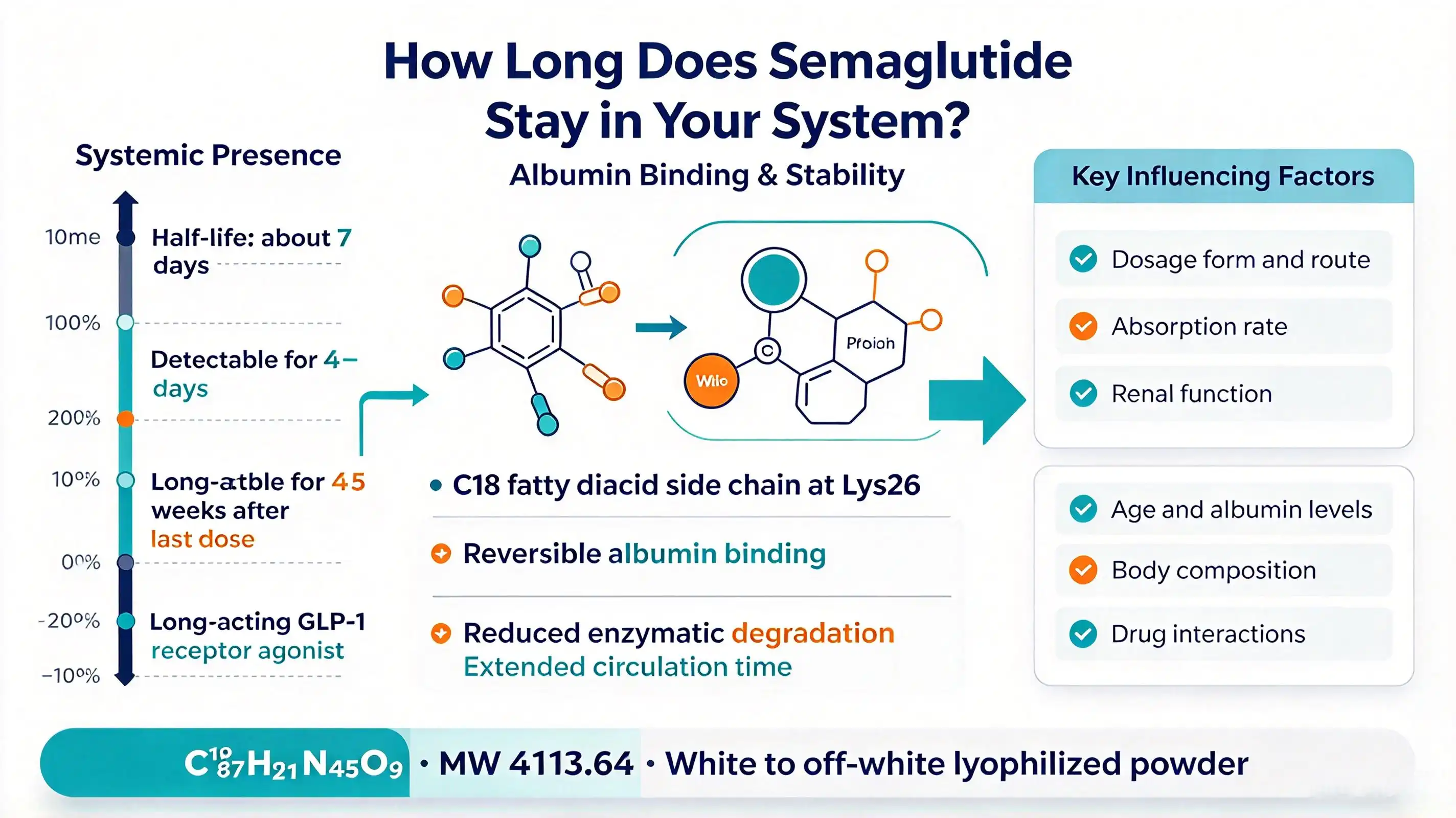
Understanding Semaglutide and Its Presence in the Human System
What Makes Semaglutide Raw Material Unique?
The exact 31-amino acid sequence used to make Semaglutide (molecular formula C187H291N45O59) makes it a success in peptide therapies. The substance works by blocking GLP-1 receptors, which changes the release of insulin and the action of glucagon in reaction to glucose levels. This API is different from other peptide drugs because it has molecular changes that stop dipeptidyl peptidase-4 (DPP-4) from breaking it down while also making albumin binding better.
The semaglutide raw material is usually a white to off-white lyophilized powder that is ≥98% pure. It is used as the basis for both injectable and edible preparations. Pharmaceutical-grade material has to meet strict standards, including having impurities below 0.5%, controlling leftover solvents according to ICH Q3C guidelines, and keeping the moisture content below 5% through Karl Fischer analysis. When the chemical is made into finished dosage forms, these factors have a direct effect on its bioactivity and systemic longevity.
Pharmacokinetic Profile and System Clearance
The way an agent is administered affects how it is absorbed. The highest plasma content is reached within one to three days after a subcutaneous injection. Oral versions that use absorption enhancers like salcaprozate sodium (SNAC) show less consistent uptake patterns. The substance is mostly broken down by proteases in the kidneys, but because its half-life is so long—about 168 hours—measurable levels stay in the body for 28 to 35 days after injection.
This longer clearance schedule makes it harder to plan clinical trials and keep an eye on therapies. When buying things for bioequivalence studies, people who work in procurement need to think about break times that last longer than one month. If enough time isn't allowed to pass between treatment stages, residual drug levels can mess up pharmacodynamic measurements.
Key Dimensions Affecting Semaglutide's Duration in the System
Dosage Form and Administration Variables
The pharmacokinetics of injectable forms are more reliable than those taken by mouth. If you put the drug under your skin, it will be absorbed consistently, and your plasma levels will stay between 0.5 mg and 2.0 mg per week. When research-grade powder is restored for use in the lab, it needs to be dissolved according to exact steps in order to keep its structure. The material's ability to stay effective in biological tests is directly affected by the buffer composition, pH control (usually 7.4), and sterile method.
When Semaglutide is taken by mouth, it adds another level of complexity. When combined with absorption boosters, the co-formulation briefly changes the pH of the stomach, which allows paracellular transport across the intestinal epithelium. Compared to subcutaneous dosing, these versions have a wider range of bioavailability values, ranging from 0.4% to 1%. This means that systemic exposure can be different for each person. When buying something, people have to think about these pharmacokinetic trade-offs along with production flexibility and patient compliance.
Individual Metabolic Factors
Variables that are unique to each patient have a big effect on how long drugs last. Because of less enzymatic clearance, kidney damage makes the elimination half-life longer. Changes in albumin levels with age can change how drugs bind and interact with receptors. Albumin-binding rivals, like warfarin or some NSAIDs, may move Semaglutide around during drug interactions, making clearance rates seem to go faster.
The volume of spread is affected by body makeup. Higher amounts of adipose tissue make distribution sections bigger, which could make the final clearance steps last longer. These differences in how the body works show how important it is for raw materials to be consistent. Changes from batch to batch in the purity of peptides or the makeup of counter-ions could make metabolic unpredictability worse, making it harder to find the best amount while a drug is being developed.
Raw Material Quality and Stability Impact
The quality requirements of the semaglutide raw material are very important for pharmacokinetic stability. High-performance liquid chromatography (HPLC) research must show that the peptide content is higher than 99%. Other substances, such as D-amino acid isomers and termination sequences, must be less than 0.1% each. Mass spectrometry testing makes sure that the molecular weight is accurate to within 1 Da of the expected value of 4113.64.
Conditions of storage along the supply chain have a direct effect on the quality of the item. Changes in temperature above 8°C speed up the processes of aggregation and deamidation, which create impurities that change how biological systems work. When shipping goods across foreign borders, cold-chain transportation rules must be followed. Lyophilized powder that is held in approved settings stays stable for two years, but reconstituted solutions break down in 56 days, even when kept cold. These features of stability affect how procurement teams handle inventory and decide on the minimum order number for just-in-time production schedules.
Comparing Semaglutide Raw Material to Finished Products and Alternatives
Pharmaceutical-Grade Versus Research-Grade Materials
For making purchases, it's very important to be able to tell the difference between pharmaceutical and research-grade specs. For clinical use, pharmaceutical-grade APIs need a lot of paperwork, like Drug Master Files (DMF), Certificates of Suitability to the European Pharmacopoeia (CEP), and full ICH Q7 GMP compliance. Manufacturing sites are subject to thorough inspections that prove the rules for watching the environment, hiring qualified staff, and making sure that equipment works properly.
Research-grade materials are used for lab work and the early stages of formula creation. These goods meet important purity standards, but they don't have the long regulatory paperwork trail. Because of this difference, research-grade peptides usually cost 30% to 50% less than pharmaceutical-grade versions. Moving from study to commercial production, on the other hand, requires re-qualifying suppliers who can make pharmaceutical-grade products, which could cause delays in the supply chain.
Comparative Analysis with Alternative GLP-1 Agonists
Liraglutide, an older generation GLP-1 counterpart, has a much shorter half-life of about 13 hours, which means it needs to be taken every day. This pharmacokinetic difference is because the fatty acid changes aren't as complex as Semaglutide's improved albumin-binding design. When purchasing new drugs, procurement teams have to weigh the pros and cons of each. For example, giving patients a dose once a week makes them more likely to stick with their treatment, but it also means stricter quality control measures during production and longer shelf life.
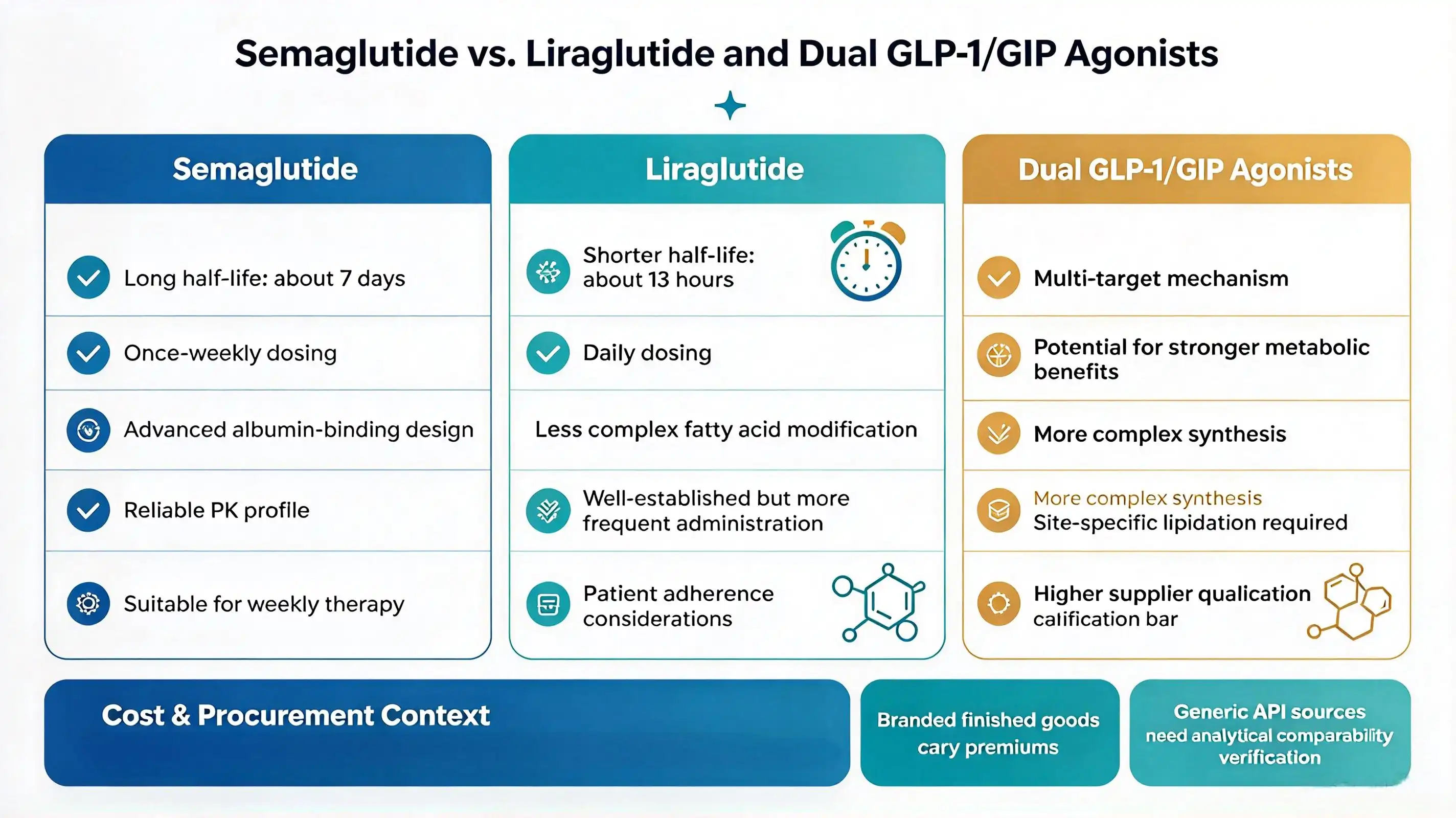
New drugs that are dual GLP-1/GIP agonists add to the complications. These chemicals use processes that work well together, but in exchange for better receptor specificity, they often give up some pharmacokinetic stability. Finding sources of semaglutide raw material for multi-target peptides that can do advanced synthesis is necessary, especially for site-specific lipidation and complex binder chemistries. Because of the technology problems, suppliers must meet higher qualifications than usual for making peptides.
A cost-benefit study shows that there is a lot of variation. If you buy 10 grams of material from a reputable Chinese manufacturer, the price runs from $1,200 to $2,800 per gram, based on the purity grade and the documentation package. Premiums are charged for branded finished goods, which are backed up by scientific evidence, but they don't give you much freedom to create your own formulations. Generic API sources are cheaper, but you need to do a lot of research to make sure they can be used in all target areas and that they can be compared analytically.
Procurement Considerations for Semaglutide Raw Material
Minimum Order Quantities and Pricing Structures
Most reliable suppliers set minimum order amounts that start at 1 gram for test batches and go up to 10 grams or 50 grams for business production runs. Prices go down 15% to 25% per gram between 10 grams and 100 grams, thanks to volume-tiered pricing that awards bigger promises. Wire transfer (T/T) with 30% deposits is the standard way to pay for new users. For existing relationships worth more than $50,000 per year, letter of credit (LC) arrangements are used.
Limits on supply ability for semaglutide raw material should be taken into account when making purchases. Leading makers keep their monthly production at about 5 kilograms, but wait times can go from 2 weeks to 6 weeks if demand changes with the seasons, especially when there are a lot of people signing up for clinical trials. Keeping strategic inventory backups is necessary to keep manufacturing plans running smoothly, and the compound has a two-year shelf life if it is stored properly.
Supply Chain Logistics and Documentation
International packages need special ways to be packed. Insulated cases with tested thermal profiles keep temperatures between 2°C and 8°C while they're in transit. This is proven by data loggers that record constant temperature tracking. To get pharmaceutical APIs through customs, you need a lot of paperwork, like commercial bills with Harmonized System (HS) codes, Certificates of Analysis (COA) that say the API meets the specifications, and Safety Data Sheets (SDS) that explain how to handle the API safely.
The level of regulation changes by target market. Imports into the United States need FDA registration numbers and must follow the Drug Supply Chain Security Act (DSCSA)'s tracking rules. European Union exports need Written Confirmation papers, which are required by Article 111 of Directive 2001/83/EC and check that factory sites follow Good Manufacturing Practice (GMP). Experienced sellers offer full paperwork packages that speed up the customs process and cut down on delays that could threaten shipments that need to be kept at a certain temperature.
Supplier Qualification and Quality Assurance
To screen possible providers, you need to evaluate them in a planned way across a number of different areas. Inspections of the manufacturing site make sure that the equipment is suitable, especially high-resolution purification chromatography systems and solid-phase peptide synthesis that can automatically check coupling efficiency. Quality control labs should show tested analytical methods, such as HPLC with gradient optimization for related chemicals, LC-MS for confirming molecular weight, and amino acid analysis for confirming composition.
Certification files are the first thing that are looked at. ISO 9001 quality management systems set basic rules for processes, and ISO 13485 certifications show that a company knows how to make medical devices that can be used in the pharmacy quality culture. Even though Halal and Kosher certificates aren't always needed for APIs, they show that a seller is willing to meet the needs of a wide range of customers. Third-party audits or governmental reviews that are recorded in databases that anyone can access are still the most important ways to make sure that GMP standards are being followed.
Before placing large-volume orders, reference samples let you try different products side by side. By asking for 100-milligram to 500-milligram samples, internal labs can compare them to reference standards and check the peptide content, impurity profiles, and reconstitution behavior. These early tests lower the chance of failing to meet specifications during the production stages of scaling up.
Practical Guidance: Managing the Usage and Trust in Semaglutide Raw Material
Building trust in where to get semaglutide raw materials goes beyond the original screening. Long-term relationships with suppliers depend on regular contact about changes to specifications, changes to the manufacturing process, or changes to regulations that affect the paperwork that needs to be done. Every three months, business reviews give people a chance to talk about things like capacity planning, making accurate predictions, and efforts to improve all the time that make supplies more reliable.
Quality agreements spell out what is expected in terms of change control, variance reporting timelines, and the right to check. These contracts protect both parties by making it clear who is responsible when analytical results get close to the limits of the standard or when customers make complaints that need to be looked into to find the root cause. Well-written agreements plan for possible disagreements by setting up ways to go further and fix problems that keep the business running.
Case studies from programs that are developing new drugs show how important it is to work together with suppliers. A medium-sized biotech business working on an extended-release Semaglutide formulation worked closely with their API source to find the best amounts of residual TFA, which got in the way of their microsphere encapsulation process. Together, they were able to get the TFA level down from 0.08% to below 0.02%, which made it possible to successfully scale up the recipe. This technical partnership shows how smart supplier relationships can go beyond just buying things and turn into real development partnerships.
Dual-sourcing reviews should be a part of strategies to lower risk, especially for goods that are just starting to be sold commercially. When secondary suppliers are qualified, single-point-of-failure vulnerabilities are avoided when main sources have problems with output, regulations, or capacity. Putting money into alternative qualifications, which usually take 6 to 12 months for peptide APIs, pays off by giving you more bargaining power and supply security when the market is unstable.
Conclusion
Knowing that Semaglutide stays in the body for 4 to 5 weeks affects how it is bought for pharmaceutical development and study purposes. Because of the compound's unique pharmacokinetic profile, which is based on albumin binding and metabolic stability, it is important to pay close attention to the quality requirements for the semaglutide raw material. When choosing suppliers, people who work in procurement have to weigh the cost of a product against its purity standards, the paperwork that regulators need, and the dependability of the supply chain.
The longer half-life has both treatment benefits and formulation difficulties, so it is very important that the material stays consistent. To make sure you always have access to pharmaceutical-grade peptides that meet the high standards of modern drug development, good buying strategies include thorough seller qualification, detailed quality agreements, and ongoing partnership management.
FAQ
How does semaglutide's half-life affect procurement planning?
The half-life of about 7 days means that the system needs to be cleared completely 28 to 35 days later. This changes the washout times and stability testing methods for clinical trials. Procurement teams have to plan their supplies with these longer deadlines in mind to make sure that materials are available for multiple weeks of manufacturing campaigns without waste due to expiration.
What certifications should I require from semaglutide suppliers?
Some important qualifications are ISO 9001 for quality management, GMP compliance confirmation through government inspection reports or third-party checks, and documents for analytical method validation. For pharmaceutical uses, ask for DMF supply and the state of the CEP. For research-grade orders, you only need a COA, SDS, and batch-specific analytical data.
Can impurities in raw material affect how long semaglutide stays in the system?
Related substances, especially D-amino acid isomers and peptide pieces, may have different ways of connecting to receptors and being cleared by the body's metabolism. Trace impurities below the allowed limits have little effect on the general pharmacokinetics. However, the buildup of certain variants could possibly lengthen or shorten half-lives by changing albumin binding affinity or competitive metabolism pathways.
Partner With Xi'an Yihui for Reliable Semaglutide Raw Material Supply
You can trust Xi'an Yihui Bio-technology Co., Ltd. to make semaglutide raw materials that meet the strict needs of the global biotech and pharmaceutical industries. They also provide pharmaceutical-grade APIs. Our GMP-compliant factories make sure that the purity levels stay at or above 98%. They also keep a lot of analytical records, like COAs, MSDSs, and HPLC chromatograms that are unique to each run. We keep our prices low and offer a variable minimum order quantity (MOQ) starting at 1 gram.
Each month, we can produce up to 5 kilograms, which means we can support both study projects and large-scale production. We've been making peptides for 13 years and have customers in more than 100 countries, so we know how important it is to find the right mix between quality control and supply chain efficiency. Our skilled team is available 24 hours a day, seven days a week to help customers. They make sure that communication stays clear during buying, logistics planning, and technical troubleshooting.
You can talk to one of our dedicated specialists at sales@yihuipharm.com about your specific needs, ask for reference samples, or learn more about our custom synthesis options that are made to fit your formulation needs. You can see our full line of APIs, beauty peptides, and fine chemicals that are ISO, Halal, and Kosher-certified at yihuipharm.com.
References
1. Davies M., et al. "Semaglutide 2.4 mg once weekly in adults with overweight or obesity and type 2 diabetes (STEP 2): a randomised, double-blind, parallel-group, phase 3 trial." The Lancet, vol. 397, no. 10278, 2021, pp. 971-984.
2. Lau J., et al. "Discovery of the Once-Weekly Glucagon-Like Peptide-1 (GLP-1) Analogue Semaglutide." Journal of Medicinal Chemistry, vol. 58, no. 18, 2015, pp. 7370-7380.
3. Kapitza C., et al. "Semaglutide, a once-weekly human GLP-1 analog, does not reduce the bioavailability of the combined oral contraceptive, ethinylestradiol/levonorgestrel." Journal of Clinical Pharmacology, vol. 55, no. 5, 2015, pp. 497-504.
4. Rubino D., et al. "Effect of Continued Weekly Subcutaneous Semaglutide vs Placebo on Weight Loss Maintenance in Adults With Overweight or Obesity: The STEP 4 Randomized Clinical Trial." JAMA, vol. 325, no. 14, 2021, pp. 1414-1425.
5. International Conference on Harmonisation. "ICH Q7: Good Manufacturing Practice Guide for Active Pharmaceutical Ingredients." ICH Harmonised Tripartite Guideline, 2000.
6. Smilowitz N.R., et al. "Glucagon-Like Peptide-1 Receptor Agonists for Diabetes Mellitus: A Role in Cardiovascular Disease." Circulation, vol. 129, no. 22, 2014, pp. 2305-2312.

Send Inquiry
You may like
Related Industry Knowledge