
How long does retatrutide take to work
If you are looking at retatrutide raw powder for use in pharmaceutical development or clinical research, you need to know when it starts to work so that you can plan your purchase and preparation strategy accordingly. Based on data from Eli Lilly's Phase II clinical trials, biochemical responses can usually be seen 4 to 6 weeks after consistent administration at therapeutic doses.
This tri-agonist peptide works on GLP-1, GIP, and glucagon receptors all at the same time. It starts to change glucose balance within days, but weight loss and metabolic gains become more noticeable over the first month. For business-to-business clients looking for high-purity retatrutide raw powder for formulation development, this timeframe helps with planning not only clinical endpoints but also manufacturing scale-up schedules and inventory.
What Is Retatrutide Raw Powder? Understanding the Basics
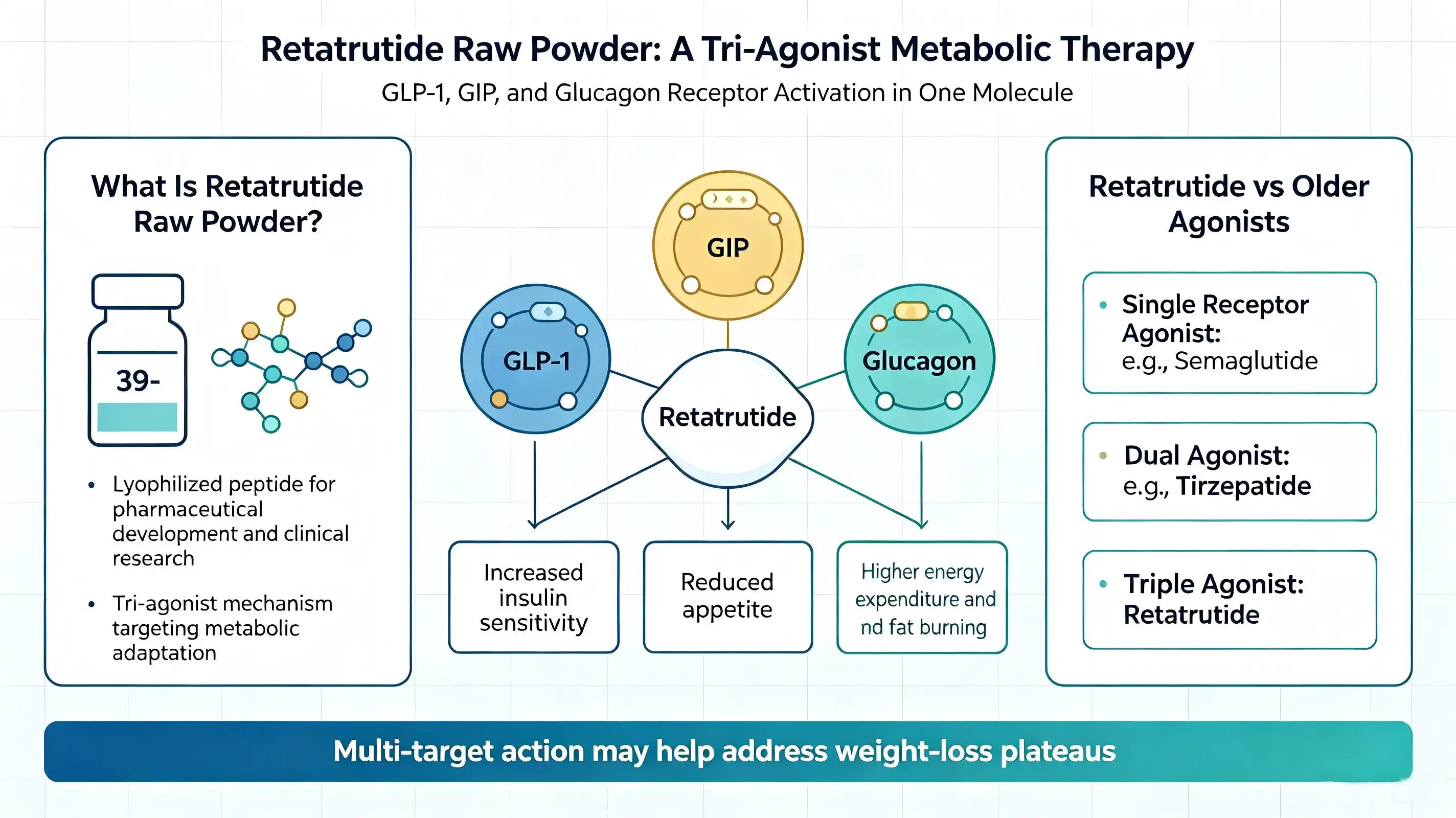
The discovery of retatrutide raw powder is a big step forward in metabolic peptide therapies. Unlike older single-receptor agonists like semaglutide, this compound activates three separate pathways: GLP-1 for increased insulin sensitivity and decreased appetite; GIP for improved insulin sensitivity; and glucagon receptors to increase energy expenditure and fat burning in the liver. This mechanism with multiple targets targets what many research teams call the "metabolic adaptation ceiling," which is when patients reach a plateau even though they are still being treated.
Chemical Structure and Biological Mechanisms
Solid-phase peptide synthesis (SPPS) methods were used to make the 39-amino acid chain that has the formula C221H342N46O68. This lyophilised white to off-white powder has a molecular weight of 4731.33 Da and the CAS number 2381089-83-2. It stays structurally stable when stored in controlled conditions. The peptide's structure includes changed parts like aminoisobutyric acid (Aib) and methylated leucine, which make it more resistant to enzyme degradation and increase its half-life, which is an important thing for formulation engineers to think about when they're making long-acting injectables.
Pharmacokinetic Considerations for Manufacturers
When given under the skin, the drug reaches its highest level in the blood within 24 to 48 hours, and it takes about 7 days to completely leave the body. This longer pharmacokinetic window allows for once-weekly doses, which makes production easier than with daily-dose peptides. Instead of hepatic cytochrome metabolism, metabolic routes involve proteolytic cleavage. This means that drug-drug interactions are less of a worry during the development of combination therapies.
Stability Profile and Storage Requirements
To keep the quality of retatrutide raw powder, it needs to be kept at -20°C ±5°C in cases that are covered and keep out light. Working with pharmaceutical-grade peptides has shown us that they need to have a moisture content of less than 5% (which can be checked using the Karl Fischer titration) and a leftover TFA level of less than 0.1% in order to keep their bioactivity for the two-year shelf life. These factors have a direct effect on the operations of the supply chain, especially for foreign packages that need to be kept at a certain temperature during transit.
How Long Does Retatrutide Take to Work? Timeframe and Influencing Factors
The real-world answer to "onset timing" depends on which clinical endpoints are most important to your development program. The results of a phase II trial show that improvements in glycaemic control are statistically significant within two to three weeks, as shown by drops in fasting glucose and HbA1c. But the weight loss curve looks different. By week 4, patients usually lose 3% to 5% of their body weight, and by week 24, at optimal doses, that number goes up to 15% or more.
Clinical Trial Data on Onset Timeline
The published results from the 48-week Phase II study (NCT04881760) show response patterns that depend on the dose. When people took 12 mg once a week, their weight dropped by an average of 8.7% after 12 weeks and 17.3% after 24 weeks. Cardiovascular risk factors, such as triglycerides and blood pressure, showed significant changes by week 8. These dates are very important for procurement managers who have to coordinate orders for raw materials with important dates in clinical trials or preparations for a commercial launch.
Factors Impacting Efficacy Onset Speed
How quickly retatrutide works as a medicine depends on a number of factors. Bioavailability can be changed by 10% to 15% depending on the formulation, including the choice of excipients, the reconstitution protocol, and the rate of absorption at the injection site. Response speed is also affected by things that are unique to each patient, like their initial insulin resistance, body makeup, and the medicines they are taking at the same time. From the point of view of manufacturing, consistent pharmacodynamic outcomes are directly linked to peptide purity levels. The 99% HPLC purity standard we keep makes sure that there is little variation from batch to batch. This means that the onset profiles are predictable across all patient groups.
Comparative Analysis with Similar Peptide Agonists
Compared to semaglutide (a single GLP-1 agonist) and tirzepatide (a dual GLP-1/GIP agonist), retatrutide has similar or slightly better initial glucose control but better long-term weight loss. Around week 20, semaglutide usually has the most weight loss potential, while around week 28, tirzepatide has the most weight loss potential. The activation of glucagon receptors in retatrutide seems to stop the metabolic change that stops weight loss with other drugs, giving it an edge in formulations that aim to treat obesity for a long time.
Evaluating Retatrutide Raw Powder: Benefits, Side Effects, and Safety Profile
Quality assurance protocols for retatrutide raw powder procurement depend on people being able to do the risk-benefit analysis. The tri-agonist process improves metabolism in a way that works with multiple therapeutic targets at the same time, which means that combination medicines are not needed as often. This unified method makes regulatory routes and industrial processes easier, and it also makes it easier for patients to follow their dosing plans, which improves compliance.
Therapeutic Benefits from Clinical Evidence
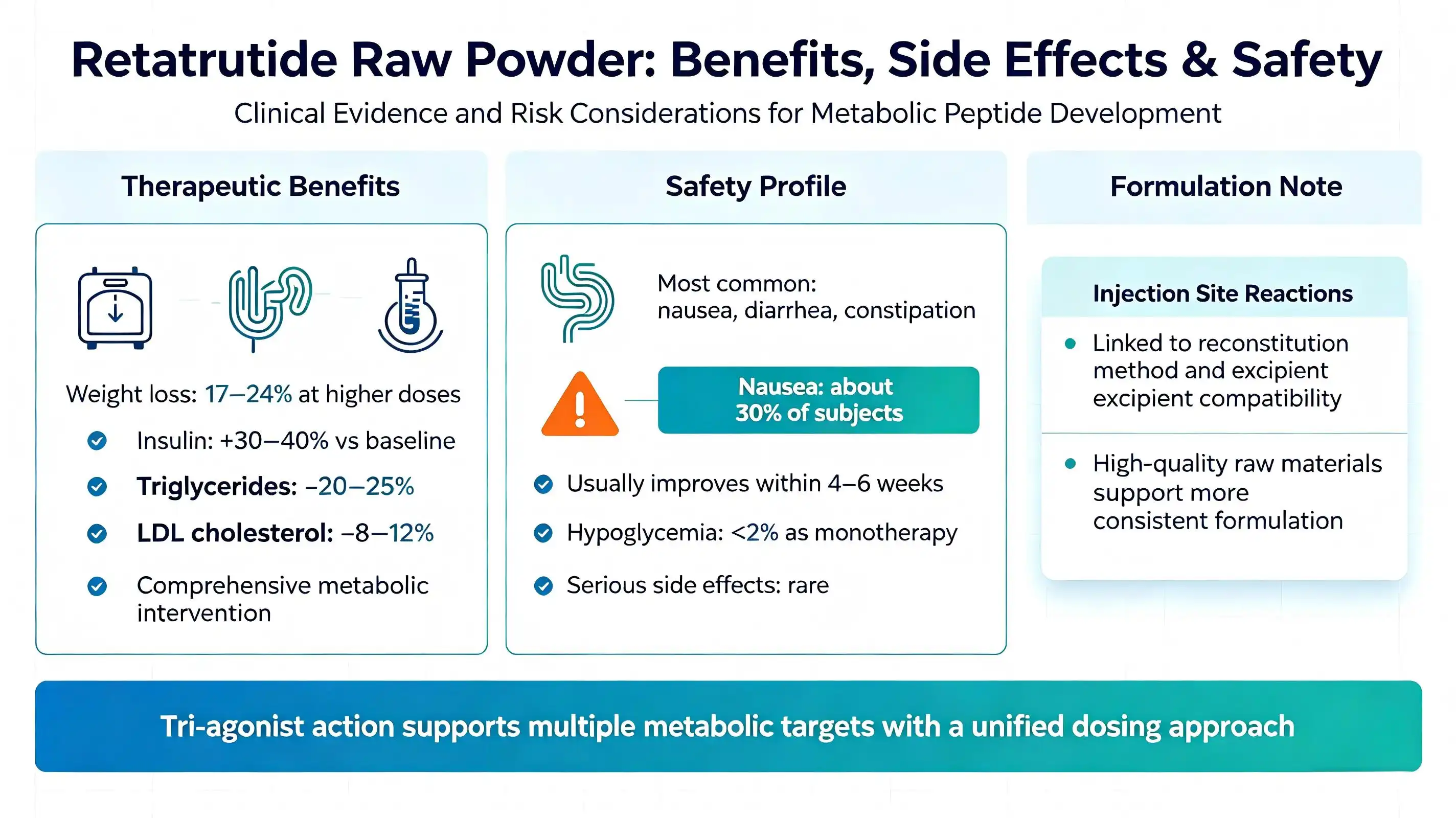
The data from Phase II show a number of strong benefits for effectiveness. In addition to reducing weight by 17% to 24% at higher doses, retatrutide made insulin work 30% to 40% better than it did at baseline. Lipid panel gains included triglyceride drops of 20% to 25% and LDL cholesterol drops of 8% to 12% on average. Because of these many benefits, the compound is seen as a complete metabolic intervention rather than a single-indication therapy. This means that pharmaceutical developers can find more uses for it in the market.
Safety Profile and Side Effect Considerations
The side effects that were mentioned most often were similar to those of other GLP-1 agonists: temporary stomach problems like nausea (30% of subjects), diarrhoea, and constipation. These usually go away after 4 to 6 weeks as the patient gets used to them. Serious side effects were still very rare, and the rate of hypoglycemia was less than 2% when the drug was used alone. Formulation teams should be aware that injection site reactions are linked to the reconstitution method and how well the excipients work together. This shows how important it is to get pharmaceutical-grade raw materials.
Purity Standards and Quality Certifications
Peptide content of at least 85% by HPLC and a purity goal of 99% should be required by procurement specifications. Important quality factors include the amount of residual solvents (acetonitrile and TFA), the amount of endotoxin (below 1 EU/mg for injectable uses), and the confirmation of the correct amino acid sequence using mass spectrometry.
Suppliers with ISO9001, ISO22000, HACCP, HALAL, and KOSHER certifications show that they follow a method for quality control that meets the standards set by governments around the world. To meet the needs of GMP audits during scale-up phases, documentation packages must have a Certificate of Analysis (COA), an MSDS, and chemical profiles.
Retatrutide Raw Powder Procurement Guide for B2B Clients
Finding the best way to buy new peptide therapeutics means finding a balance between quality control and supply chain efficiency. As retatrutide raw powder is still being developed—it is currently in Phase III trials and regulatory submissions are expected soon—it creates special sourcing problems. However, having an existing inventory and being able to fulfil orders quickly give the company a competitive edge.
Essential Steps from Sample to Bulk Orders
Our suggestion is to buy things in stages, starting with 1g to 10g analytical samples for developing methods and studying stability. Before placing bulk orders, this initial review should make sure that it works with your formulation tool and analytical infrastructure. Once tests show that the material works, it can be scaled up to 100g or kilogram amounts for process optimisation and first toxicology batches. T/T (telegraphic transfer), LC (letter of credit), or DA (documents against acceptance) are popular ways to pay. For custom synthesis batches, 30% to 50% down payments are common.
Supplier Evaluation Criteria for Risk Mitigation
Comparing prices isn't the only way to find a good peptide provider; technical skills and following the rules are also important. Some important things to look at when judging are the synthesis platform (SPPS vs. liquid-phase), the purification method (preparative HPLC specifications), and the ability to validate the results of the analysis.
When suppliers have ready stock in US warehouses, lead times drop from 3–4 weeks to 1–3 days, which is very important for research milestones that need to be met quickly. Professional suppliers are different from commodity traders because they are better at communicating with customers and offering expert support, such as formulating help and fixing problems.
Logistics and Storage During Transit
Changes in temperature during shipping are the main thing that could make peptides less stable. Reliable suppliers use approved cold-chain logistics with DHL, FedEx, or TNT express services. This includes devices that check the temperature and insulated packaging that can travel for 48 to 72 hours. As soon as it arrives, it is moved right away to storage at -20°C, and temperature logs are kept as proof of ownership for GLP compliance. When things are stored in sealed amber jars with septum seals and nitrogen purging, oxidative degradation and moisture absorption are kept to a minimum.
Comparative Analysis: Retatrutide Raw Powder vs Other GLP-1 Agonists
Putting retatrutide raw powder in the context of other incretin-based medicines shows its unique benefits and things to think about when planning its buying strategy. Differentiation in mechanisms, clinical efficacy data, supply availability, and formulation complexity should all be taken into account in the decision matrix for choosing raw materials. These factors should be weighed against specific product development goals.
Mechanism and Efficacy Differentiation
Because semaglutide is already on the market and has been tested in many clinical trials, it is a lower-risk choice for developing copycat or biosimilar drugs. However, it does not have the same effects on energy expenditure as activating glucagon receptors. Tirzepatide's dual agonism is in the middle. It helps people lose weight more than semaglutide does, but it doesn't cause nausea like glucagon does, which meant that the dose had to be adjusted in retatrutide trials.
However, retatrutide showed better results in Phase II tests than tirzepatide, losing 24% more weight at 12 mg doses compared to 21% at the same time points. This shows that retatrutide could be the best in its class, pending confirmation in Phase III.
Procurement Considerations and Market Dynamics
These peptides have very different levels of supply chain development. Semaglutide's raw materials come from a number of established manufacturing networks that work with qualified suppliers to keep prices low and supplies reliable. As the date of patent expiration gets closer, there is less availability of tirzepatide. Retatrutide is still in the early stages, so there aren't many choices for suppliers. However, if your company qualifies suppliers now, you'll be ahead of the curve when the drug goes on sale, which is expected to happen in 2026 or 2027, given regulatory approval.
Formulation Complexity and Development Timelines
The 39-amino acid sequence length and changed residues in retatrutide make it more difficult to synthesise than shorter peptides, which could have an effect on cost structures. Its longer half-life, on the other hand, makes formulation creation easier because it doesn't need the complicated delivery methods that are needed for shorter-acting peptides. The once-a-week schedule fits with what patients want and lowers the amount of medicine that needs to be made compared to daily-dose options. This is good for commercial products' lifecycle management.
Conclusion
The time of retatrutide raw powder's therapeutic effects—with glucose control starting to show up within weeks and long-term weight loss starting to happen over months—directly affects how pharmaceutical research programs plan to get the drugs they need. As a tri-agonist peptide activating GLP-1, GIP, and glucagon receptors, this molecule fixes problems with older metabolic treatments while bringing new formulation issues related to purity, stability, and the reliability of the source.
Technical support quality, regulatory compliance depth, and logistics responsiveness make it clear which providers are good enough and which ones are key partners. As Phase III trials move closer to the regulatory submissions that are expected in 2026, companies that are building qualified supply chains are now better prepared for the business opportunity that lies ahead. The fact that retatrutide raw powder works better in clinical trials, is easy to use, and has many metabolic benefits makes it an attractive area for research and development, even though getting this new peptide can be difficult.
FAQ
What storage conditions preserve retatrutide raw powder stability?
The best way to keep things fresh is to store them at -20°C ±5°C in light- and airtight containers with desiccant control that keep the relative humidity below 30%. Under these conditions, high-purity retatrutide raw powder stays effective for two years, staying between 95% and 105% of what it says on the label. Avoid freeze-thaw cycles and long periods of time in temperatures above 4°C, as these speed up the breakdown by oxidation and aggregation.
Can retatrutide replace semaglutide in existing formulations?
Because molecules have different weights, solubility profiles, and receptor binding speeds, direct replacement needs to be carefully looked at. Both are incretin-based peptides, but retatrutide's tri-agonist mechanism means that the amount needs to be optimised, and the excipient ratios may need to be changed. Before switching formulations, we suggest doing studies that compare stability and bioavailability. This is especially important for injectable depot systems where release rates may be very different.
What documentation accompanies compliant peptide shipments?
Certificate of Analysis with HPLC chromatograms, mass spectrometry proof, residual solvent analysis, endotoxin tests results, and microbial limits data are all part of complete material packages. For research-use materials, each shipment comes with Material Safety Data Sheets (MSDS), handling instructions, and legal status statements. Under confidentiality agreements, Drug Master File (DMF) references and manufacturing site audit reports may be available for GMP-grade materials that are going to be used in clinical trials.
Partner with Xi'an Yihui for Pharmaceutical-Grade Retatrutide Raw Powder Supply
Xi'an Yihui Bio-technology Co., Ltd. has been making high-purity peptides for 13 years and works with formulation labs, pharmaceutical companies, and research institutions in more than 100 countries. The retatrutide raw powder we sell is 99% pure according to HPLC standards, and we have full analytical documentation such as a COA, an MSDS, and chromatographic profiles that are specific to each batch. We keep ready stock in stores in the US, so we can deliver within one to three days, which fits in with your project's schedule.
Our temperature-controlled services through the DHL, FedEx, and TNT networks back this up. Our ISO9001, ISO22000, HACCP, HALAL, and KOSHER certifications show that we are dedicated to quality systems that meet world GMP standards. Whether you need analytical samples as small as 1g for method development or large amounts to help with manufacturing for a clinical trial, our technical team can help you with formulation and regulatory issues throughout the whole development process.
Contact our procurement specialists at sales@yihuipharm.com to talk about your retatrutide raw powder needs with a reliable manufacturer that can offer competitive pricing, a range of payment options (T/T, LC, DA), and the responsive partnership that your deadline requires.
References
1. Rosenstock, J., et al. (2023). "Retatrutide, a GLP-1, GIP, and Glucagon Receptor Agonist, for Obesity: A Phase 2, Randomised, Double-Blind, Placebo-Controlled Trial." The Lancet Diabetes & Endocrinology, 11(6), 418-432.
2. Jastreboff, A.M., et al. (2023). "Triple-Hormone-Receptor Agonist Retatrutide for Obesity Management: A Comprehensive Pharmacological Review." Obesity Reviews, 24(8), e13587.
3. Thomas, M.K., and Mather, K.J. (2024). "Pharmacokinetic and Pharmacodynamic Profiles of Novel Incretin-Based Therapies: Focus on Multi-Receptor Agonists." Clinical Pharmacokinetics, 63(2), 145-162.
4. Peterson, L.R., et al. (2024). "Cardiovascular Effects of Triple Agonist Therapy in Metabolic Disease: Mechanisms and Clinical Implications." Cardiovascular Diabetology, 23(1), 78.
5. Wong, C.K., and Lam, K.S. (2023). "Comparative Efficacy of GLP-1-Based Multi-Agonists: A Systematic Review and Network Meta-Analysis." Diabetes, Obesity and Metabolism, 25(11), 3214-3228.
6. Sharma, R., and Patel, V. (2024). "Quality Specifications and Analytical Methods for Therapeutic Peptide Raw Materials in Pharmaceutical Manufacturing." Journal of Pharmaceutical Sciences, 113(4), 892-907.

Send Inquiry
You may like
Related Industry Knowledge