
How is the GHK-CU Peptide Used in Skin Rejuvenation and Anti-Aging?
Cosmetic serums, creams, ampoules, and masks contain anti-aging GHK-Cu as a signal peptide for firmer, smoother, more even skin. Copper Tripeptide-1, a Gly-His-Lys tripeptide containing a copper ion, is linked to collagen-related and extracellular-matrix processes. It is commonly added to water-based systems below 40°C with mild supporting actives. The whole recipe, packaging, and regular usage determine results. I describe the method, advantages, ingredient comparisons, supplier checks, and typical formulation problems in this guide.
How Does GHK-Cu Work on Aging Skin?
A Signal Peptide Linked to Skin Structure
GHK-Cu is a natural copper-glycyl-L-histidyl-L-lysine molecule. The tripeptide was initially described in 1973 by Pickart and Thaler. People's plasma GHK levels decline with ageing. It ranges from 200 ng/mL at 20 to 80 at 60. This supports the assumption that skin ageing is involved. This was proved by Maquart and companions in 1988. The copper compound increased fibroblast collagen production. I doubt these lab tests will function in a cosmetic.
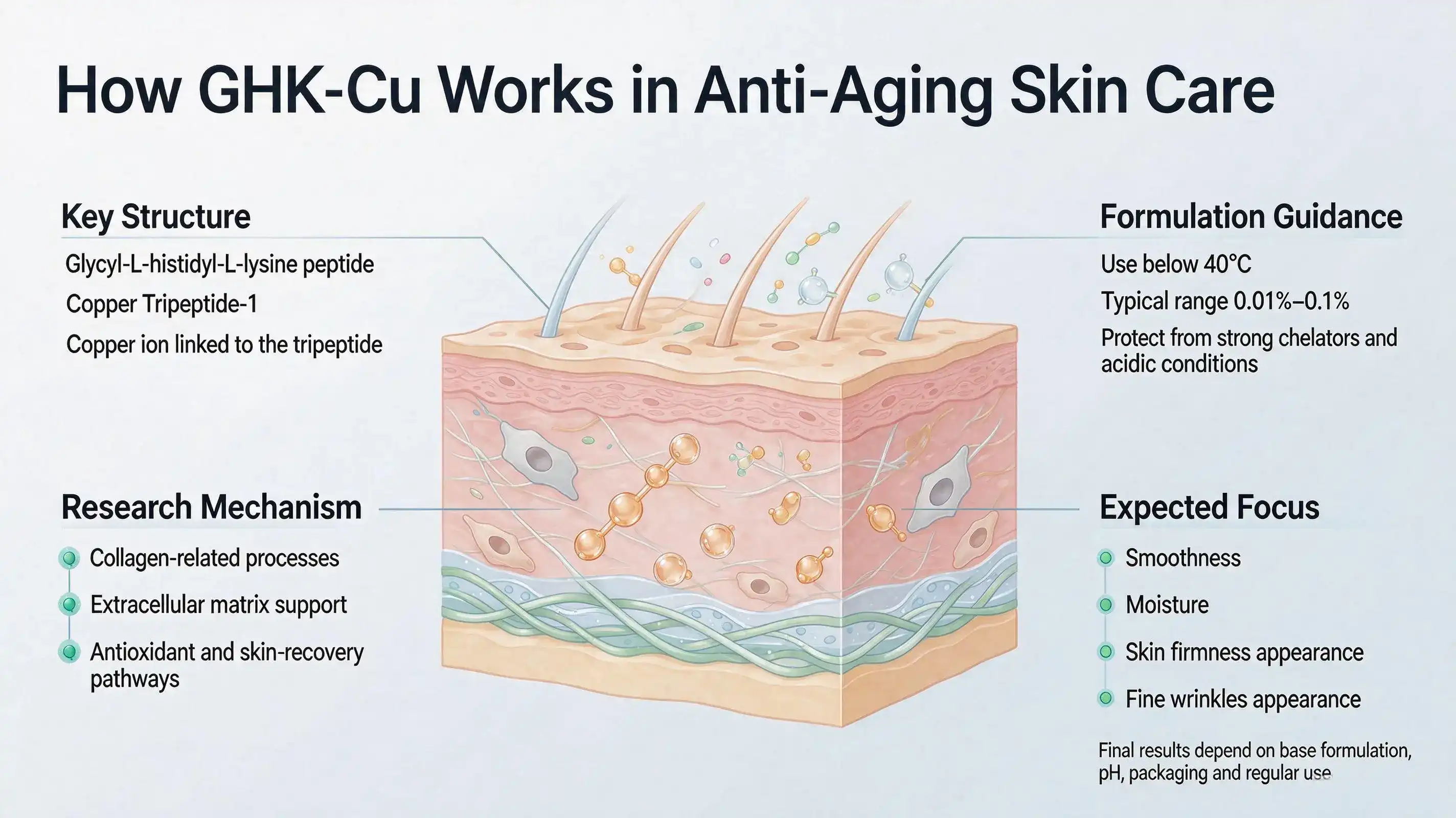
Connecting the Mechanism to Visible Concerns
Skin with dermal tissue and surface issues is dull, has small wrinkles, feels scratchy, and is less rigid. GHK-Cu seems to alter collagen, glycosaminoglycan, antioxidants, and skin-recovery processes. Strong, bendable, and waterproof items benefit from it. Makeup still improves appearance. They won't treat injuries or illnesses. Why does this matter in America? It alters brand labelling.
Why Formula Design Shapes Real Performance
Because it breaks down in water, the peptide works with most water-based skin care treatments. To maintain bioactivity, keep it below 40°C and use 0.01%–0.1%. Strong chelators and acidic substances like pure Vitamin C may disrupt the copper complex. Light and air can't pass through heavy or airless enclosures. Copper peptide product testing can last weeks rather than hours. Thus, frequent usage is crucial.
What Are the Potential Skin Benefits of GHK-Cu?
Immediate Effects on Feel and Smoothness
A good soap can clean and smooth your face right away. Base changes, moisturizing agents, and moisturizing oils all play a part in making that early result happen. Copper Tripeptide-1 adds its own signal peptide story, but the surface isn't soft just because of the peptide. To find out right away how the product feels, brands can measure how smooth the skin's surface is, use a corneometer to check for moisture, and ask customers to give feedback soon after using the product.
Longer-Term Appearance Benefits
Anti-aging GHK-Cu products target fine wrinkles, stiffness, elasticity, and rejuvenation. Making these outcomes evident from long-term promises keeps marketing honest and easy to defend. Cosmetics published a 2018 research showing copper peptide products improved wrinkles, skin density, and thickness. However, studies were conceived and executed differently. Not all products achieve these outcomes. Each completed serum requires confirmation since ingredients function differently regardless of quantity, pH, or container.
Evidence That Supports Claims
Tests that assess hydration, flexibility, and wrinkle depth, natural light photos of the skin before and after usage, controlled user trials, and stable data showing the active ingredient remains active in storage may support claims. I recommend testing every claim. To prove a product is stiff, you need consumer feedback or flexibility statistics. You need a corneometer to prove wetness. Keep good files to monitor test circumstances, panel size, and time. This allows purchasers and bureaucrats swiftly review claims.
How Does GHK-Cu Compare With Other Anti-Aging Ingredients?
GHK-Cu vs. Retinol and Hyaluronic Acid
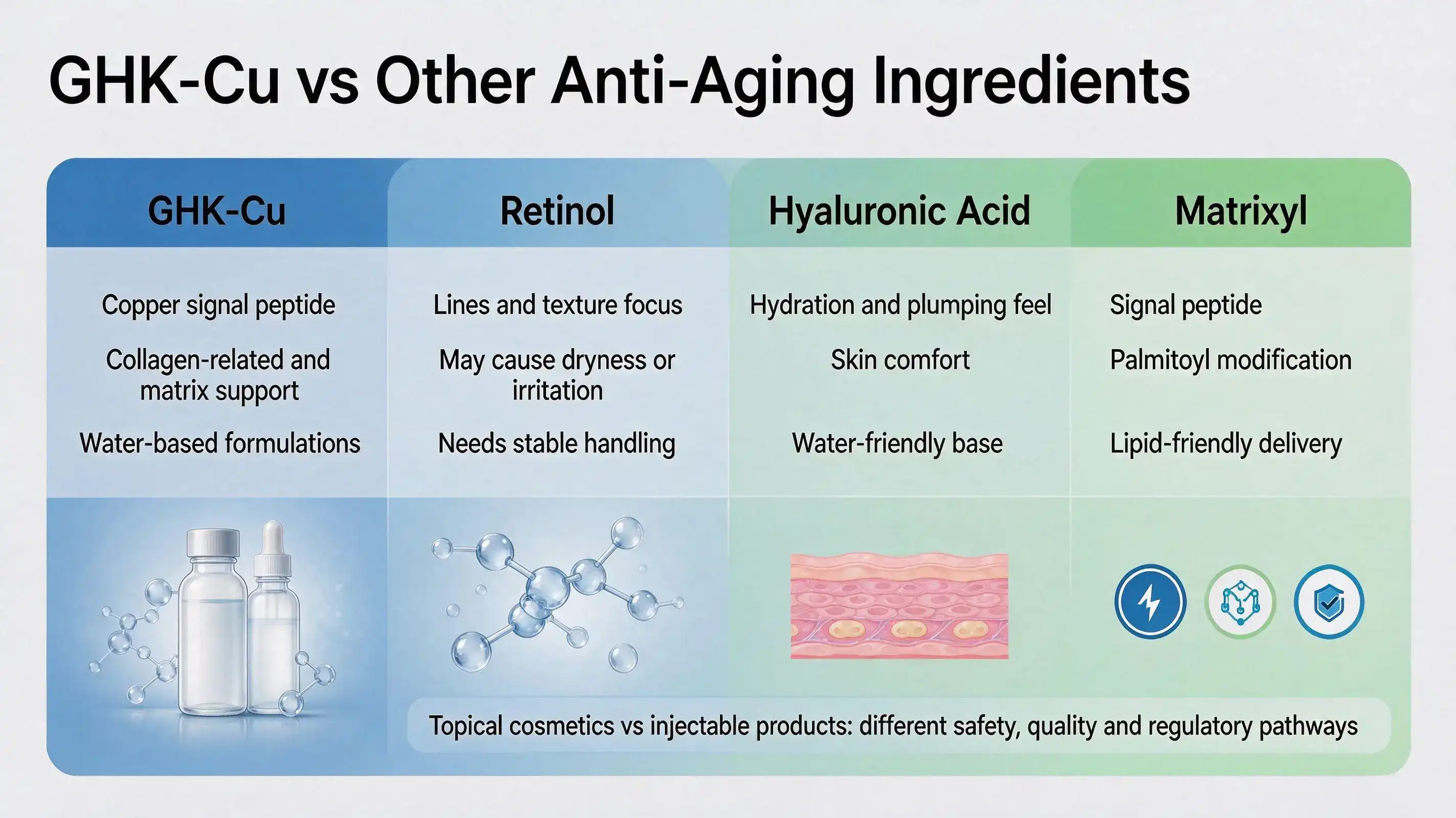
Most people use retinol to get rid of lines. However, the sun and air should be kept away from it because it can dry out and hurt the skin. Hyaluronic acid keeps the skin full and moist and feels good on it. It doesn't make the skin red or itchy. The peptides in GHK-Cu make it different from other skin care products. It is meant to help the skin heal and get stronger. Quite a few people mix them together because they both work well with water-based bases. Before you mix GHK-Cu and retinol, you should make sure they have stable pH levels.
GHK-Cu vs. Vitamin C and Matrixyl
Vitamin C helps cells appear better and stay safe. The copper complex may not operate with pure L-ascorbic acid due to its low pH. Keep them apart or try stable versions together to see how they operate. Non-palmitoyl pentapeptide-4 signal peptides are Matrixyl. They link to lipids better after the palmitoyl modification, changing their distribution. If brands can prove that, they can offer GHK-Cu as a copper-based peptide and Matrixyl as lipid-friendly.
Topical GHK-Cu vs. Injectable Products
Topical Anti-aging GHK-Cu in cosmetic formulations only acts on the superficial skin layer and is used to improve facial appearance. Injectable GHK-Cu differs from cosmetic products and is subject to separate safety, quality and regulatory requirements. Finished injectable products are not available for purchase. The Modernization of Cosmetics Regulation Act of 2022 requires U.S. brands to clearly state facility information on products. Confirm your compliance pathway before starting formulation development.
How Can Brands and Distributors Evaluate a GHK-Cu Supplier?
Specifications That Matter
We produce Copper Tripeptide-1 (GHK-Cu). CAS 49557-75-7 is Gly-His-Lys-Cu2+. It is at least 98.0% pure in HPLC and 99% pure in assay. The beauty peptide ships from stock, so purchase at least 1 gram. Small bits and 1 g, 100 g, or 1 kilogram packs are available. C14H24N6O4 shows how hefty the tripeptide ligand is. Check each COA's copper content. How does the product appear, break down, be stored, how much water is in it, and are there heavy metals?
Documents and Traceability
We deliver a Certificate of Analysis with every run, along with chromatogram data and trade compliance paperwork. No consistent template should be used by QA and procurement to compare these papers. They should examine the supplied batch. The COA, label, and shipment record should have the same batch number. We can trace the things this way. Check whether your product is stable and requires proof. Xi'an Yihui can accomplish ISO, Halal, and Kosher. Users from over 100 countries have utilised the service since 2010.
Total Procurement Value
Price is crucial, but quality, documentation, reliable shipment, and expert support come first. A cheaper lot without full records might delay start date or create a compliance gap. Copper Tripeptide-1 is always available in sealed corrosion-proof cartons. We also provide reduced MOQ. Our support crew works 24/7. We can't share this; we can only study it. Before ordering, request a sample and try it locally. Consider customer service and wait time.
What Are the Common Mistakes When Formulating GHK-Cu Skincare?
Treating Higher Concentration as Better
More peptide doesn't always mean better skin. If the price goes up, the blue copper complex might show through in a light base, and people might have more trouble getting along. It works best when added below 40°C and between 0.01% and 0.1%. Change things there based on what the panel says and how stable things are. Also, skin compatibility is important. Make sure that the finished product is gentle enough for sensitive or skin that has been through surgery. A mix that isn't too strong usually works better than one that has a lot of medicine in it.
Ignoring Stability and Claim Limits
Light, air, heat, pH, and metal ions are some of the factors that can alter Anti-aging GHK-Cu. Strong chelating agents can sequester copper, and the complex becomes less stable under acidic conditions. Evaluate pH, concentration, safety, and the performance of the complete formulation. Follow regulatory requirements and avoid claims that the product can treat disease or permanently eliminate wrinkles. Review not only the COA of raw materials but also the finished formulation. In all marketing materials, clearly distinguish cosmetic GHK-Cu from injectable products.
A Practical Development Workflow
I agree with this order. First, make a list of the skin care problem, price range, structure, rules, and people you want to reach. After that, choose GHK-Cu and any other actives that will help it do its job. This is the last step. Check the pH and thickness of the mix when you make it in the lab. Also, make sure the product is stable, has the right stabilizers, and works with the package.
Last, put it on a person or an instrument to see how it feels, looks, and acts after being used. Finally, make plans for restocking, including the minimum order quantity (MOQ) and how long it will take to come. This should be done after getting approval for the artwork, filing the appropriate paperwork, running a test run, and releasing the quality. To begin, each of the boosters, serums, ampoules, creams, masks, and serums must have its own structure and way of being used.
Conclusion
Copper Tripeptide-1, or GHK-Cu, is a peptide used in skin care products. It sends signals and has been linked to activity in collagen and extracellular matrix in the lab. This is why it's found in products that say they can make skin smoother, firmer, and less fine and wrinkled. The recipe itself is not as important as the food that goes into it. This includes the pH level, the amount, how it is shipped, how it is packed, and how often it is used.
Retinol, hyaluronic acid, vitamin C, and Matrixyl peptides do not interact the same way with Anti-aging GHK-Cu. Regulatory rules and allowable claims differ greatly between topical application and injection. Buyers get the best value when every claim is supported by test data, and they review purity records, documentation, traceability, and stability data. Phased development reduces the risk of avoidable mistakes early in the project.
FAQ
What is GHK-Cu used for?
It's used in makeup to improve the look of fine lines, smoothness, stiffness, and flexibility. It's also being looked into how to make skin better.
Is GHK-Cu safe for skin?
In public beauty tests, this peptide has been shown to be safe for most people and to happen spontaneously. There are still safety and sensitivity tests that need to be done on every finished formula.
How do I formulate with GHK-Cu?
It's broken down by water. If the temperature is below 40°C, you should add 0.01% to 0.1%. It is not a good idea to use strong chelators or lots of acidic systems.
Which documents should I request from a supplier?
You should ask for a COA, an MSDS, a chromatogram report, trade compliance papers, and information on how stable the product is. Also, make sure that the batch number on the package matches the batch number on the box.
Request an Anti-aging GHK-Cu Sample from Xi'an Yihui
A store in Xi'an called Yihui is where you can buy Copper Tripeptide-1. Their service team is available 24 hours a day, seven days a week, and they offer a 99% test. The minimum order size is 1 gram, and they deliver from stock. We will send you details and a sample of Anti-aging GHK-Cu if you email sales@yihuipharm.com with your target market, product format, and quantity. Please go to yihuipharm.com to learn more. People who need it for study are the only ones we can sell it to. No one else can buy from us.
References
1. Pickart L., Vasquez-Soltero J. M., Margolina A. GHK Peptide as a Natural Modulator of Multiple Cellular Pathways in Skin Regeneration. BioMed Research International, 2015.
2. Pickart L., Margolina A. Regenerative and Protective Actions of the GHK-Cu Peptide in the Light of the New Gene Data. International Journal of Molecular Sciences, 2018.
3. Pickart L., Margolina A. Skin Regenerative and Anti-Cancer Actions of Copper Peptides. Cosmetics, 2018.
4. Maquart F. X. et al. Stimulation of Collagen Synthesis in Fibroblast Cultures by the Tripeptide-Copper Complex Glycyl-L-Histidyl-L-Lysine-Cu2+. FEBS Letters, 1988.
5. Pickart L., Thaler M. M. Tripeptide in Human Serum Which Prolongs Survival of Normal Liver Cells and Stimulates Growth in Neoplastic Liver Cells. Nature New Biology, 1973.
6. U.S. Congress. Modernization of Cosmetics Regulation Act of 2022 (Federal Food, Drug, and Cosmetic Act amendments). 2022.

Send Inquiry
You may like
Related Industry Knowledge