
How does retatrutide work
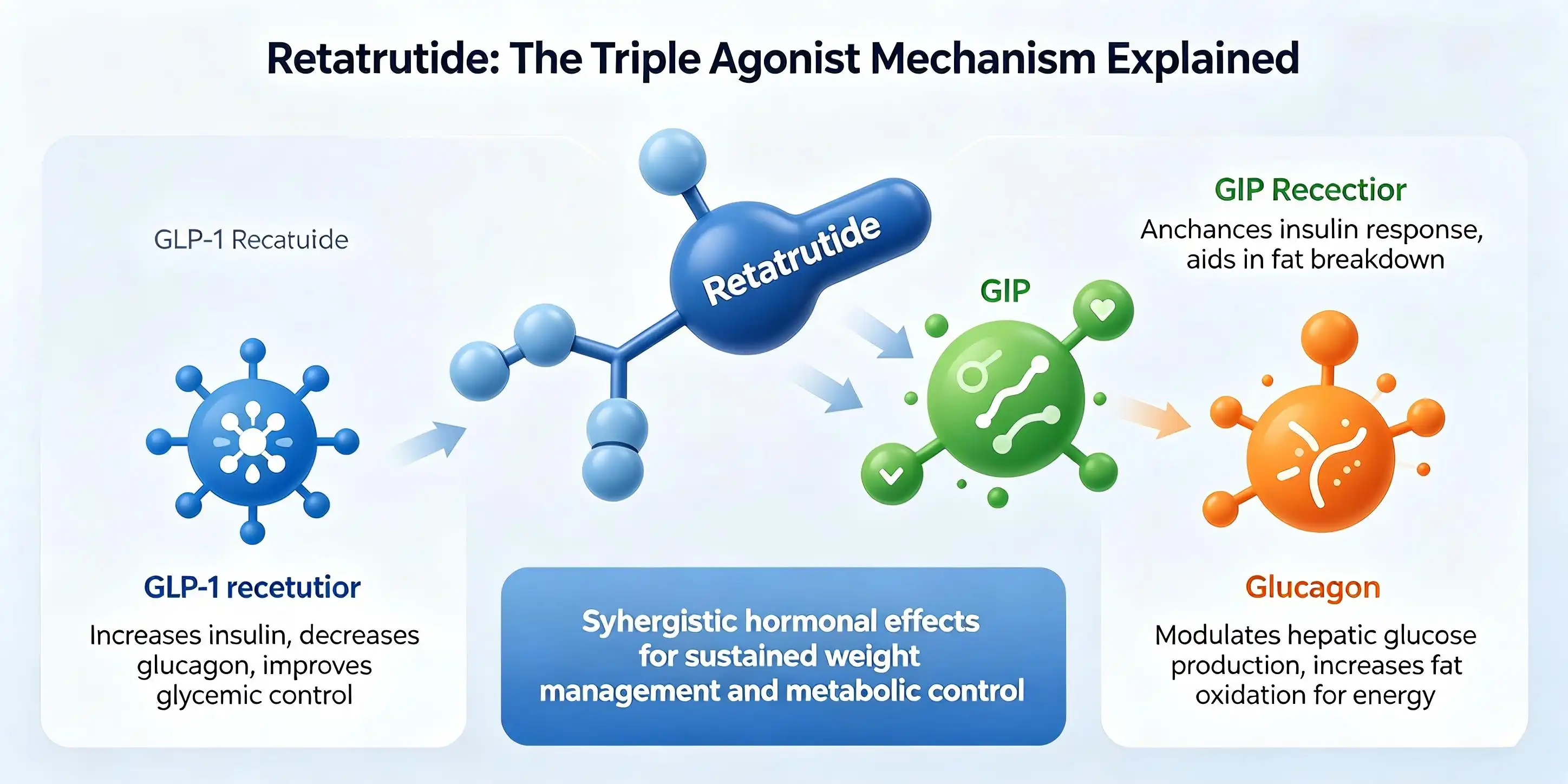
Retatrutide powder works by activating three different types of receptors at the same time: GLP-1, GIP, and glucagon. This tri-agonist approach controls the whole metabolic process: it lowers hunger through pathways in the central nervous system, increases glucose-dependent insulin secretion from pancreatic beta cells, slows gastric emptying to make feeling full last longer, and raises body temperature through glucagon-mediated thermogenesis.
Unlike single-target therapies, this multi-receptor engagement has effects that work together to treat the complex pathophysiology of both obesity and type 2 diabetes. With a molecular weight of 4731.33 Da and a carefully planned amino acid structure, the peptide ensures optimal receptor binding affinity and long-lasting pharmacological action. This makes it an attractive option for pharmaceutical R&D teams looking for next-generation metabolic interventions.
Understanding Retatrutide Powder: Composition and Mechanism of Action
Molecular Structure and Purity Standards
With its carefully designed 39-amino acid structure, Retatrutide powder (CAS: 2381089-83-2) is a big step forward in peptide engineering. The molecular formula C221H342N46O68 shows complex structural changes, such as aminoisobutyric acid and alpha-methylated leucine residues that make metabolism more stable.
Our pharmaceutical-grade material meets strict purity requirements of ≥99% by HPLC, which is a key standard for R&D formulation scientists who need results that can be repeated. The white to off-white lyophilised powder keeps its shape at -20°C±5°C, which is the right temperature for storage and makes sure that batch-to-batch uniformity is important for clinical research programs.
Protocols for quality assurance use a number of different testing methods. High-performance liquid chromatography checks to see if there are any shortened sequences or delete peptides. Mass spectrometry proves the exact molecular weight profile, and the LAL assay for endotoxin tests makes sure that amounts stay below 5 EU/mg for sensitive in vivo uses. The main thing that procurement managers worry about is making sure that APIs are safe and meet both regulatory standards and research performance requirements.
Triple-Receptor Activation Mechanism
The therapeutic novelty is that receptors are activated at the same time along three separate paths. When the GLP-1 receptor is activated, insulin is released in a way that depends on glucose. This lowers the chance of hypoglycemia compared to other diabetes drugs. This pathway also tells hypothalamic centers that the body is full, which directly makes people eat less. GIP receptor activation adds to this effect by improving beta-cell activity and encouraging the release of insulin in response to nutrients, especially after eating.
This peptide is different from other dual agonists on the market because it contains a glucagon receptor. When glucagon is released, the liver makes more glucose when you're fasting. At the same time, this increases energy use by making lipolysis and thermogenesis more efficient. This metabolic flexibility fixes one of the main problems with methods that only reduce the appetite: keeping the body's energy balance while losing weight.
Clinical trial data from Eli Lilly's Phase III program shows that this process leads to results that can be measured. Over the course of 48 weeks, participants lost an average of more than 20% of their starting body mass. This is a much better outcome than with semaglutide or tirzepatide alone. HbA1c drops by an average of 2.1%, showing that strong glycaemic control is helpful for diabetic patients.
Quality Control and Analytical Verification
When purchasing teams look at different sources, they need to know how to tell the difference between quality levels. For high-quality peptide synthesis, solid-phase peptide synthesis (SPPS) methods with strict cleaning steps are needed to get rid of chemical contaminants and incomplete sequences. The amount of residual trifluoroacetic acid should stay below 10% so that it doesn't mess up biological tests and there aren't too many concerns about its safety.
Karl Fischer titration for moisture content research shows that the lyophilization process is working correctly, since too much water speeds up the breakdown process. Our standards keep the moisture level below 5%, which means that when stored correctly, the food will last up to two years. The paperwork for the Certificate of Analysis should include tests for sterility, verifying the amino acid composition, and quantifying the peptide content. These are all basic requirements for pharmaceutical production compliance.
Benefits and Applications of Retatrutide Powder in Weight Management and Diabetes
Clinical Efficacy in Metabolic Disease Management
The fact that obesity and type 2 diabetes can both be treated opens up huge market opportunities. The compound's ability to cause long-lasting weight loss without the plateau effect that often happens with diet and exercise alone makes it useful for weight management. There are several ways that the appetite is reduced: delayed gastric emptying makes you feel fuller for longer after a meal, and effects on the central nervous system stop you from eating for pleasure.
From the point of view of managing diabetes, the result of dropping glucose works in ways that work together. Increasing insulin release helps control glucose levels after a meal, and changing the liver's glucose output helps with fasting hyperglycemia. Because these effects rely on glucose levels, hypoglycemic episodes are less likely to happen. This is an important safety factor that quality assurance managers look at when they look at treatment risk profiles.
Comparative efficiency studies done by research institutions have shown that these drugs are better than current GLP-1 receptor agonists. Adding glucagon receptor agonism leads to about 30–40% more weight loss than GLP-1 monotherapy. This fills in the gaps in effectiveness that kept people from using earlier generation therapies. Because of this difference in performance, higher prices are reasonable, and formulators working on the next wave of fat drugs will be able to compete.

Safety Profile and Adverse Event Management
Understanding the safety environment helps with choices about what to buy and how to make new medicines. Similar to the GLP-1 class, the most common side effects are gastrointestinal symptoms like nausea, vomiting, and diarrhoea, which happen most often during dose increase stages. As the body gets used to the exposure, these effects usually get weaker over time. retatrutide powder, when considered in this context, shares the same safety profile regarding gastrointestinal tolerability during titration, though its unique triple-agonist mechanism may introduce additional metabolic effects that are still under clinical investigation.
Cardiovascular safety data from ongoing Phase III studies will give us solid proof, but early signs show that the drug may have neutral to positive effects on blood pressure and cholesterol profiles. When someone loses weight through treatment, it helps with health problems related to obesity, such as obstructive sleep apnoea, nonalcoholic fatty liver disease, and osteoarthritis. These extra benefits make the value argument stronger for healthcare systems that are figuring out how cost-effective something is.
For companies that make cosmetic ingredients that are looking into medical aesthetics uses, the metabolic improvements mean better skin health. Stabilising your weight lowers the muscular stress on your skin's structures, and making your body more sensitive to insulin may slow down the ageing process caused by inflammation. These links allow pharmaceutical and dermatological product development teams to work together to come up with new ideas.
Comparing Retatrutide Powder with Alternative Peptide Powders and Diabetes Treatments
Competitive Analysis: Tirzepatide and Semaglutide
People who work in procurement can gain from knowing what makes different incretin-based therapies perform differently. Tirzepatide, a dual GLP-1/GIP agonist, worked very well in the SURMOUNT clinical program, helping people lose weight by 15–21% on average, depending on the dose. The addition of glucagon receptor agonism should provide extra benefit, but head-to-head studies are still needed to confirm this.
At its highest amounts, semaglutide, which is currently the market leader, causes weight loss of about 12 to 15 percent. It's easy to use because it only needs to be put under the skin once a week, but the single-receptor mechanism may be too weak for patients who need more help. A study of costs shows that tirzepatide costs around $1,000 to $1,200 a month, setting market standards for high-end multi-agonist treatments.
The way the drug binds to receptors causes unique chemical properties. Pure GLP-1 agonists, such as liraglutide, make people feel sick more often because they activate more pathways at once. Spreading activity across three receptors might make it easier for people to handle by lowering the strength of stimulation at any one receptor. However, direct comparison studies are needed to show this in humans. Formulation scientists who are making treatment plans that focus on the patient are interested in this theoretical advantage.

Market Positioning and Strategic Value
Early entry into the tri-agonist peptide market has strategic benefits from the point of view of the supply chain. As Eli Lilly moves into the late stages of development, API suppliers that position themselves as qualified vendors get first dibs on new demand. The world market for treating obesity was worth $2.4 billion in 2023, but it's expected to be worth more than $15 billion by 2030 as more people use new drugs.
Complex manufacturing creates hurdles to entry that help companies that are already making peptides. To make the 39-amino acid sequence with its many non-natural changes, you need more than just standard peptide production skills in chemistry and analysis. This technical moat protects the profit margins of qualified providers who put money into developing processes and setting up quality systems.
Decisions about when to buy things are affected by the regulatory pathway. As regulatory applications move through the FDA and EMA review process, demand will change from small amounts for study to large amounts for business use. Suppliers who can go from making grams to kilograms while still meeting quality standards see themselves as long-term partners instead of just transactional suppliers. When suppliers change in the peptide market, expensive revalidation studies have to be done, so this relationship continuity is very helpful.
Procurement Guide: Buying Retatrutide Powder for Bulk Use
Supplier Qualification and Certification Requirements
To find good peptide suppliers, you need to carefully look at their manufacturing skills and compliance systems. The ISO9001 certification shows that a quality management system is being used, and the ISO22000 certification talks about food safety management that is useful for nutraceutical uses. Checking for pollution is very important for injectable-grade materials, and HACCP methods do just that. retatrutide powder, as a novel investigational peptide, demands even stricter scrutiny of these quality benchmarks, since its purity and sterility directly affect both research reproducibility and patient safety in clinical settings.
GMP certification is the top standard when it comes to pharmaceutical uses. Suppliers should show proof of facility inspection reports from reputable regulatory bodies and show they have experience making peptide APIs in controlled environments. Being able to provide Drug Master Files (DMF) makes regulatory submissions easier for formulators working on business goods. This gives suppliers with well-established paperwork systems an advantage.
Kosher and Halal licenses help sellers who serve a wide range of global markets get into more markets. To get these certifications, the manufacturing processes and where the ingredients come from have to be checked by outside parties. This adds to the confidence in the supply chain. When buying things for international companies, procurement managers like it when sellers have a lot of different certifications to meet the needs of different regions.
Quality Verification and Testing Protocols
When you get bulk peptide orders, you can protect yourself from getting materials that aren't up to par by doing verification testing. Each shipment should come with a proof of analysis, but independent evidence from third-party labs is even better. Identity verification is part of priority tests, and mass spectrometry is used to make sure the molecular weight matches what theorists say it should be for the right sequence.
Analytical HPLC should show a single major peak that corresponds to the target peptide, along with other substances that are linked being found and measured separately. For medicinal uses, acceptance standards usually say that the purity must be at least 98–99%. Tougher rules are in place for certain impurities that may have biological activity. Gas chromatography testing for residual solvents makes sure that enough of the manufacturing solvents have been removed during purification.
Finding the peptide content tells you how much of the active ingredient is actually present, taking into account water, counterions, and other parts that aren't peptides. This value is different from purity and has a direct effect on how formulations are calculated. To avoid preparation mistakes, it should be made clear in the specifications whether the peptide content is given "as is" or without water. Professionals who buy peptides on a regular basis are not interested in these scientific details.
Logistics and Storage Optimization
Temperature-controlled logistics are needed to keep peptides stable during shipping. Shipment of dry ice in insulated containers keeps things safe while they're in transit, and temperature monitoring devices show that no changes happened. Some sellers keep goods in regional warehouses, which lets them deliver within one to three days. This cuts down on cold chain exposure and speeds up project timelines.
Immediately putting it in storage at -20°C after receiving it stops it from going bad. Lyophilised peptides are very stable when they are frozen, but they break down quickly when they are mixed with water. When labs need working stocks, making aliquots cuts down on the number of freeze-thaw cycles that can damage the structure of peptides. Most of the time, tri-agonist peptides are most stable when they are reconstituted in slightly acidic buffers (pH 4-6).
Specifications for packaging should include ways to keep moisture out, like using sealed foil bags or amber glass bottles with the right closing systems. When dealing with large amounts, it's best to break them up into smaller pieces so that there is less chance of contamination during repeated entry. Clear labels with batch numbers, manufacturing dates, and expiration dates make it possible to track products throughout their entire lifecycle, which is necessary in regulated manufacturing environments.
Future Outlook and Market Trends for Retatrutide Powder in Pharmaceutical Procurement
Emerging Applications and Research Directions
In addition to obesity and diabetes, research teams are looking into other therapeutic uses that could make the market bigger. Nonalcoholic steatohepatitis (NASH) is a big unmet need where tri-agonist therapy may reverse hepatic fibrosis by improving metabolism. Cardiovascular outcome studies will find out if losing weight leads to fewer big adverse cardiac events.
If so, the substance might be useful for secondary protection. retatrutide powder, as the experimental form of this triple-agonist candidate, is central to these ongoing trials, and its stability and dosing precision are critical factors that will determine whether the observed metabolic and cardiovascular benefits can be reliably translated into clinical practice.
Combination treatment methods offer a different way to grow. When you combine tri-agonist peptides with mechanisms that work in a different way, like amylin analogues or lipase inhibitors, the effects may be stronger. This method works well for patients who don't respond to other treatments or who reach a plateau with one treatment. API makers benefit from combination goods because they keep customers coming back, even when biosimilars start to compete with single-agent formulations.
In medical beauty, metabolic health changes are used to improve the way someone looks. Body contouring clinics might use peptide therapies to improve fat loss procedures, and dermatology clinics might treat skin conditions caused by obesity. For these cross-sector chances to work, sellers need to know how to deal with different legal systems for cosmetic ingredients, medical equipment, and pharmaceuticals.
Regulatory Evolution and Compliance Considerations
The rules for peptide therapeutics are getting more complex as time goes on, with agencies putting in place stricter analytical requirements. In their guidance on peptide drug substance characterisation, the FDA stresses the need for thorough impurity profiling and process-related substance identification. As standards get stricter, suppliers who invest in advanced analytical tools will be in a good position.
Concerns about the environment are pushing peptide synthesis to use green chemistry. Manufacturing operations have less of an impact on the environment when they use solvent recovery systems, aqueous-based purification methods, and renewable reagents. Sustainability factors are being added to supplier scorecards more and more by procurement teams. This gives environmentally conscious makers a competitive edge.
International harmonisation through ICH guidelines makes it easier for products to be sold in all over the world, but suppliers have to make sure they follow the rules in all of these different places. Full-service suppliers are different from regional makers because they can provide paperwork that meets legal standards in the US, Europe, Japan, and China. This global compliance feature is especially useful for international drug companies that manage centralised procurement across different areas.
Strategic Partnership Development
Because advanced peptide treatments are so complicated, it's better to have long-term ties with suppliers than to buy things one time. When engineers work together in the early stages of development, they can improve the cost structure and make the process more efficient, which is good for everyone. Suppliers who take the time to learn about their customers' needs can suggest formulation improvements or analytical strategies that cut down on the time it takes to develop new products.
As products move forward in clinical testing, capacity reservation deals protect the supply chain. The industry that makes peptides sometimes has trouble meeting demand because too many programs are trying to use the same limited synthesis slots. Procurement managers who are forward-thinking negotiate capacity commitments during the research phase to get early access when commercial demand comes up.
Formulators can finally make their own products or switch to different suppliers without having to do a lot of revalidation work if they can move technology. Suppliers who carefully document processes and help with tech transfer show that they are confident in their quality systems and build trust, which leads to repeat business and referrals. These changes in relationships are becoming more and more important for positioning in the specialised peptide supply market.
Conclusion
Knowing how this tri-agonist peptide works by activating GLP-1, GIP, and glucagon receptors at the same time is important for making smart choices about what to buy. The process has better metabolic effects than single-target therapies, which supports its place as a next-generation option for managing diabetes and obesity. Purity, peptide content, and analytical verification are some of the quality standards that make sure materials meet the high standards needed for pharmaceutical development and clinical research.
Retatrutide powder, in particular, requires the most rigorous application of these quality criteria, as even minor deviations in purity or content can significantly alter its receptor activation balance and clinical outcomes. As the market changes due to new indications and regulatory approvals, procurement teams that form early partnerships with suppliers will be able to take advantage of this transformative therapeutic class while managing supply chain risks well.
FAQ
What distinguishes this tri-agonist from dual-agonist peptides?
This compound is different from dual GLP-1/GIP agonists like tirzepatide because it binds to glucagon receptors. Activating glucagon makes you burn more calories by improving thermogenesis and lipolysis, which are processes that are missing in dual-agonist formulas. Based on early study results, this extra pathway should theoretically lead to 30–40% more weight loss, solving the effectiveness plateau seen with earlier generation treatments. The multi-receptor method also spreads pharmacological activity across pathways, which might make adverse events less severe than with single-target agents that are fully dosed.
What storage conditions preserve peptide stability during warehousing?
Lyophilised material needs to be kept at -20°C±5°C in cases that are covered, won't let moisture in, and are out of the light. Under these conditions, a product that was made correctly stays pure and effective for 24 months after the date it was made. Changes in temperature above -10℃ speed up decline, especially if they happen over and over again. Reconstituted solutions are not as stable as freshly made solutions, so they should be made from scratch every time or kept at 2–8°C for no more than 72 hours if they are properly buffered.
How do procurement teams verify supplier authenticity and product quality?
Checking the supplier's certifications, such as ISO9001, GMP compliance, and any relevant pharmacopeial registrations, is the first step in the verification process. By asking for proof of analysis with each shipment, you can get quality data that is specific to each batch. Using mass spectrometry and HPLC analysis, independent testing by third-party labs that have been approved by the government proves the identity and purity of the substance. Suppliers should be happy to give you reference standards and detailed methods for analysis. Site audits of manufacturing facilities let you directly check the quality systems and production capabilities. This is especially important before you agree to buy a lot of something.
Partner With Xi'an Yihui for Reliable Retatrutide Powder Supply
Securing pharmaceutical-grade peptides requires a supplier who understands the critical intersection of quality, regulatory compliance, and supply chain reliability. Xi'an Yihui Bio-technology Co., Ltd. brings 13 years of specialized experience in advanced peptide synthesis, serving over 100 countries with materials that meet stringent international standards. We can make Retatrutide powder and have a wide range of certifications, such as ISO9001, ISO22000, HACCP, Halal, and Kosher, to meet the needs of different governing bodies around the world.
We maintain ready stock in regional stores so that we can deliver within one to three days, which speeds up your development timelines and reduces the risk of cold chain exposure. Our technical team gives you full documentation, such as COAs, MSDSs, and data on how to validate methods, which makes your quality control processes easier. Flexible packing choices range from 1g for study purposes to 100g for large sales, so they can be used for projects at any point, from the early stages of finding to mass production.
Our edge over our competitors goes beyond the quality of our products and includes the technical help that transforms suppliers into strategic partners. Our team can help you with custom peptide synthesis, formulation advice, or regulatory documentation. We can make solutions that fit your exact application needs. Contact our procurement specialists at sales@yihuipharm.com to discuss your requirements and discover how our retatrutide powder for sale meets the exacting standards your projects demand.
References
1. Jastreboff AM, Kaplan LM, Frías JP, et al. Triple-hormone-receptor agonist retatrutide for obesity: A phase 2 trial. New England Journal of Medicine. 2023;389(6):514-526.
2. Coskun T, Sloop KW, Loghin C, et al. LY3298176, a novel dual GIP and GLP-1 receptor agonist for the treatment of type 2 diabetes mellitus: From discovery to clinical proof of concept. Molecular Metabolism. 2018;18:3-14.
3. Müller TD, Finan B, Bloom SR, et al. Glucagon-like peptide 1 (GLP-1). Molecular Metabolism. 2019;30:72-130.
4. Nauck MA, Quast DR, Wefers J, Meier JJ. GLP-1 receptor agonists in the treatment of type 2 diabetes: State-of-the-art. Molecular Metabolism. 2021;46:101102.
5. Drucker DJ. GLP-1 physiology informs the pharmacotherapy of obesity. Molecular Metabolism. 2022;57:101351.
6. Tschöp MH, DiMarchi RD. Unimolecular polypharmacy for treatment of diabetes and obesity. Cell Metabolism. 2021;33(4):692-701.

Send Inquiry
Related Industry Knowledge