
How Does Etelcalcetide Affect Calcium Levels?
Etelcalcetide hydrochloride lowers calcium levels indirectly. It activates the calcium-sensing receptor (CaSR) on parathyroid cells, and those cells then release less parathyroid hormone (PTH). With less PTH, bone releases less calcium, so serum calcium often falls. In adults with chronic kidney disease (CKD) on hemodialysis, this effect helps control secondary hyperparathyroidism (SHPT). It also means calcium can drop too far, so clinicians check blood levels often. I wrote this guide for pharmaceutical, research, and laboratory teams in the United States who want clear science and clear sourcing details.
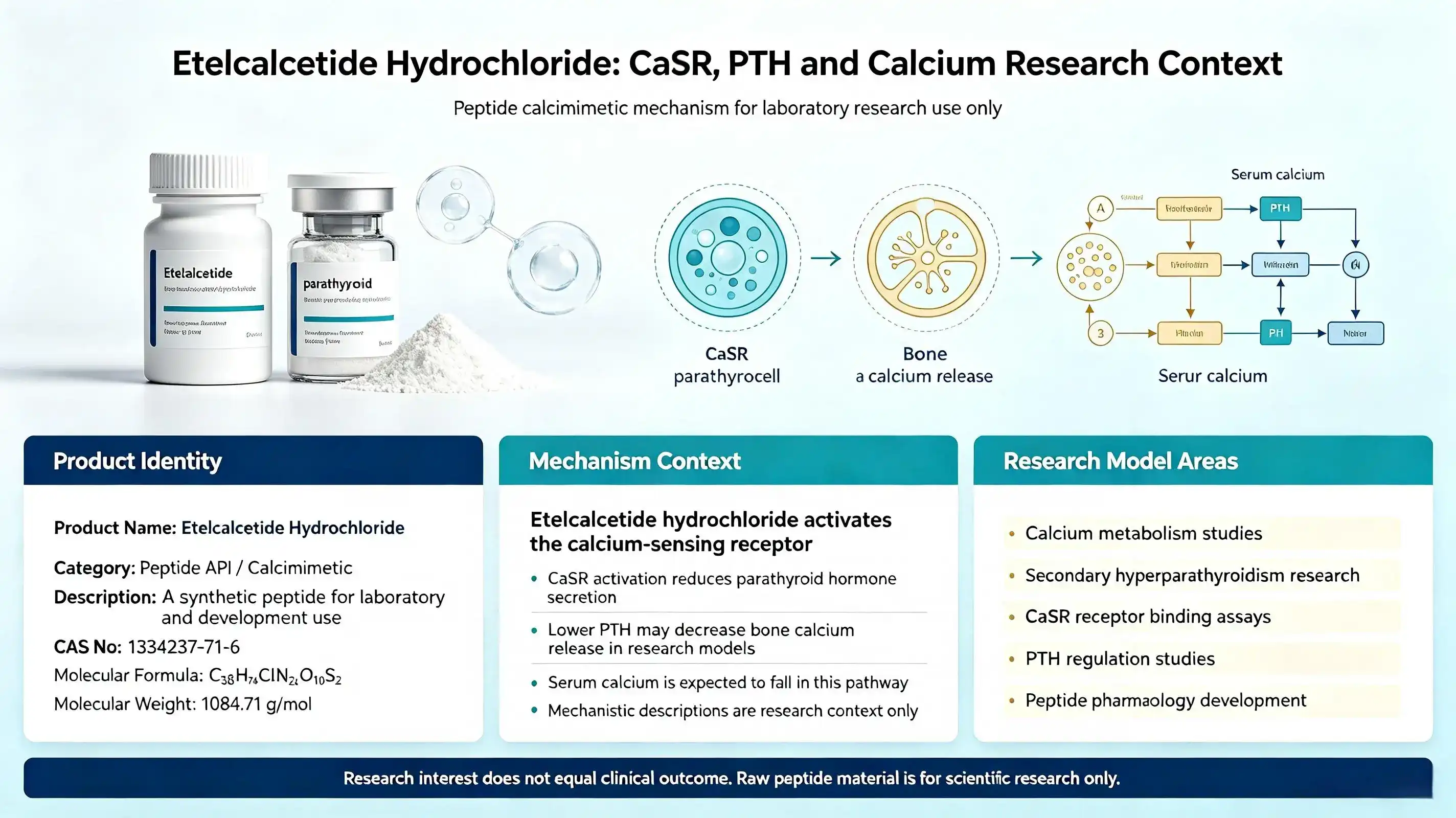
How Etelcalcetide Hydrochloride Influences Calcium Levels
CaSR Activation and PTH Suppression
The CaSR supplies calcium to parathyroid cells. The receptor directs the gland to generate less PTH when blood calcium rises. Calcimimetic Etelcalcetide hydrochloride replicates this signal. Connects and activates the CaSR. This makes the gland think calcium levels are greater than they are. PTH production drops. In three quarters of haemodialysis patients on Etelcalcetide hydrochloride, PTH dropped by above 30%. In comparison, fewer than 10% of placebo users saw PTH decline more than 30%. JAMA published both phase 3 studies' findings in 2017. PTH declines fast, so researchers read it first, then calcium.
Why Serum Calcium Falls
When taking the drug, Ca2+ stays in the blood. It changes hormone function. When PTH signals calcium production, bones do. It also activates vitamin D, which aids intestinal calcium absorption. Low PTH levels reduce bone calcium production, lowering blood pressure. CKD patients have high PTH levels, hence therapy aims to reduce these. Calcium levels below the usual range (8.5–10.5 mg/dL, although labs vary) increase risk. This backward approach may assist researchers determine PTH, calcium, phosphate, and bone marker levels.
What Shapes Each Patient's Calcium Response
Two patients will feel differently about the same item. Initial calcium and PTH levels matter most. A person with elevated PTH loses calcium faster. Calcium dialysate, vitamin D, calcium-based phosphate binders, meals, and pharmaceuticals may also modify this. Dialysis removes the medication, thus plenty is needed. They should explicitly write these parameters down while modelling them in the lab. One source of data noise is eliminated by this well-documented, pure peptide lot. The changes you perceive are caused by biology, not material quality.
Etelcalcetide Mechanism of Action and Clinical Use in Hemodialysis
A Peptide Calcimimetic Built With D-Amino Acids
Etelcalcetide hydrochloride is a human-made peptide. A disulphide bond connects seven D-amino acids and one L-cysteine. Our product is composed of [Ac-D-Cys-D-Ala-D-Arg-D-Arg-D-Arg-D-Ala-D-Arg-NH₂] ↔ [L-Cys]. Peptidases that don't break down D-amino acids are helpful for bloodstream medicines. Its formula is C₃₈H₇₄ClN₂₁O₁₀S₂ and its molecular weight is 1084.71 g Your team must consider these when building an HPLC or mass spectrometry technique. This is because identification tests begin with mass and sequence. Experts can predict peptide behaviour in buffers based on structure.
Clinical Use in Hemodialysis
The U.S. Food and Drug Administration (FDA) approved the brand-name drug Parsabiv for SHPT in hemodialysis-dependent people with CKD in 2017. That's how often the dialysis team puts it in: once a week, three times a week. The label says that 5 mg is the best starting dose, but doctors change it based on lab results. The label doesn't cover people with CKD who aren't on dialysis, and the drug wasn't tested on people with primary hyperparathyroidism or parathyroid carcinoma. There is a difference between it and our Etelcalcetide hydrochloride. We never sell it to people to use for their own pleasure; we only sell it for research purposes.
Pharmacokinetics and Dialysis Timing
Time is important because dialysis gets rid of Etelcalcetide hydrochloride. Because it is dosed at the end of the session, the drug stays in the body between sessions. To work in blood, it doesn't need cytochrome P450 enzymes. Instead, it trades disulfide bonds with plasma proteins like albumin. This changes the way the study is set up. People who study CaSR in cells or on animals need to make sure that proteins will bind to their media and use HPLC to check the concentration of peptides before each series. We give you an HPLC chromatogram and an MS report with every package to help you with that step.
Calcium Monitoring, Safety, and Drug Interactions
Calcium Monitoring Schedule
Doctors should examine the patient's blood calcium level before the first dosage, one week after beginning therapy or modifying the dose, and every four weeks while on the drug. If calcium intake is below normal, the medicine shouldn't be administered. Since one number might be inaccurate, PTH is viewed as a trend. Other tests include phosphate, magnesium, and albumin. Low albumin makes calcium seem lower than free, active calcium. This is why albumin matters. Teams compare same-lab data wherever possible. Because laboratories employ various test procedures and reference ranges.
Adverse Effects and Contraindications
Calcium deficiency is the main danger. The label lists negative symptoms such low blood calcium, muscular spasms, nausea, vomiting, diarrhoea, headaches, and loss of sensation. QT delay, tachycardia, low blood pressure, seizures, and increasing heart failure may result from severe hypocalcaemia. The label also warns about upper GI bleeding and bone-locking disease. Avoid using the product due to a known response. Heart patients and seizure sufferers require special attention. Doctors should investigate a reduction in calcium levels immediately and follow the warning.
Drug Interactions
Etelcalcetide hydrochloride doesn't often connect with body molecules since it doesn't require cytochrome P450 enzymes. Common calcium effects are the major concern. Calcium supplements, calcium phosphate binders, vitamin D analogues, and other calcimimetics may alter calcium or PTH. Clinicians check the whole list of medications before beginning or altering treatment. They strictly observe label instructions for concurrent calcimimetic usage. Calcium deficiency may lengthen the QT interval, therefore cardiac rhythm medicines should be reconsidered. When adding a second chemical to a CaSR test, researchers should note how it affects calcium readings.
Etelcalcetide Compared With Other SHPT Treatments
Etelcalcetide vs. Cinacalcet
Both medications are calcimimetics. Oral cinacalcet alters CaSR function. IV Etelcalcetide hydrochloride is administered during dialysis. A 2017 JAMA study examined 683 haemodialysis patients. Only 57.7% of cinacalcet users reported a PTH reduction of more than 30%, compared to 68.2% of Etelcalcet users. After passing noninferiority, dominance was passed. Both groups had lower calcium levels, therefore either medication should be monitored. Another factor affecting the best decision is obedience, stomach tolerance, dialysis unit work flow, and area marking.
Vitamin D Analogs and Other Options
Paricalcitol activates vitamin D receptors. PTH might decline while calcium and phosphate increase. Doctors may blend calcimimetics with phosphate because they diminish calcium and phosphate. According to the 2017 KDIGO report on CKD-mineral and bone disease, dialysis patients who need to reduce PTH should take calcimimetics, calcitriol, vitamin D analogues, or a combination. The appropriate therapy for each patient relies on their treatment response and calcium, phosphate, and PTH levels. These distinctions allow researchers to compare objects.
A Practical Decision Path for Research and Procurement Teams
Choose a career: route research, assay development, peptide drug development, or analyst. Ensure the grade helps you achieve your aim. Early research requires clear, understandable identity data. More documentation and a formal quality agreement are needed for government program management. Compare quality, papers, wait time, MOQ, and overall cost, not just pricing. Store this peptide at -20°C and away from light and water. Pre-plan its storage. Now, list your choices and reasons. When new regulations or facts emerge, reconsider your option. A brief message might also help when new team members arrive.
Etelcalcetide Hydrochloride Specifications, Documentation, and Supplier Checks
Product Specifications at Xi'an Yihui
Our Etelcalcetide hydrochloride has the CAS number 1334237-71-6. The assay is 99% pure, and the HPLC is ≥98% pure. The powder seems to be white to light white. We put 1 g, 100 g, and 1 kg in bags. The minimum order quantity is 1 gram. At -20°C, keep it away from light and water. The item is in stock and can be sent out right away. It can only be used for research. It is often used for research into calcium metabolism, hyperparathyroidism, kidney health, peptide drug development, and endocrine research. People aren't the only ones we sell to; companies and organizations are.
Documents to Request Before You Buy
We provide a COA, HPLC chromatogram, mass spectrometry report, and MSDS with every shipment. When making products, we follow ISO 9001 and ISO 14001, and our key performance measurements meet European and American drug requirements. Make sure a service provider's documentation matches your project's status before hiring. To be meaningful, a COA must include assay, test procedures, results, and batch number. Learn how items will be transported and stored. Then, quality managers may follow each batch from shipment to usage. If you require extra documentation, let us know before project start. We'll try to assist.
How to Evaluate a Supplier
Make sure the seller makes the peptide and not just sells it. Goods that are research-grade and GMP-grade are used for different things, so make sure that the grade you choose is right for your needs. Put the MOQ, lead time, package sizes, export documents, and payment terms in writing in the RFQ. This will make the quotes line up next to each other. We have been in business since 2010 and ship to more than 100 countries. Xi'an Yihui has ISO, Halal, and Kosher certifications. We're here for you 24 hours a day, seven days a week, and our MOQ is cheap. Send us an RFQ with the papers you need, the amount you need, and the quality level you want. We'll get back to you on this.
Conclusion
Etelcalcetide hydrochloride indirectly reduces calcium. It activates the CaSR, decreases PTH, and lowers blood calcium because bones manufacture less. Patients might respond differently to baseline calcium and PTH, vitamin D, phosphate management, and dialysis. Before the initial dosage, after a change, and every four weeks, monitor calcium levels since they may decrease too low. Etelcalcetide hydrochloride is administered intravenously during dialysis, whereas cinacalcet is taken orally. JAMA reported in 2017 that more individuals experienced 30% or greater PTH drops. Research teams trust calcium-pathway data due to its comprehensive papers, explicit peptide IDs, and HPLC purity.
FAQ
What is Etelcalcetide indicated for?
This drug can be used to treat secondary hyperparathyroidism in adults with CKD who are on hemodialysis. Etelcalcetide hydrochloride is a peptide that is used in research to look into how the parathyroid glands work and how calcium levels are controlled. We do not sell it for human use.
Is Etelcalcetide a calcimimetic?
Yes. It activates the calcium-sensing receptor on parathyroid cells and lowers PTH secretion. In models of kidney health, hormonal health, and calcium metabolism, this method is used to learn more about them.
How to store Etelcalcetide HCl?
At -20°C, keep it away from light and water. Find out how to store your Etelcalcetide hydrochloride by reading the notes on your COA.
Can individuals buy it?
Not at all. Business, schools, and labs are the only ones who can buy from us.
Request Etelcalcetide Hydrochloride Supplier Information from Xi'an Yihui
Want to buy Etelcalcetide hydrochloride from a company that also stocks research-grade peptide? Xi'an Yihui offers customer service and output that is ISO-certified 24 hours a day, seven days a week. You can email sales@yihuipharm.com with the amount, package size, and paperwork you need, or you can visit yihuipharm.com to learn more. Companies and labs are the only ones we work with. People are not our clients.
References
1. Block GA et al., Effect of Etelcalcetide vs Cinacalcet on Serum Parathyroid Hormone in Patients Receiving Hemodialysis With Secondary Hyperparathyroidism: A Randomized Clinical Trial, JAMA, 2017.
2. Block GA et al., Effect of Etelcalcetide vs Placebo on Serum Parathyroid Hormone in Patients Receiving Hemodialysis With Secondary Hyperparathyroidism: Two Randomized Clinical Trials, JAMA, 2017.
3. Parsabiv (etelcalcetide) Prescribing Information, U.S. Food and Drug Administration, 2017.
4. KDIGO 2017 Clinical Practice Guideline Update for the Diagnosis, Evaluation, Prevention, and Treatment of Chronic Kidney Disease-Mineral and Bone Disorder, Kidney International Supplements, 2017.
5. Walter S et al., Pharmacology of AMG 416 (Velcalcetide), a Novel Peptide Agonist of the Calcium-Sensing Receptor, for the Treatment of Secondary Hyperparathyroidism in Hemodialysis Patients, Journal of Pharmacology and Experimental Therapeutics, 2013.
6. Block GA et al., Cinacalcet for Secondary Hyperparathyroidism in Patients Receiving Hemodialysis, New England Journal of Medicine, 2004.

Send Inquiry
You may like
Related Industry Knowledge