
GHK-Cu Peptide Serum: Copper Peptides for Skin Firmness
GHK-Cu (Copper Tripeptide-1, CAS 49557-75-7) is one of the most studied signal peptides in modern skincare science. Originally isolated from human plasma, this tripeptide with sequence Gly-His-Lys-Cu²⁺ has earned a strong position in anti-aging formulation because of its documented ability to stimulate collagen synthesis, accelerate wound repair, and reduce oxidative stress. For B2B buyers developing premium serums or clinical-grade treatments, anti-aging GHK-Cu represents a scientifically backed, regulatory-friendly raw material that addresses real skin aging biology at the cellular level.
Understanding GHK-Cu and Its Role in Skin Firmness
Molecular Structure and Biological Identity
GHK-Cu is made up of the chains C₁₄H₂₄N₆O₄, and its molecular weight is 340.38. To make a stable complex that can pass through the stratum corneum, the copper ion (Cu²⁺) binds to the tripeptide glycyl-L-histidyl-L-lysine. Because of its shape, it can act as both a signal peptide (which activates dermal fibroblasts) and a copper carrier (which provides the ion needed for lysyl oxidase action and tightens the skin by connecting collagen fibers).
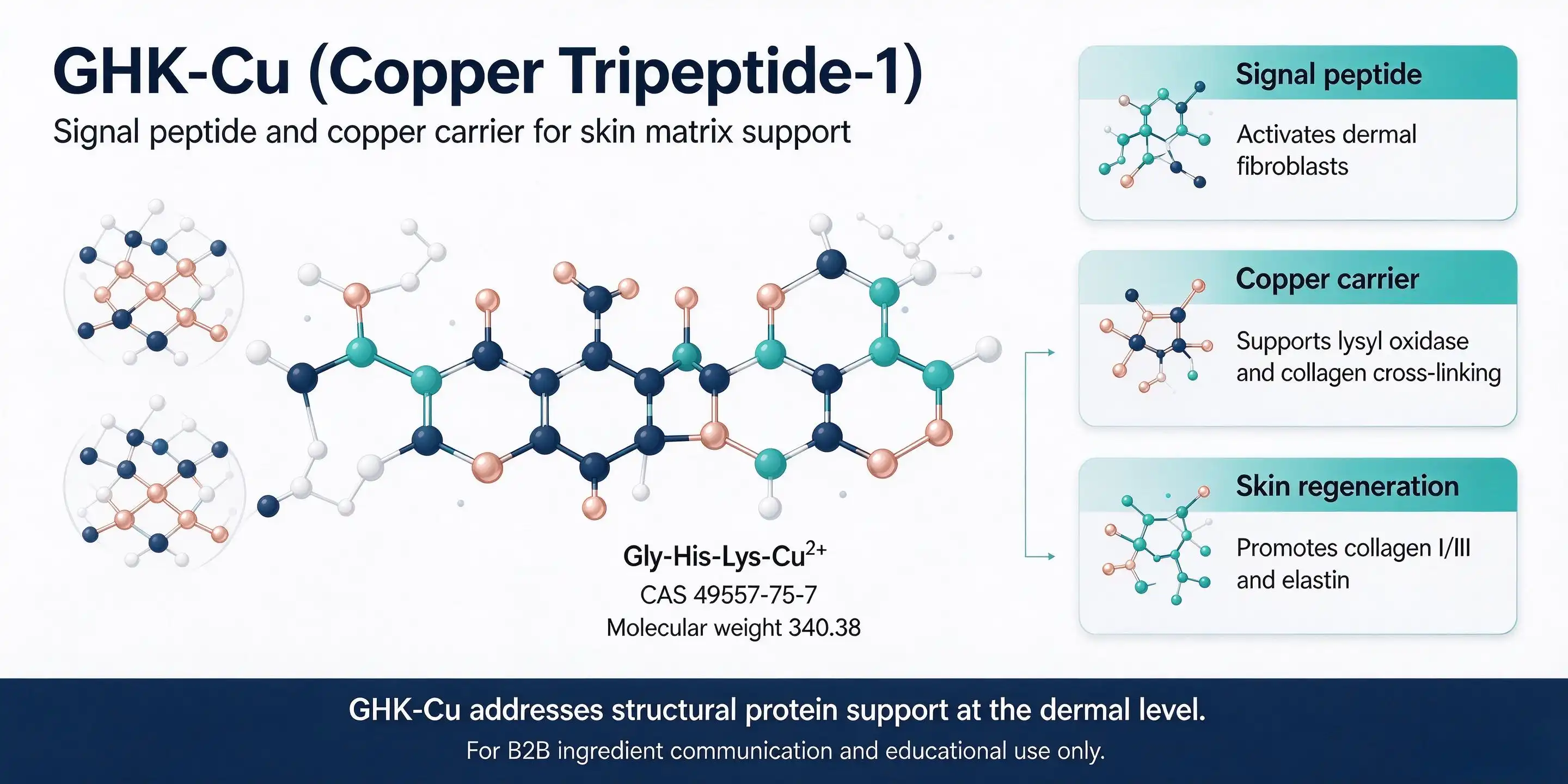
Collagen, Elastin, and Skin Regeneration
Pickart et al.'s published study showed that GHK-Cu raises the levels of genes that make collagen I and III and also raises the levels of genes that make elastin. In 2001, a study showed that putting GHK-Cu on the skin made it about 7% thicker after 12 weeks. The biological actions directly cause changes in skin elasticity scores and less wrinkle depth. This means that companies that make anti-aging products can honestly say that their products work.
Antioxidant and Anti-Inflammatory Properties
When GHK-Cu is added to the body, it changes hormones that cause inflammation and fights reactive oxygen species (ROS). Turning on the catalase and superoxide dehydrogenase pathways has been shown to lower signs of oxidative stress. Structure proteins are fixed, and chronic skin inflammation is lowered at the same time. This is why it is used in mending products like masks and serums that are used after laser or microneedling treatments.
Comparing GHK-Cu to Other Popular Anti-Aging Ingredients
GHK-Cu vs. Retinol
When used in amounts above 0.3%, retinol can irritate the skin, but it is still one of the most widely suggested anti-aging ingredients. For GHK-Cu to work, it must copy the body's normal ways of healing scars, not force cells to divide. This means that skin types that retinol shouldn't be used on, like sensitive skin, skin that has been treated, or skin that doesn't have a good barrier can use it. This tolerance advantage is a useful way for companies that want to sell their products in medical esthetics stores to make their products stand out.
GHK-Cu vs. Hyaluronic Acid and Niacinamide
Hyaluronic acid keeps the skin's surface moist, and niacinamide gets rid of spots and strengthens the skin barrier. At the level of the dermis, neither of these chemicals starts collagen neosynthesis directly. Anti-aging GHK-Cu works deeper in the dermis by getting fibroblasts to start up signaling pathways that rebuild networks of structural proteins. This means that GHK-Cu works best when mixed with ingredients that protect and moisturize the skin. This means that brands can make their products work as well as possible without adding extra chemicals.
Delivery Systems: Serum vs. Cream
GHK-Cu stays steady at a normal pH level and breaks down in water. It has a low molecular weight, which makes it easier for it to get into the skin. When put into cream bases, capsules or vehicles that are high in emollients may make it harder for the body to absorb. Most of the time, serum forms give B2B clients better bioavailability data when they choose a delivery method. When they go into the US or EU market, this helps them make better marketing claims and clinical confirmation reports.
Procurement Guide for GHK-Cu Peptide Serums: What B2B Buyers Need to Know
Verifying Purity and Documentation
People who want to buy copper peptide raw materials should look for good papers that have been checked by HPLC. For use in cosmetics and study, the purity level must be at least 98.0% by HPLC. There are many pieces of paper that come with every batch from a reputable provider. These include a Certificate of Analysis (COA), MSDS, chromatogram reports, and trade compliance papers. You can't leave these papers out of your regulatory submission for cosmetics to both the FDA and the EU.
Understanding Price Benchmarks and MOQ
How much GHK-Cu costs depends on how pure it is, how big the batch is, and how certified the supplier is. It normally costs more for batches that aren't as pure than for batches that are good for study and have a 99% test. Before buyers decide that a lower price means the same quality, they should look at the heavy metals, moisture, and analysis data. Buyers can choose from 1g/bag, 100g/bag, or 1kg/bag packaging, and the minimum order size is 1g. This gives them choices for both study and business production.
OEM Collaboration and Bulk Purchasing
You can cut out the middleman and have more control over the specs when you make OEM or ODM deals directly with a maker for big names. When choosing an anti-aging GHK-Cu, it is important to verify the batch-to-batch consistency data, the supplier's legal standing (ISO, Halal, and Kosher certifications), and the supplier's ability to meet your specific packing needs. These things are more important than unit price when building a supply chain that will last.
Integrating GHK-Cu Into Skincare Routines and Product Lines
Recommended Formulation Parameters
GHK-Cu breaks down in water and works with most skin care items that are water-based. To keep the bioactivity, it should be added to mixtures that are below 40°C, and the concentration should be between 0.01% and 0.1%. To keep things stable, strong chelating agents and very acidic environments should not be used together. Pure ascorbic acid at a low pH and strong chelating agents can make it harder for copper to bind.
Combination Strategies With Other Actives
Ingredients like Argireline or Matrixyl (palmitoyl pentapeptide-4) are often mixed with GHK-Cu to treat wrinkles in more than one way. GHK-Cu heals the barrier better when panthenol or ceramides are added. The peptide changes the structure over time. With this type of focused peptide stack, brands can make product lines that stand out. These stacks can be used in both retail and medical esthetics.
Addressing Diverse Consumer Segments
Anti-aging GHK-Cu is good for many kinds of skin, such as skin that is getting older and needs to be fixed up, skin that has just had surgery and needs to heal faster, and sensitive skin that can't handle stronger actives. A brand can make a core serum for sale, a concentrated healing mask for clinic use, and a head treatment that improves the health of hair follicles all from the same copper peptide raw material. Companies that sell to other companies can use the same material for more than one SKU because of this.
Addressing Safety, Side Effects, and Regulatory Compliance
Safety Profile and Tolerability
GHK-Cu has been safe for a long time in both medical situations and market goods. As a biomimetic peptide that looks like molecules that are found naturally in human plasma, the recommended amounts don't make the skin too sensitive or irritated. At a concentration of 0.01% to 0.1% on the skin, patch tests and published safety reports consistently show no major negative effects. Because of this, it is one of the better-tolerated anti-aging ingredients used in modern cosmetics.
Regulatory Status in the US and EU
In the US, GHK-Cu is controlled by the FDA as a cosmetic chemical. It does not need to be cleared though in order to be sold. Laws in the EU say that the INCI label must have the words "Copper Tripeptide-1" on it. To make sure there are no gaps in compliance during product registration, buyers should check that their supplier's batch paperwork matches the most recent pharmacopeial standards in both areas.
Documentation Required for Market Entry
Before approving production, regulatory and quality assurance managers should get a COA with HPLC purity data, an MSDS, heavy metals test results, and a microbiological analysis. If the use is linked to pharmaceuticals, like for wound care or after surgery, you might need to show more GMP papers. By giving this paperwork ahead of time, a supplier cuts down on the time and money needed to file with the government and speeds up the process of entering the market.
Conclusion
Researchers have found that Copper Tripeptide-1, also known as anti-aging GHK-Cu, is one of the best peptide ingredients for skin care right now. It has been shown to affect the production of collagen and elastin and the repair of the dermis. These benefits are more about how the skin works than just how it looks. Those in charge of buying things, research and development, or starting a brand that makes high-end anti-aging goods need to make sure that the company they work with has a steady supply of products that have been tested to make sure they are pure. In Xi'an, Yihui sells all of these things. They've been in business for 13 years and are ISO approved.
FAQ
Q1: What is GHK-Cu (Copper Tripeptide-1)?
A: Three amino acids, glycyl-L-histidyl-L-lysine, naturally occur together to form the copper complex GHK-Cu. It was first found in plasma from people. As a signal and messenger peptide, it gets fibroblasts to work, speeds up the production of collagen and elastin, and helps tissues change shape. It comes from biomimicry, so it can be used for both health research and making high-performance cosmetics.
Q2: What are the main benefits of GHK-Cu?
A: GHK-Cu fixes skin at the dermal level by boosting collagen neosynthesis. This makes skin tissue firmer, less wrinkled, and smoother all around. It also helps the body heal after beauty treatments because it reduces inflammation and protects cells from damage.
Q3: Is GHK-Cu safe for sensitive skin?
A: Yes. GHK-Cu is a biomimetic peptide that is good for those with sensitive skin or skin that has been treated. The public record on safety shows that concentrations between 0.01% and 0.1% are well tolerated, and therapeutic use at these levels has not been linked to any major side effects.
Q4: How do I formulate with GHK-Cu?
A: GHK-Cu breaks down in water and works with most skin care products that are water-based. Put it in below 40°C to keep the peptide's shape. The number should be between 0.01% and 0.1%. Strong chelators or vitamin C mixtures that are very acidic or have a low pH should not be mixed with it, as they can weaken the copper coordination bond.
Partner With Xi'an Yihui for Certified Anti-Aging GHK-Cu Supply
Since 2010, the Xi'an Yihui Bio-technology Co., Ltd. has sold makeup and drug raw materials to people in over 100 different countries. Copper Tripeptide-1 (GHK-Cu, CAS 49557-75-7) is available from us at a test level of 99%. It comes with all the necessary paperwork, including a COA, MSDS, and proof of compliance. As a certified anti-aging GHK-Cu maker, we provide a custom MOQ starting at 1g, custom packaging, and OEM support. Please email sales@yihuipharm.com right now to get a sample or talk about prices for groups.
References
1. Pickart, L., & Margolina, A. (2018). Regenerative and Protective Actions of the GHK-Cu Peptide in the Light of the New Gene Data. International Journal of Molecular Sciences.
2. Pickart, L. (2008). The human tri-peptide GHK and tissue remodeling. Journal of Biomaterials Science, Polymer Edition.
3. Finkley, M. B., Appa, Y., & Bhandarkar, S. (2003). Copper Peptide and Skin. Cosmetics & Toiletries Magazine.
4. Gorouhi, F., & Maibach, H. I. (2009). Role of topical peptides in preventing or treating aged skin. International Journal of Cosmetic Science.
5. Draelos, Z. D. (2010). Peptides in cosmetic and aesthetic dermatology. Cosmetic Dermatology.
6. Baumann, L. (2007). Skin ageing and its treatment. Journal of Pathology.

Send Inquiry
You may like
Related Industry Knowledge