
Does semaglutide need to be refrigerated
Yes, semaglutide bulk powder needs to be kept in the fridge at 2–8℃ for two years so that it stays chemically stable, effective, and pure. The API powder form is more stable than finished injectable formulations, but it still needs to be kept in a controlled cold chain to keep the peptides from breaking down, clumping together, and hydrolysing when they come in contact with water. These temperature limits must be followed by pharmaceutical companies, compounding labs, and research labs that work with this GLP-1 receptor agonist to protect the integrity of the 31-amino acid sequence and make sure they meet FDA and EMA quality standards for diabetes and weight management uses.
Understanding Semaglutide Bulk Powder and Its Storage Requirements
Semaglutide bulk powder is the pure Active Pharmaceutical Ingredient (API) form of this glucagon-like peptide-1 analogue, which was made using solid-phase peptide synthesis techniques. This lyophilized white powder has the molecular formula C187H291N45O59 and the molecular weight 4,113.64 g/mol. It is the starting material for making both injections and oral medicines to treat type 2 diabetes mellitus and long-term weight control.
The main difference between bulk powder and final medicinal goods is how complicated the formulation is and how stable the product is. Reconstituted injectable semaglutide has buffering agents, inhibitors, and stabilisers that make it very sensitive to changes in temperature once it is made. The bulk API powder, on the other hand, is more stable because it is dry and has been lyophilized. However, this benefit does not mean that refrigeration is not needed.
Why Temperature Control Matters for Peptide APIs
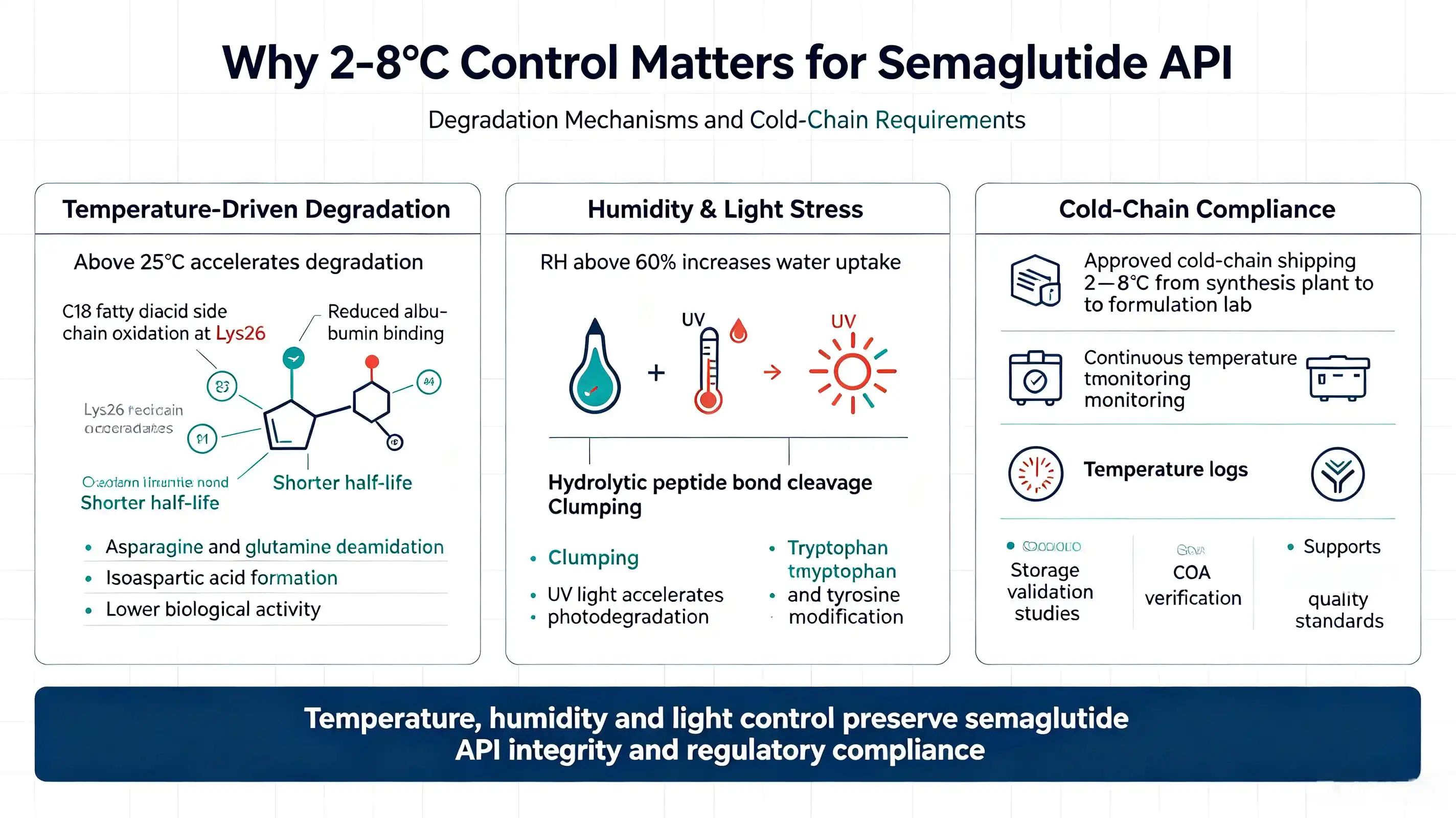
Changes in temperature have a direct effect on the structure of the complex amino acid chain in semaglutide. When exposed to high temperatures, the C18 fatty diacid side chain attached at the Lys26 position can still be broken down by oxidation. This side chain is what makes albumin bind and gives the drug a longer half-life. Studies show that peptide APIs kept above 25℃ have asparagine and glutamine residues deamidated more quickly, which makes isoaspartic acid forms that are less biologically active.
These risks are made worse by environmental factors other than temperature. When the relative humidity is higher than 60%, it makes it easier for water to absorb, which breaks down peptide bonds hydrolytically. Light, especially UV light, speeds up photochemical processes that change the tryptophan and tyrosine parts of semaglutide's sequence. These ways of breaking down make it clear why manufacturer guidelines always say to store things in the fridge between 2 and 8℃, which is the same range of temperatures that were used in studies for FDA and EMA submissions.
Bulk Powder Versus Injectable Storage Protocols
When you compare storage needs, you can see subtle differences. Reconstituted injectable semaglutide must always be kept cold and goes bad 56 days after it was reconstituted because the aqueous solution is unstable. When properly packed in moisture-barrier packaging and kept in the fridge, the bulk API powder stays stable for two years. This longer shelf life gives purchasing managers more options for their inventory and eases the pressure on the supply chain compared to finished dosage forms, which have to be delivered on time.
For drug companies to get semaglutide bulk powder, they need to use approved cold-chain shipping from the synthesis plant to the formulation laboratory. For quality assurance and regulatory compliance, it's important to keep records like temperature monitoring logs, Certificate of Analysis verifications, and storage validation studies.
Best Practices for Handling and Storing Semaglutide Bulk Powder
To keep the purity of this sensitive peptide API, controls over the surroundings and proper treatment must be followed all the time. Protocol changes that seem small at first can cause quality loss over time when stored for long periods of time.
Optimal Temperature and Environmental Conditions
The best way to keep semaglutide bulk powder fresh is to store it in a refrigerator between 2 and 8°C. Managers of procurement should make sure that storage units keep temperatures stable and don't freeze and thaw, which can damage peptide structure by causing ice crystals to form. Temperature mapping studies of storage areas help find hot spots or broken equipment before they damage the quality of the materials.
Controlling humidity is just as important as refrigeration. To keep moisture from getting in through packaging seals, storage areas should keep the relative humidity below 50%. Putting desiccant packets inside secondary packaging cases adds another layer of protection, especially when the goods need to be taken out of refrigeration for sample or weighing purposes.
To keep light out, you need containers that are opaque or amber in colour and block UV and visible light wavelengths. Photodegradation processes can start with just a short time of direct sunlight during material movement. Laboratories that work with semaglutide powder should set aside areas with low light for working with the powder and keep workers from being exposed for as long as possible while they weigh and dispense it.
Packaging Strategies for Long-Term Stability
The choice of primary packaging material has a big effect on how well it stores. For amounts between 1g and 50g, high-density polyethylene (HDPE) bottles with induction-sealed foil liners work great to keep moisture out. These containers keep oxygen out, which could damage sensitive amino acid residues, and keep their hermetic seals for the two-year shelf life.
Pharmaceutical-grade aluminium foil bags with heat-sealed closures are the best way to protect larger amounts than 100g. The multi-layer laminate construction, which is usually made of polyester, aluminium, and polyethylene, blocks out light, oxygen, and moisture. International shipments that go through more than one climate zone are better protected when they are double-bagged with desiccant packets between the layers.
During long-term storage, testing the integrity of the seals should be done on a regular basis. Visual checking for package deformation, moisture buildup, or seal split lets quality control staff know about possible problems before the materials get worse. When setting criteria for qualifying vendors, purchasing teams should make sure that the packing methods used by suppliers have been tested and that the suppliers have recorded shelf-life stability data to back up the claimed expiration dates.
Monitoring and Quality Verification
Setting up a strong tracking system is important to protect the large amount of money that was spent on pharmaceutical-grade peptide APIs. Temperature data loggers that can record continuously should be sent with valuable items and should stay active while they are being stored. Alarm systems that go off at 10℃ let you know right away if your refrigerator system fails, so you can move the goods before the critical temperature levels are reached.
Testing stored samples on a regular basis allows for proactive quality review. Every three months, stored materials go through a high-performance liquid chromatography (HPLC) analysis that finds trends in purity drift or impurity formation before they reach the limits set by the manufacturer. By comparing the results to the original values on the Certificate of Analysis, you can figure out how fast the product is breaking down and make sure that the storage conditions keep the product's integrity as suggested by stability studies.
Semaglutide Bulk Powder vs Injectable Semaglutide: Storage & Usage Comparison
Knowing how these two forms work differently helps procurement professionals make their companies' inventory strategies and cost structures work better.
Storage Requirement Distinctions
Whether they are brand-name or compounded, injectable semaglutide formulations need to be kept cold from the time they are made until they are given to a patient. The water-based solutions with buffering agents, stabilisers, and preservatives stay stable for up to 56 days after being reconstituted if they are kept in the fridge all the time. Changing the temperature by more than 8℃ speeds up the degradation process, which could make whole batches useless.
Because it is not water-filled, semaglutide bulk powder is more durable. Even though refrigeration is still needed, the API can handle short changes in temperature during shipping or lab transfers without losing quality right away. This feature cuts down on the waste that comes with broken cold chains and gives facilities that don't have pharmaceutical-grade refrigerators in every work area more operating freedom.
Bulk powder has a longer shelf life than reconstituted product—two years instead of 56 days. This means that it is easier to keep track of supplies. Pharmaceutical companies can keep strategic API reserves without having to worry about expiration dates all the time, which is a problem with finished injectable products. This longer timeline makes it easier to plan production more efficiently and lowers the costs of emergency purchases that come up when demand goes up without warning.
Logistics and Operational Considerations
To move injectable semaglutide, you need to use approved cold-chain shipping with gel packs, insulated containers, and temperature tracking devices, which makes each package very expensive. The small range of temperatures that are allowed means that shipping has to be done faster, and there is a higher chance of rejection at the receiving check.
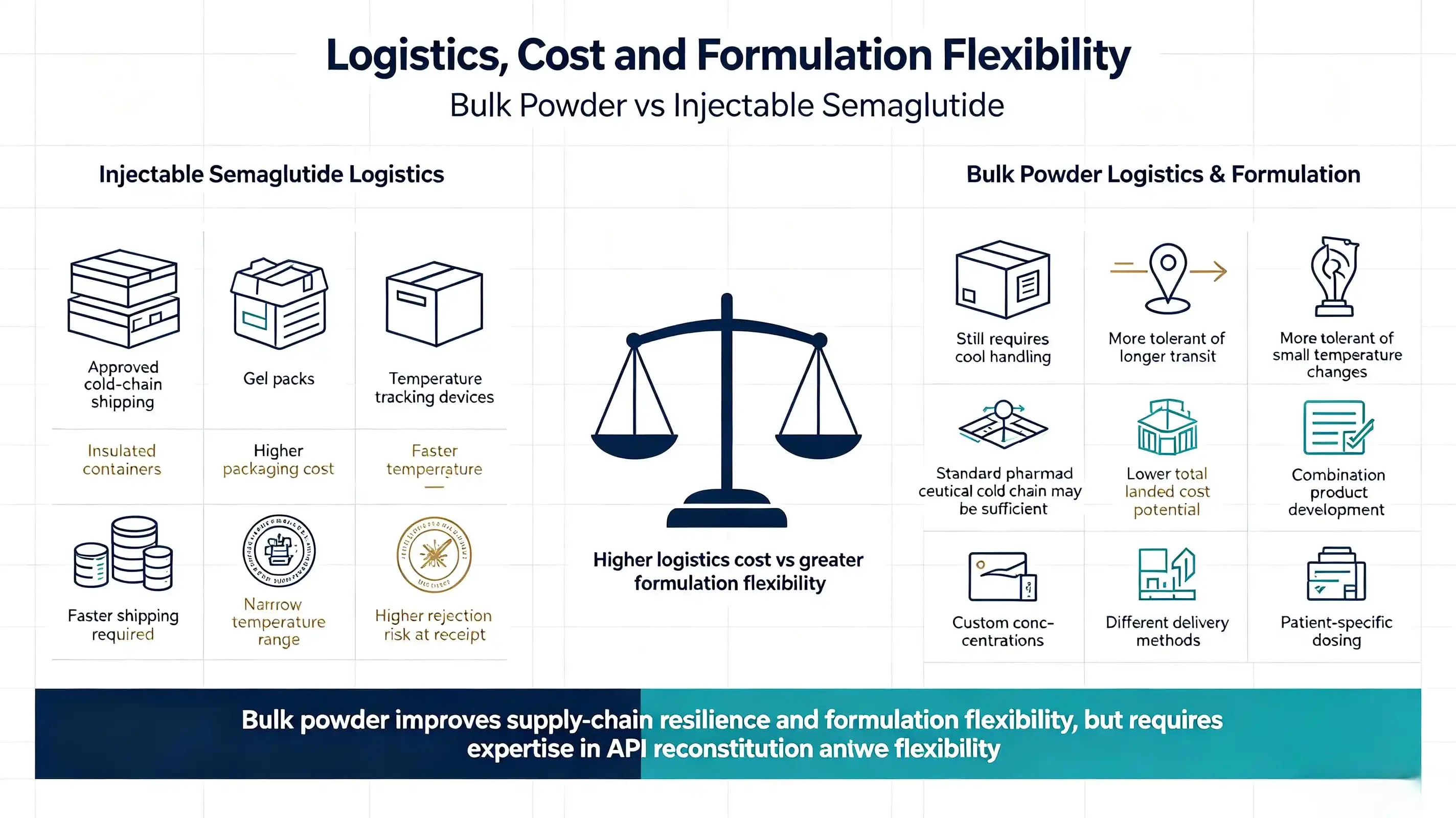
Even though bulk powder shipments still need to be kept cool, they can handle longer transit times and small changes in temperature better. Because it is less sensitive, standard pharmaceutical cold-chain logistics can be used instead of the more expensive services that are needed for liquid formulations. When buying things from other countries, this difference has a big effect on figuring out the total landing cost and the stability of the supply chain.
When it comes to formulation, bulk powder gives you the most freedom to make customised concentrations, different delivery methods, or mix goods. This flexibility is useful for research institutions and compounding pharmacies that need to make patient-specific dosing plans that aren't offered in market forms. However, this versatility makes formulation more difficult and needs specialised knowledge to reconstitute and compound the API while keeping its potency and cleanliness.
Procurement Considerations: Choosing a Reliable Semaglutide Bulk Powder Supplier
For companies making semaglutide-based medicines, choosing qualified sources is one of the most important choices that affects product quality, legal compliance, and supply chain security.
Certifications and Regulatory Compliance
Registration in the FDA Drug Master File (DMF) is one of the best ways to tell if a supplier is trustworthy for the US market. This secret document explains how things are made, how quality is checked, and information about stability. It gives government agencies a full picture of production standards. Suppliers who keep their DMFs current show that they are committed to transparency and regulatory consistency, which are both very important for pharmaceutical uses.
A Good Manufacturing Practice (GMP) approval from a reputable organization shows that the factories that make medicinal APIs meet strict quality standards. Instead of general chemical processing, the license should only cover the ability to synthesise peptides. For more proof that quality control processes are being carried out in a planned way, ISO 9001 quality management system certification is useful. However, GMP certification is more important for pharmaceutical applications.
Suppliers that serve international markets need to make sure they follow the rules set by the European Medicines Agency (EMA). A Certificate of Suitability (CEP) to the European Pharmacopoeia shows that the manufacturing process meets European standards. This makes it easier for regulatory submissions to be made in all EU member states. To keep the supply chain from splitting up, procurement teams that are looking for materials to be sent all over the world should give preference to suppliers who have multiple regional certifications.
Supplier Reputation and Technical Capabilities
Certifications are only one part of due diligence. A supplier's track record and technical know-how are also important. Established suppliers that have been working with major pharmaceutical companies for a number of years show that they are stable and consistent in their quality. References from satisfied clients from trustworthy businesses can tell you a lot about a supplier's responsiveness, technical support, and ability to solve problems that a supplier's specification sheet alone can't.
The ability to manufacture on a large scale should be carefully looked at. Suppliers who can make at least 5,000g of goods per month can keep up with rising demand without having to cut off supplies as products move from the testing phase to the business launch phase. On the other hand, suppliers who are ready to provide small research quantities (minimum order quantities of 1g) help early-stage development efforts without asking for large material commitments.
Analytical skills set superior suppliers apart from commodity providers. In-house testing labs with tools for peptide characterisation, such as HPLC, mass spectrometry, amino acid analysis, and peptide mapping, make it easy to make a Certificate of Analysis quickly and help with quality issues when they come up. Suppliers who offer unique impurity analysis or accelerated stability studies help companies with their regulatory applications in more ways than one.
Pricing, Terms, and Logistics
The high cost of semaglutide bulk powder is due to the complicated process of making it and the strict quality standards that are typical of medicinal peptides. The current market rates depend on the amount you order, the purity requirements, and the scope of your certification. Instead of just looking at unit price, businesses should also look at the overall cost of ownership, which includes things like consistent quality, reliable supply, and the value of expert support.
Payment terms usually include telegraphic transfer (T/T), letter of credit (LC), or documents against acceptance (DA). The exact terms are negotiated based on the size of the order and the history of the relationship with the customer. Established customers usually get better payment terms, which means the supplier doesn't have to take on as much risk. Samples are available so that analytical checks can be made before large-scale purchases are made. This is normal practice for qualifying a new seller.
Cold-chain logistics skills set apart qualified drug suppliers from general chemical distributors. Reliable partners keep storage facilities at a controlled temperature, use approved shipping methods that keep an eye on the temperature, and provide proof that the temperature stays between 2 and 8 degrees Celsius while the goods are in transit. Customs broking skills are needed for international packages to keep crossing delays to a minimum, which could affect temperature control.
Quality Control and Testing for Semaglutide Bulk Powder
Organisations are safe from the terrible effects of using APIs that aren't up to par when they're developing or making medicines when they do strict quality checks.
Essential Analytical Methods
High-performance liquid chromatography is still the best way to check the quality of semaglutide bulk powder. With reversed-phase HPLC and gradient elution, the parent peptide can be separated from impurities related to synthesis, such as truncated sequences, deletion peptides, and amino acid substitution variants. Acceptance standards usually say that the purity must be ≥98% and that each impurity must be less than ≤0.5%. However, even stricter requirements may be needed for pharmaceutical uses.
Electrospray ionisation mass spectrometry (ESI-MS) checks the accuracy of molecular weight and finds mistakes in the order of the molecules that might not be picked up by HPLC. The mass that was measured should be the same as the expected value, which is 4,113.64 Da, as long as the device is accurate to within ±2 Da for peptides this size. Discrepancies mean that there were mistakes in the production or degradation, which needs to be looked into before the material can be used.
By measuring the amount of each amino acid residue after it has been completely broken down, amino acid analysis can confirm an orthogonal sequence. By comparing measured ratios to theoretical sequence makeup, one can prove the identity of a sequence and find some impurities. Since amino acid analysis takes longer to do than HPLC or mass spectrometry, it is not used as often. However, it is very useful for high-stakes situations or to check out new sources.
Possible contaminants and stability indicators are covered by other testing parameters. Karl Fischer titration checks how much water is in something. To keep things stable, the wetness level is usually limited to ≤5.0%. For injectable uses, the Limulus Amebocyte Lysate (LAL) assay is very important for testing for bacterial endotoxin; limits are usually set at less than 10 EU/mg. Gas chromatography study of residual solvents shows that synthesis solvents have been removed, especially trifluoroacetic acid, which should stay below 0.1% to avoid harming cells.
Stability Data and Research Findings
Stability studies that have been published on semaglutide under different storage conditions give evidence-based advice on how to handle the drug. Researchers have found that lyophilized semaglutide kept at 2–8°C in sealed containers doesn't lose much of its purity over 24 months. This backs up the two-year shelf life that quality suppliers say it has. On the other hand, if you store it at 25°C, it will break down within 6 months, with deamidation products and aggregates building up over time.
Accelerated stability studies done at high temperatures (40℃/75% relative humidity) show that the substance will be stable for a long time when stored normally. These studies show that exposure to moisture is a bigger cause of degradation than temperature alone. This shows how important it is to use packaging that blocks moisture. At the same temperatures, samples stored in permeable containers lose their purity three to five times faster than samples stored properly.
Freeze-thaw stability testing takes away worries about things freezing by chance while they are being stored or moved. Although semaglutide bulk powder can handle freezing better than reconstituted solutions, it is best to avoid repeated freeze-thaw cycles because they can cause aggregates to form. Quality control procedures should include checking visually to see if the cake falls apart or changes in look that could mean it was exposed to freeze-thaw, which would then lead to analytical testing before the material is released.
Conclusion
For semaglutide bulk powder to keep its complex peptide structure, stay pharmaceutical-grade pure, and stay effective for two years, it needs to be kept in the fridge at 2–8℃. The API form has many benefits over finished injectables, such as longer stability, more inventory options, and more formulation options. This makes it perfect for pharmaceutical companies, research institutions, and compounding facilities.
To make a good purchase, you need to work with qualified providers who can show that they follow good manufacturing practices (GMPs), have strong analytical skills, and have proven cold-chain logistics. By following strict storage rules that include controlling humidity, blocking light, and keeping an eye on the temperature all the time, you can keep this valuable material from breaking down while also meeting regulatory requirements and product quality goals.
FAQ
Can semaglutide bulk powder be stored at room temperature?
It's not a good idea to keep semaglutide bulk powder at room temperature for long amounts of time. Short changes in temperature during lab handling are okay, but keeping the peptides above 8℃ for a long time speeds up their breakdown, lowers their purity, and shortens their useful shelf life. Refrigeration at 2–8°C is still needed to keep the two-year stability that has been proven in studies of pharmaceutical development.
How long does refrigerated semaglutide bulk powder remain stable?
If you store semaglutide bulk powder properly in sealed, moisture-barrier packaging at 2–8°C, it will stay pharmaceutical-grade for two years from the date it was made. This stability timeline only applies to containers that haven't been opened yet. Once they have, the humidity and temperature of the room will make quality checks more often, and the use-by dates may be shortened based on how often the containers are handled.
What certifications should I look for when sourcing semaglutide bulk powder suppliers?
Some of the most important certificates are ISO quality management certification, FDA Drug Master File registration, and GMP compliance related to peptide APIs. For selling medicines in other countries, the European Medicines Agency issues certificates of suitability that show the quality of the making meets the standards set by the European Pharmacopoeia. These certifications make sure that the manufacturing process is strict, that quality control systems are in place, and that the regulations are in line with what is needed for pharmaceutical applications.
Partner With Xi'an Yihui for Pharmaceutical-Grade Semaglutide Bulk Powder Supply
Xi'an Yihui Bio-technology Co., Ltd. is a reliable company that makes semaglutide bulk powder for drug companies, research centers, and compounding labs in the US, Europe, Japan, and South Korea. Our GMP-certified factory makes research-grade peptide APIs that are guaranteed to be at least 98% pure. They come with full Certificates of Analysis that show the results of HPLC, mass spectrometry, and endotoxin testing. We keep stock that is ready to ship right away, and our cold-chain operations make sure that the temperature stays between 2 and 8 degrees Celsius during foreign shipping.
We can meet the needs of both early-stage study projects and large-scale manufacturing companies. Our minimum order amounts start at 1g and go up to 5,000g per month. With 13 years of experience in fine chemicals and pharmaceutical intermediates, our technical team can give you advice on how to store, handle, and formulate your products. Samples are available so that quality can be checked before production starts, and our ISO, Halal, and Kosher certifications show that we have fully implemented our quality system. You can reach our professional team at sales@yihuipharm.com or visit yihuipharm.com to talk about your specific needs and get detailed specifications that will help you make decisions about buying peptide API.
References
1. Lau J, Bloch P, Schäffer L, et al. Discovery of the Once-Weekly Glucagon-Like Peptide-1 (GLP-1) Analogue Semaglutide. Journal of Medicinal Chemistry. 2015;58(18):7370-7380.
2. Buckley ST, Bækdal TA, Vegge A, et al. Transcellular stomach absorption of a derivatized glucagon-like peptide-1 receptor agonist. Science Translational Medicine. 2018;10(467):eaar7047.
3. Manning S, Pucci A, Finer N. Pharmacotherapy for obesity: novel agents and paradigms. Therapeutic Advances in Chronic Disease. 2020;11:2040622320905633.
4. International Conference on Harmonisation. Stability Testing of New Drug Substances and Products Q1A(R2). ICH Harmonised Tripartite Guideline. 2003.
5. European Pharmacopoeia Commission. European Pharmacopoeia 10.0: Peptides and Proteins. Council of Europe. 2020.
6. United States Pharmacopeia. General Chapter <1047> Biotechnology-Derived Articles—Peptide Stability. USP 43-NF 38. 2020.

Send Inquiry
You may like
Related Industry Knowledge