
Clascoterone & Hair Loss: Does It Work & Is It Safe?
Androgenetic alopecia is a major clinical and economic issue in dermatology. It affects millions of people around the world. Clascoterone powder, a cosmetic anti-androgen with the chemical formula C24H34O5 and the CAS number 19608-29-8, has shown promise. This white to light yellow powder works by blocking androgen receptors directly in hair follicles, instead of going into the bloodstream like finasteride does. Topical formulations with this API have been shown in clinical tests to stop hair loss by blocking dihydrotestosterone (DHT) locally. This is a safer option with few side effects. This cortexolone derivative can be used by pharmaceutical companies and beauty formulators looking for new ingredients to make next-generation hair loss products that are backed by thorough dermatological research.
Understanding Clascoterone Powder and Its Role in Hair Loss
The Chemical Foundation of Anti-Androgen Efficacy
Clascoterone is a big step forward in changing how androgen receptors work in specific areas. The steroidal substance has an EINECS number of 685-282-9 and a molecular weight of 402.52 g/mol. It only affects androgen receptors in dermal papilla cells and doesn't get absorbed by the body as a whole. The way it works is through competitive inhibition. The molecule fights with DHT for receptor binding sites in hair follicles, stopping the process of hair loss that happens when hairs get thinner. It's different from oral anti-androgens, which can cause hormonal side effects, because it only works in certain areas. For R&D teams working on new formulas, the Clascoterone powder form (99% purity) lets them precisely control the dose and keep it stable in a range of external media, such as dry gels and emulsions.
Clinical Evidence Supporting Hair Regrowth
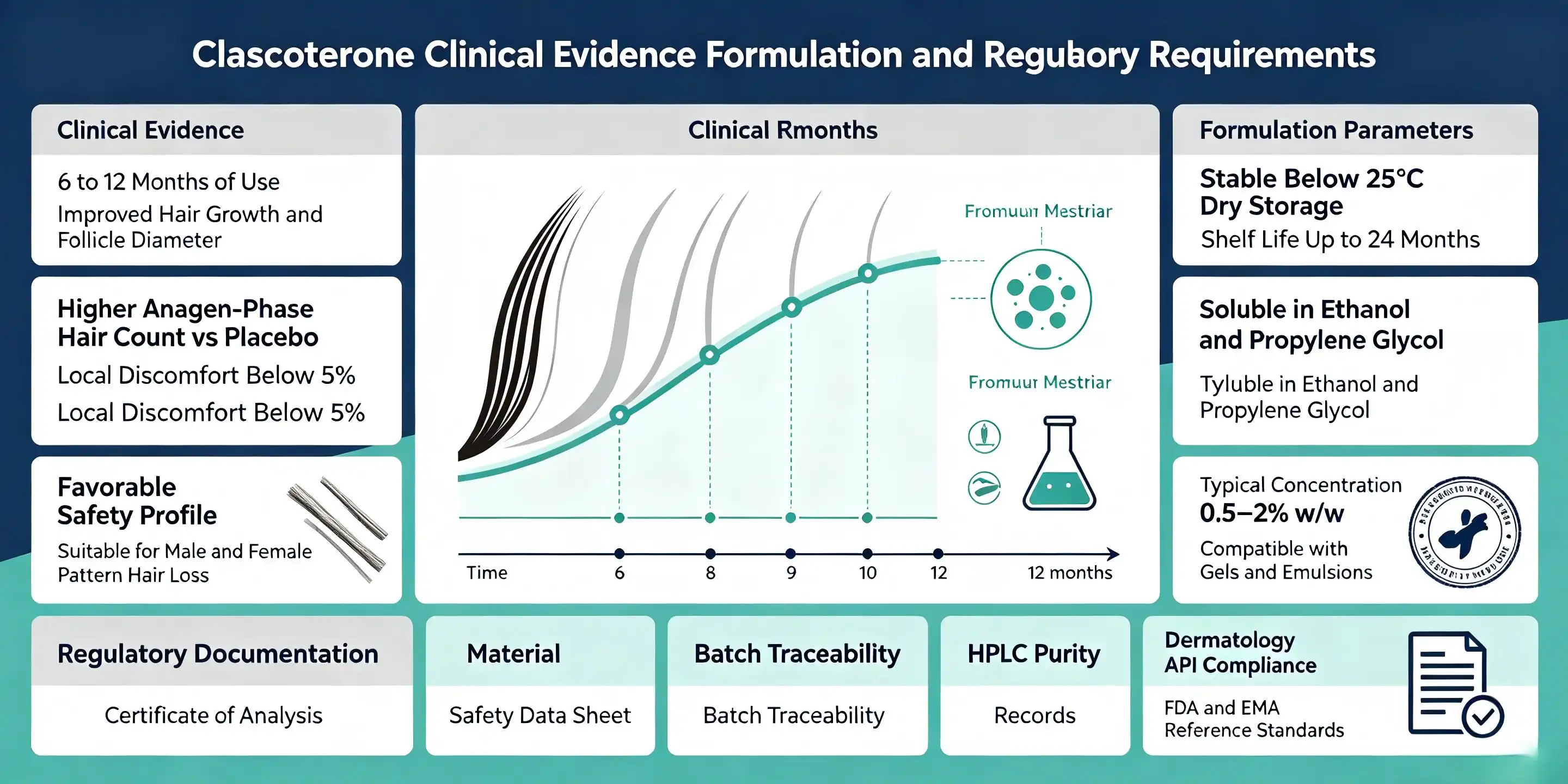
After 6 to 12 months of use, published studies have shown that hair growth and follicle width have gotten better. In controlled tests, people who used topical formulations with this API had statistically significant higher anagen-phase hair numbers than people who used placebos. The safety rating is still good. The most common side effect, local discomfort, happened in less than 5% of subjects. Based on these results, clascoterone could be a good choice for formulators who want to target both male and female pattern hair loss markets. There is enough proof to back up claims on cosmetics labels that stress "clinically proven ingredients" or "dermatologist-tested solutions," which is important for positioning a high-end brand.
Formulation Parameters for Optimal Delivery
The powder's physical qualities make it possible to use it in a number of different cosmetic forms. Because it stays stable at normal storage temperatures (<25°C, kept dry), it can be kept for 24 months if it is properly packed. Formulators should know that the compound dissolves easily in organic solvents like ethanol and propylene glycol, which makes it easier to spread the compound evenly in skin products. Most products on the market have concentrations between 0.5% and 2% w/w, which is a good balance between effectiveness and discomfort risk. To meet FDA and EMA standards for dermatology APIs, each batch must come with regulatory paperwork like a Certificate of Analysis (COA) and a Material Safety Data Sheet (MSDS).
Comparing Clascoterone Powder with Other Anti-Androgens for Hair Loss
Mechanism Differentiation Across Therapeutic Classes
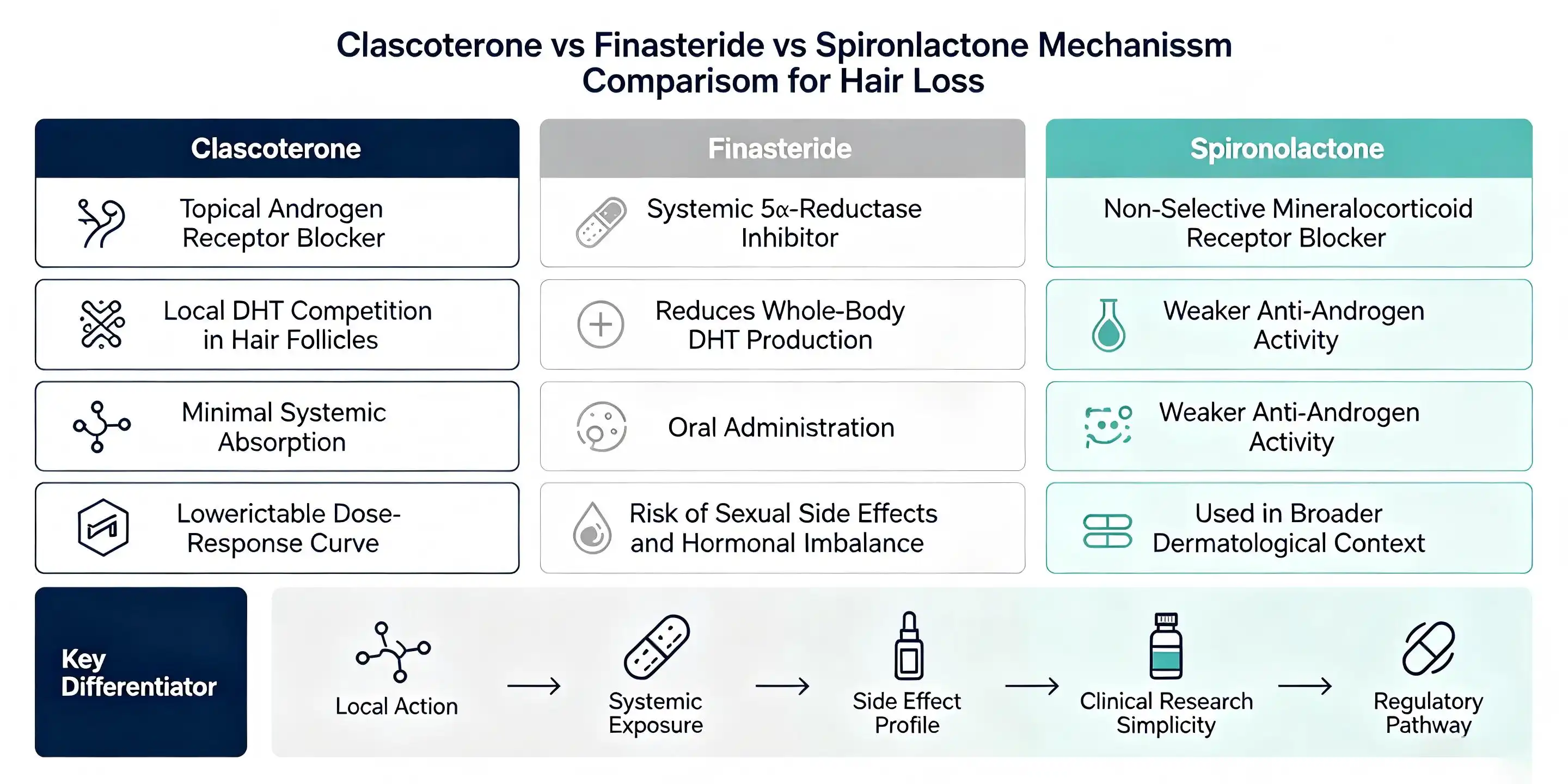
Clascoterone works as an androgen receptor blocker on the outside of the body, while finasteride blocks 5α-reductase systemically, which lowers the production of DHT all over the body. Because of this difference, there are no longer any worries about sexual problems or chemical imbalances that might happen with oral 5α-reductase inhibitors. Another topical choice is spironolactone, which works as a non-selective mineralocorticoid receptor blocker and has lower anti-androgen effects. Because clascoterone binds to receptors in a very specific way, dose-response curves can be predicted. This makes clinical research and regulatory applications easier. For drug firms, this accuracy cuts down on the need for long systemic toxicity studies, which speeds up the time it takes to get a drug on the market.
Cost-Benefit Analysis for Procurement Teams
The changes in prices show how complicated chemistry and governmental positioning are. Clascoterone powder usually costs more than generic anti-androgens because it is protected by a patent and has to be made in a certain way. But the lack of widespread side effects lowers the costs and risks of monitoring after the product is sold. When purchasing managers look at quotes from suppliers, they should compare costs to the suppliers' ability to supply (the current average in the industry is 100 kg per month per seller), their purity standards (at least 99%), and their certification portfolios. Terms of payment like T/T, LC, or DA affect how cash flows, and shipping times from ready stock in local stores (1-3 days via DHL or FedEx) affect how production schedules are made.
Regulatory Pathway Considerations
Depending on the claims, different types of clascoterone are regulated in different ways. In the US, goods sold to treat androgenetic alopecia need to be approved by the FDA as prescription drugs, which means they need strong Phase III study results. However, the chemical can be used in cosmetics that focus on "hair support" or "scalp health" as long as the claims don't use language that sounds like it's treating a disease. Quality managers have to make sure that the materials they get meet GMP standards and have all the paperwork they need to prove it, like batch records and stable studies. The MDL number MFCD18384978 is a unique number that can be used to check the supply chain across foreign lines.
Practical Considerations for Using Clascoterone Powder
Dosage Guidelines and Application Protocols
Standard treatment plans say that formulas with 0.5 to 2% active ingredient should be applied to the affected head areas once a day. Because the Clascoterone powder is concentrated when it is in bulk, formulators can change the strength to suit different groups of people. Clinical studies show that lower concentrations (0.5–1%) help with female pattern hair loss, while higher concentrations (1.5–2%) help with more severe male androgenetic alopecia. Usually, between 0.5 and 1 mL is used for each dose, which is enough to cover about 50 cm² of head. These factors help product development teams make sure that the pump systems and package sizes are the best they can be for customers.
Formulation Versatility and Stability Challenges
When compared to ready-made creams, raw powder is more flexible. Manufacturers can come up with dry solutions for people with oily scalps or polymer systems to make cosmetics look better. The hard part is keeping the chemical stable; the substance breaks down in alkaline pH and UV light for a long time. Some good ways to formulate products are to use pH buffers (the best range is between 5.0 and 6.5), vitamins like tocopherol, and clear packing. According to ICH standards, stability tests should show that the substance doesn't change by more than 5% over 24 months at 25°C/60% RH. HPLC tests must be part of quality control methods to make sure that the medicine stays effective over time.
Safety Profile and Risk Mitigation
Potentially bad effects are limited to the application spot by the localized process. Mild erythema, itching, and temporary scaling have been reported in sensitive people. Before applying to the whole head, patch testing guidelines say that occlusive testing should be done on the inner forearm skin for 48 hours. There aren't many reasons not to use it, but makers should tell people not to put it on broken skin or mix it with other external retinoids that may make irritation worse. From a regulatory point of view, this good safety margin makes it easier to report bad events and keep an eye on things after the product has been sold. This lowers brand owners' long-term compliance costs.
Procurement Insights: How to Source High-Quality Clascoterone Powder?
To find reliable providers, you need to look at more than just price. Verification of approval is the first step in quality assurance. ISO 9001 is for quality management, ISO 14001 is for environmental standards, and ISO 13485 is best for medical device parts if they are going to be used in pharmaceuticals. GMP approval for making APIs makes sure that process controls meet the standards set by foreign regulators. Third-party quality teams should do on-site checks of cleanroom classifications, equipment validation processes, and deviation management systems. Suppliers with 13 years of experience making APIs, like Xi'an Yihui Bio-technology Co., Ltd., show that they have the business maturity needed for a steady supply of Clascoterone powder.
When negotiating prices, the total cost of ownership should be taken into account, not just the per-kilogram rate. For initial approval runs, the minimum order quantity is usually between 1 kg and 10 kg. For commercial production, it increases to 50 kg to 100 kg. Logistics costs vary a lot. Express shipping (DHL, FedEx, TNT) works best for small orders that need to be delivered quickly, while sea freight is the most cost-effective way to ship large orders over 500 kg. To avoid delays in clearing customs, goods must be correctly labeled with the HS code (usually under Chapter 29: Organic chemicals) and have correct paperwork. Payment terms have an effect on working capital. Letters of Credit offer security for new supply ties, while T/T is easier to use.
To build long-term relationships, supply chain stability needs to be made clear. Suppliers should be open about how they get their raw materials, where they make backup products, and how they handle stockpiles. Lead times and global risk are affected by where the API comes from (China is a big production hub). Diversification tactics might include finding qualified secondary providers in other areas, but in some markets, this needs more legal paperwork. To protect against supply gaps, procurement contracts should include quality agreements that spell out acceptance standards, who is responsible for testing, and how to handle batch failures.
Future Trends and Market Outlook for Clascoterone Powder in Hair Loss Treatment
According to market research, the demand for oral anti-androgens is growing quickly. This is because more people are becoming aware of hair loss treatments and the population is getting older. The prescription skincare section is expected to grow at a compound annual growth rate (CAGR) of 8–12% through 2030 in North America and Europe. As female pattern hair loss becomes more recognized by doctors, the move toward gender-neutral products opens up more markets that can be reached. Nanoparticle encapsulation and follicle-penetrating peptides are two new delivery methods that may improve bioavailability. This could mean that lower amounts of Clascoterone powder are needed, which would save money.
Regulatory environments are always changing. The FDA's approval of the first clascoterone-containing product for acne in 2020 sets a standard for more dermatology uses. This could make the approval process easier for hair loss applications through 505(b)(2) entries. This clear regulation makes it easier for people to spend in clinical research and the infrastructure of the supply chain. At the same time, the "clean beauty" trend is increasing demand for synthetic options to natural extracts. This well-studied molecule is better than plants that have different levels of strength.
As market entry speeds up, strategic relationships between suppliers become more and more important. Formulators gain when suppliers offer expert support in addition to providing raw materials. This support can include help with stability testing, regulatory paperwork packages, and formulating problems. Established makers are different from sellers who are just looking to make quick money because they can switch from making small batches to making a lot of them at once without changing the quality. Companies that spend money on analysis tools like impurity profiling and polymorphic form definition add value that makes charging higher prices fair.
Conclusion
Clascoterone powder is an answer for topical hair loss treatments that has been proven to work by science and can be sold in stores. Its targeted process, good safety profile, and growing body of clinical data meet important goals in the creation of dermatological products. Buyers in business-to-business (B2B) must put seller qualification first, paying special attention to purity standards (≥99%), regulatory compliance certifications, and the stability of the supply chain. Because the substance can be used in a lot of different ways and is becoming more popular among people of all genders and locations, it is becoming a key ingredient for drug and beauty companies that want to stand out in the competitive hair care market.
FAQ
What distinguishes pharmaceutical-grade from cosmetic-grade material?
Pharmaceutical-grade clascoterone is made with stricter controls, such as cleaning methods that have been proven to work, tracking of the environment, and full batch traceability that meets FDA 21 CFR Part 211 or EU GMP Annex 1. Material made for cosmetics may meet the same quality standards, but it doesn't have all the detailed paperwork that is needed for drug master files (DMFs). Buying choices should be in line with what the product is supposed to do and how it is classified by the government.
Can smaller companies access this ingredient with limited budgets?
Each seller has different minimum order amounts. For research and development reasons, some factories can handle orders of 1 to 5 kg, even though pharmaceutical development usually needs larger amounts. Prices naturally reflect economies of scale, but trustworthy providers like Xi'an Yihui offer reasonable prices while still guaranteeing quality. Collaborative relationships that let purchases be made in stages as recipes move through the development process reduce the amount of money that needs to be paid up front.
How does powder form compare to purchasing finished topical solutions?
Raw powder gives you the most control over the composition, so you can change the stabilizers, taste properties, and vehicle systems to fit the needs of specific markets. Finished products make it harder to be different, and they usually cost more per dose. Powder buying is more important for brands that want to make their own formulas or special profiles for cosmetic elegance, even though they need to be able to do their own manufacturing or hire someone to do it for them.
Partner with Xi'an Yihui for Reliable Clascoterone Powder Supply
You can trust Xi'an Yihui Bio-technology Co., Ltd. to provide you with high-quality Clascoterone powder. They have been making APIs for 13 years and follow strict pharmaceutical quality standards. Express carriers can send our ready stock in one to three days, so there aren't many problems in the supply chain that affect production plans. Our material meets strict regulations in markets around the world thanks to its ≥99% purity, full COA paperwork, and ISO/Halal/Kosher certificates.
We understand the different needs of people who make medicines, cosmetics, and skin research institutions because we work with people from over 100 countries. Competitive price structures allow for different order sizes without lowering quality, and open payment terms (T/T, LC, DA) make it easier for you to buy things. Our expert team is available 24 hours a day, seven days a week to help customers with formulation problems and regulatory paperwork needs. For your next project to create a hair loss treatment, you can email sales@yihuipharm.com to get samples, technical specs, or unique quotes.
References
1. Rosette C, Agan FJ, Mazzetti A, Moro L, Gerloni M. Clascoterone: A novel topical androgen receptor antagonist for acne and potentially androgenetic alopecia. Expert Opinion on Investigational Drugs. 2019;28(12):1041-1048.
2. Blume-Peytavi U, Whiting DA, Trueb RM. Hair Growth and Disorders. Berlin: Springer-Verlag; 2008. Chapter 15: Anti-androgens in the treatment of hair loss.
3. Cassano N, Miracapillo A, Coviello C, Vena GA. Topical anti-androgen therapies for androgenetic alopecia and acne vulgaris: Mechanisms and clinical evidence. Dermatologic Therapy. 2021;34(4):e14973.
4. Irwig MS, Kolukula S. Persistent sexual side effects of finasteride for male pattern hair loss. Journal of Sexual Medicine. 2011;8(6):1747-1753.
5. Zito PM, Roper CR. Cortexolone 17α-propionate for the treatment of acne vulgaris. Drugs of Today. 2020;56(10):637-643.
6. Shapiro J, Otberg N. Hair Loss in Women: Medical and Cosmetic Approaches to Increase Scalp Hair Fullness. London: Informa Healthcare; 2008. Chapter 8: Topical anti-androgen strategies.

Send Inquiry
Related Industry Knowledge