
Carbetocin powder: Uses, Interactions, Mechanism of Action
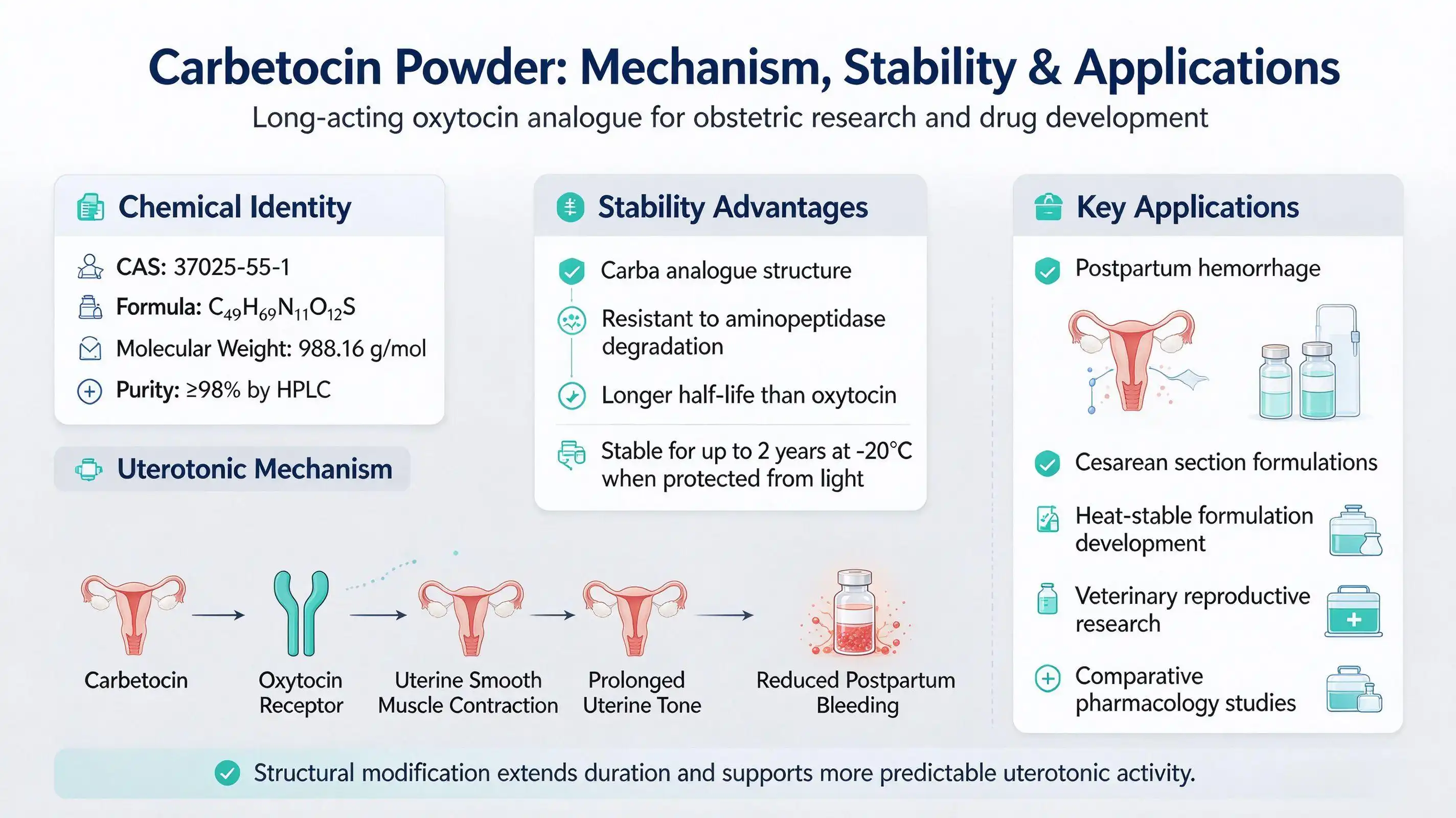
Carbetocin powder is an important synthetic peptide main ingredient that is mostly used in maternal drug formulations to stop bleeding after a caesarean delivery. As a long-acting oxytocin analogue with the chemical formula C₄₉H₆₉N₁₁O₁₂S and the CAS number 37025-55-1, this research-grade peptide is more metabolically stable than natural oxytocin. Carbetocin powder is used by pharmaceutical researchers, CRO/CDMOs, and formulation scientists who need reliable uterotonic compounds for drug development and clinical investigation. It has a molecular weight of 988.16 g/mol and a purity level of ≥98% by HPLC.
Understanding Carbetocin Powder: Pharmacology and Mechanism of Action
The pharmacological nature of carbetocin shows why this man-made peptide has become so important in obstetric study and drug development. By understanding how it works, procurement managers and research and development teams can use science to check the accuracy of supplier quality claims and product specifications.
Receptor Binding and Uterotonic Activity
Carbetocin works by attaching itself specifically to oxytocin receptors on smooth muscle cells in the uterus. Natural oxytocin is quickly broken down by aminopeptidases, but carbetocin has changes to its structure that make it less likely to be broken down by metabolic processes. The deamination at position 1 and the replacement of the disulphide bridge with a methylene group make a carba analogue whose half-life is much longer. Compared to oxytocin's short 3–4 minute action window, this molecular architecture means that the uterus contracts for 60–120 minutes after a single dose.
Enhanced Stability Profile
Under controlled settings, research-grade Carbetocin powder demonstrates amazing chemical stability. The peptide can stay structurally stable for up to two years if it is kept at -20°C and kept out of the light. This stability benefit goes beyond the fact that it makes storage easier. Additionally, during formulation development, carbetocin shows less vulnerability to changes in pH and thermal stress compared to other uterotonics. This peptide sequence, Tyr-Met-Leu-Gly-Asn-Glu-Asn-Cys-Pro-Leu-Gly-NH₂, works the same way every time an experiment is done. This makes it very useful for studies that need to get the same results over long periods of time.
Pharmacokinetic Considerations
How well carbetocin products are absorbed and spread depends a lot on how pure and high-quality the starting API is. A high-quality powder that is at least 98% pure by HPLC makes sure that the pharmacokinetic profiles in preclinical studies are predictable. Carbetocin reaches its highest levels in the blood within minutes of being reconstituted and administered. Its effects last much longer than those of natural oxytocin because it has a stronger affinity for receptors and is less easily broken down by the body.
Primary Uses and Clinical Applications of Carbetocin Powder
Carbetocin powder can be used in many different ways, including making medicines, doing research in schools, and making medicines for animals. Knowing about these different uses helps procurement teams find the right specifications for their own operational needs.
Obstetric Research and Drug Development
Carbetocin powder is used as the primary active ingredient (API) in injectable formulas that aim to stop postpartum bleeding by pharmaceutical firms and research institutions. The peptide is an important ingredient in making clean 100 mcg/mL liquids that are meant to be given all at once after a caesarean section while the patient is under epidural or spinal anaesthesia.
Postpartum haemorrhage is still the top cause of death among mothers around the world, so this app meets a big clinical need. Carbetocin powder can be used by formulation scientists to create products that simplify hospital procedures, by removing the need for constant intravenous infusions with oxytocin.
Heat-Stable Formulation Development
Making carbetocin formulations that are stable at room temperature for use in places with limited resources is a growing area of application. Standard oxytocin needs to be kept in a cold chain, which can be hard to do in poor areas. Pharmaceutical companies get high-purity Carbetocin powder to make products that can withstand changes in temperature at 30°C/75% relative humidity. This helps WHO's efforts to lower maternal mortality in climate zones III and IV. This app shows how the quality of an API has a direct effect on health results around the world.
Veterinary Pharmaceutical Research
Carbetocin powder can be used for more than just human health. It also helps the development of medicines for managing animals. Teams of researchers are looking into how it can be used to time the birth of babies in sows and dairy cows, shorten the time it takes to give birth, and treat problems with milk ejection. The longer period of effect is especially helpful in farming settings, where repeated dosing can be hard to do and raises the cost of labour.
Comparative Efficacy Studies
Comparative pharmacology studies use analytical-grade Carbetocin powder to set standards for how well it works compared to other drugs like oxytocin and misoprostol. For these studies, they need very small amounts with strict purity requirements. Usually, orders must be at least 1 gram in order to allow for pilot study designs and dose-response evaluations.
Procurement Insights: How to Source Quality Carbetocin Powder
Strategic review of supplier skills, quality systems, and regulatory compliance are necessary to ensure steady supplies of pharmaceutical-grade Carbetocin powder. To build strong supply chains that meet both technical and business goals, procurement workers have to balance a lot of different factors.
Quality Certifications and Manufacturing Standards
Leading suppliers have production environments that follow good manufacturing practices (GMPs), and their ISO certification shows that they manage quality in a systematic way. When procurement managers are looking at possible sellers, they should ask to see proof that they follow the appropriate pharmacopoeial standards. There should be full analytical test results for every batch, including HPLC purity checks, mass spectrometry confirmations, impurity profiling, moisture content analyses, and heavy metal screenings. When suppliers give full Certificates of Analysis (CoA), Material Safety Data Sheets (MSDS), and Drug Master Files (DMF), as needed, they show the openness that regulators need to trust.
Batch Consistency and Traceability
Pharmaceutical and science businesses need all of their production lots to be exactly the same. Validated analytical methods and standard synthesis protocols are used by quality suppliers to keep tight control over each lot. Full traceability from raw materials to finished API makes it possible to meet the rules set by the FDA, EMA, and other organisations. When Carbetocin powder enters clinical development or commercial manufacturing processes, this documentation becomes even more important.
Minimum Order Quantities and Pricing Structure
Carbetocin powder usually has a minimum order quantity of 1 gram, which works for research institutions that are just starting out with their studies. Standard packaging comes in 1g/bag, 100g/bag, and 1kg/bag sizes to meet the needs of a wide range of scales, from academic labs to industrial production sites. Pricing is based on a number of factors, such as the number of orders, the purity standards, the amount of analytical paperwork needed, and the transportation needs. Suppliers often offer better prices for long-term relationships because they know that peptide APIs have high repurchase rates once they are added to development pipelines.
Storage and Handling Requirements
Carbetocin powder purity must be preserved throughout the supply chain. The peptide needs to be kept at -20°C and out of the light for two years in order to stay fresh. Procurement teams need to make sure that their sites have the right cold chain equipment and that shipping companies use approved temperature-controlled logistics. When you handle things the right way, you keep them from getting wet, which can damage peptide stability and the results of your experiments.
Comparison and Decision-Making: Carbetocin Powder vs Alternatives
Comparing carbetocin to other uterotonic drugs in a planned way can help with strategic purchasing decisions. Figuring out the relative benefits helps choose products that meet clinical goals and work within the limits of the business.
Clinical Effectiveness and Safety Profiles
Compared to oxytocin, carbetocin has clear benefits in a number of therapeutic areas. The longer half-life of the drug eliminates the changes in blood flow that come with giving oxytocin quickly, and changes to its structure lower the vasopressin-like activity that can lead to high blood pressure and water retention. Misoprostol has more unpredictable dose-response relationships, but carbetocin has fewer side effects that affect the stomach. These clinical differences are important for drug companies that want to make their products stand out and for researchers who are planning experiments where side effect profiles could throw off the results.
Supply Chain Stability and Market Availability
When compared to natural oxytocin extraction methods, Carbetocin powder from well-known makers with demonstrated synthetic skills offers more reliable supply chain management. Lead times for in-stock items usually allow for immediate shipping, which helps with research and production needs that need to be met quickly. As programs move from research to commercial production, suppliers who have shown they can handle production in a range of batch sizes give programs more options.
Cost-Benefit Analysis for Procurement
Carbetocin powder may cost more per gram than simpler options, but a full cost study shows that the numbers are good. The improved stability cuts down on waste from breakdown, the longer shelf life cuts down on ordering again and again, and the ability to make a single dose lowers the costs of hospital administration. When purchasing managers look at the total cost of ownership instead of the unit price, they often find that carbetocin is a better deal. This is especially true in situations where consistent quality has a direct effect on regulatory success and patient results.
Interactions and Safety Profile: What Procurement Managers Should Know
For pharmaceutical procurement risk management, it's important to know how peptide APIs behave in different formulation situations and what interactions might be important for end-use applications.
Side Effects and Contraindications
Carbetocin powder formulations may cause side effects like nausea, abdominal pain, itching, flushing, and low blood pressure. These effects usually show up at doses that are too high for the body or in people who are sensitive to drugs that affect the heart. Some situations where this shouldn't be done are when someone is allergic to oxytocin analogues, when they are pregnant before the third stage of labour, or when they have certain heart conditions. Procurement teams that help with clinical research need to make sure that sellers give full safety data sheets so that investigatory methods can be properly risk assessed.
Drug Interaction Considerations
Carbetocin might react badly with anaesthetics that are often used during caesarean deliveries. When given together, prostaglandin analogues may have additive uterotonic effects that need dosage changes. Sympathomimetic drugs can make hypertensive reactions stronger. Good suppliers give formulation scientists detailed knowledge about drugs that lets them make combination treatments that are safe. This information is very useful for QA/RA managers who are looking at the rules for regulatory submissions.
Storage Integrity Throughout Distribution
Strict cold chain management is needed to keep peptides' potency from the time they are made until they are used. Carbetocin powder that is shipped without proper temperature control may break down in a way that makes the results of experiments or formulations less reliable. Temperature tracking should be required during transport, and suppliers should provide data loggers to show that they are always meeting the -20°C storage standards. When the samples are received, they are immediately sent to the right storage facilities to avoid temperature changes that could make the analysis specs useless.
Conclusion
Carbetocin powder is a useful pharmaceutical peptide API that has special benefits for study into pregnancy, drug creation, and specific formulation needs. This compound is very important for pharmaceutical companies and research institutions because it is more stable in the body, works for longer, and is safer than natural oxytocin. To do good procurement, you need to look at more than just price when deciding which suppliers to work with.
You should look at their quality certifications, analytical rigour, batch consistency, and compliance with regulations. Access to high-purity Carbetocin powder from reliable sources is becoming more and more important for organisations that want to be innovative and make a clinical impact as maternal health programs spread around the world and research into peptide therapeutics moves forward.
FAQ
How does carbetocin powder purity affect research outcomes?
Levels of purity have a direct effect on how well experiments can be repeated and how stable a product is. Research-grade material that is ≥98% pure by HPLC makes sure that the binding rates to receptors are always the same and that peptide-related flaws don't cause too many problems. It's possible for lower purity grades to have truncated sequences or oxidised variants that change pharmacological profiles. This can make study validity and regulatory acceptance for drug development uses less certain.
What minimum order quantity should research institutions expect?
Carbetocin powder is typically available from reliable sources with orders of just one gram, which is sufficient for test studies and the development of the first formulation. Due to its ease of access, academic researchers and small biotechnology companies can do preliminary studies before committing to larger-scale purchases. As programs move forward, 100-gram and 1-kilogram packaging options offer economies of scale for bigger studies and mass production.
Can carbetocin formulations replace oxytocin in all clinical scenarios?
While carbetocin has some benefits, like lowering the risk of postpartum bleeding after a caesarean delivery, it is not always better than other drugs used in the same situation. The longer half-life that is good for single-dose protocols might not be so good when you need to quickly offset. Decisions about what to buy should be based on how it will be used and be backed up by clinical effectiveness data that is important to the treatment goals.
Partner with Xi'an Yihui for Premium Carbetocin Powder Supply
Pharmaceutical-grade Carbetocin powder is sold by Xi'an Yihui Bio-technology Co., Ltd., which has strict quality control and knowledge of world regulations. We have worked with pharmaceutical companies, research institutes, and CRO/CDMOs in more than 100 countries for 13 years, so we know how important it is for batches to be consistent, for full paperwork to be kept, and for supply lines to be reliable. Our Carbetocin powder is ≥98% pure, as shown by HPLC analysis, and comes with full COA, MSDS, and traceability paperwork that meets FDA and EMA standards. We offer flexible minimum order amounts starting at just 1 gram to meet the needs of research-scale needs all the way up to business production volumes.
Our products come in 1g, 100g, and 1kg packaging and are in stock and ready to ship right away. Our ISO, Halal, and Kosher licenses show that we are committed to quality systems that are known all over the world. Please email our professional team at sales@yihuipharm.com to talk about your unique needs and get cheap quotes from a reliable Carbetocin powder manufacturer that wants to help your research and development success.
References
1. Hunter DJ, Schulz P, Wassenaar W. Effect of carbetocin, a long-acting oxytocin analog on the postpartum uterus. Clinical Pharmacology and Therapeutics. 1992;52(1):60-67.
2. Su LL, Chong YS, Samuel M. Oxytocin agonists for preventing postpartum haemorrhage. Cochrane Database of Systematic Reviews. 2007;3:CD005457.
3. Dansereau J, Joshi AK, Helewa ME, et al. Double-blind comparison of carbetocin versus oxytocin in prevention of uterine atony after cesarean section. American Journal of Obstetrics and Gynecology. 1999;180(3):670-676.
4. Boucher M, Nimrod CA, Tawagi GF, et al. Comparison of carbetocin and oxytocin for the prevention of postpartum hemorrhage following vaginal delivery. Journal of Obstetrics and Gynaecology Canada. 2004;26(5):481-488.
5. Sweeney G, Holbrook AM, Levine M, et al. Pharmacokinetics of carbetocin, a long-acting oxytocin analogue, in nonpregnant women. Current Therapeutic Research. 1990;47(3):528-540.
6. Melin P. Worldwide experience with carbetocin in the management of postpartum haemorrhage. International Journal of Gynecology and Obstetrics. 2003;83(Suppl 1):S175-S181.

Send Inquiry
You may like
Related Industry Knowledge