
Acetyl Decapeptide-3 Powder Explained: How This Anti-Aging Peptide Supports Skin Repair
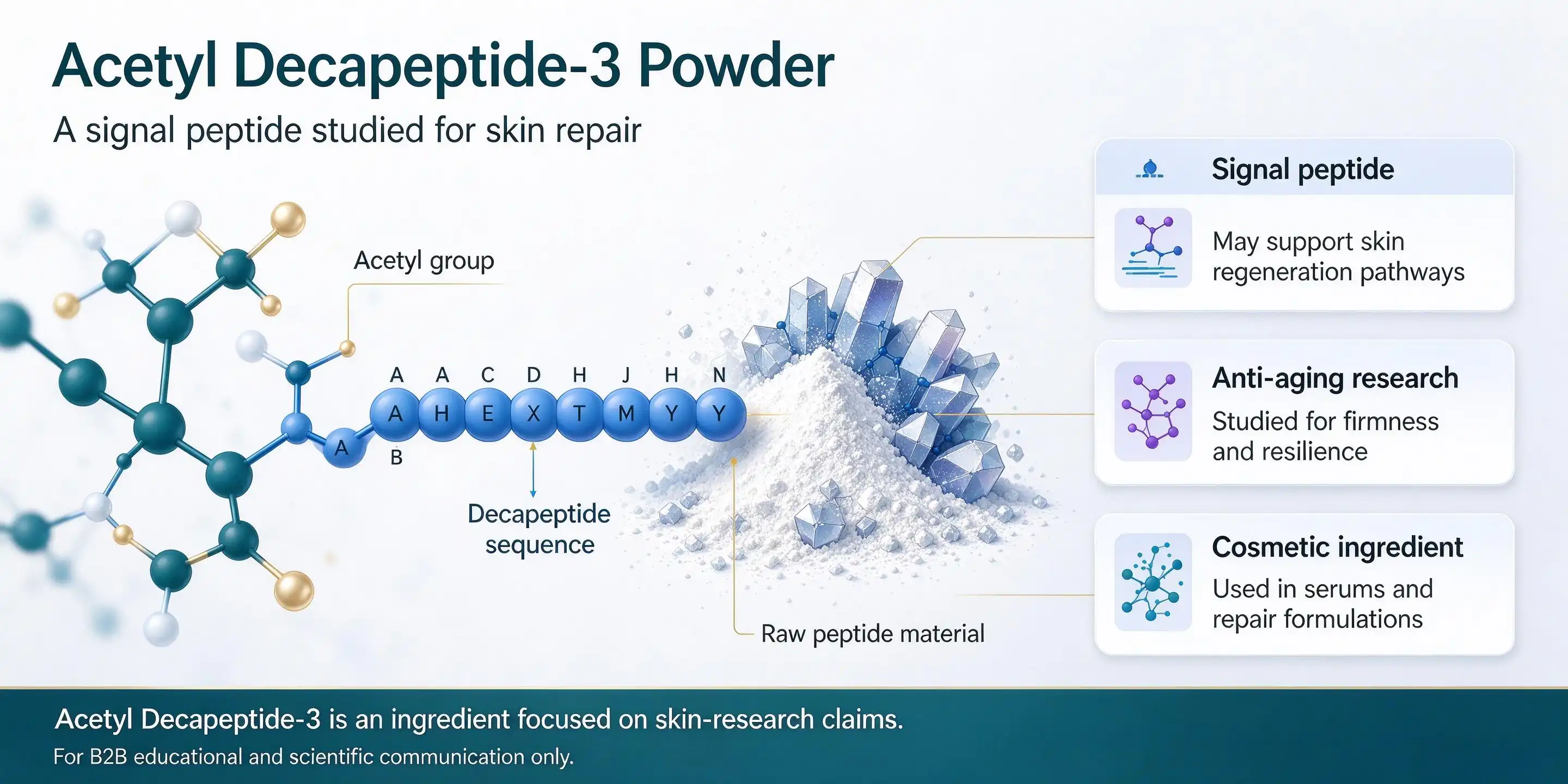
Acetyl decapeptide-3 powder (CAS 935288-50-9) is a synthetic signaling peptide with the sequence Ac-Tyr-Arg-Ser-Arg-Lys-Tyr-Thr-Ser-Trp-Tyr-NH₂ and a molecular weight of 1450.6 Da. It was engineered to mimic acidic fibroblast growth factor (aFGF), stimulating fibroblast proliferation and driving collagen and elastin production at the dermal level. For R&D teams and procurement managers in the skincare and dermo-cosmetic sectors, this peptide addresses a real formulation gap: delivering growth-factor-level biology without the instability of proteins. Its purity of ≥98.0% by HPLC makes it a dependable raw material for anti-aging product development.
What Is Acetyl Decapeptide-3 Powder?
Molecular Identity and Structure
The molecular formula for acetyl decapeptide-3 is C₆₈H₉₅N₁₉O₁₇, and its molecular weight is 1450.6 Da. The N-terminal acetyl group makes the peptides more lipophilic and less likely to be broken down by enzymes than peptides that have not been changed. Because of this structural feature, the peptide can stay functionally stable in finished makeup formulas with a pH range of 5.0 to 7.0, which is the same as most serum and emulsion systems.
Biological Mechanism of Action
This peptide acts like aFGF by turning on fibroblast receptor pathways that increase the production of Type I collagen and elastin. Studies on growth-factor-mimicking peptides show that short-chain synthetic analogs can cause extracellular matrix (ECM) remodeling that can be measured. In order to get biological activity, formulators can use amounts of 100 to 500 ppm of active peptide. This is because it works at the receptor signaling level.
Why Synthetic Peptides Beat Natural Growth Factors?
Large proteins make up natural growth factors. They break down quickly, are closely watched by regulators, and don't go deep into the skin very well. These problems can't happen with a man-made decapeptide like this one. Its low molecular weight helps it spread through the skin, and the acetylated end stops peptidases that are found in the stratum corneum. This makes it more effective in real-world formulation conditions.
Benefits and Applications in Skincare Formulations
Anti-Aging and Structural Skin Repair
The main commercial value of acetyl decapeptide-3 powder is in making skin firmer and less wrinkled. It helps the organization of collagen fibers in the dermis by activating fibroblasts. After repeated use, bFGF-mimicking peptides have been shown to improve the skin's elasticity and surface texture in clinical studies. Brands that market their goods as "functional anti-aging" should use this ingredient because it tells a story that aware customers can relate to.
Comparison With Other Cosmetic Peptides
Copper peptides help wounds heal and tissues grow back, and acetyl hexapeptide-8 (Argireline) works by stopping the release of neurotransmitters to lower expression lines. This decapeptide works in a different way; it directly affects the cells that build the structure of the skin. People who make multi-peptide combinations often combine it with Acetyl Hexapeptide-8 or Palmitoyl Pentapeptide-4 so that they can work on both mending structures and relaxing surface lines in different ways.
Here are the main types of applications where this peptide works well:
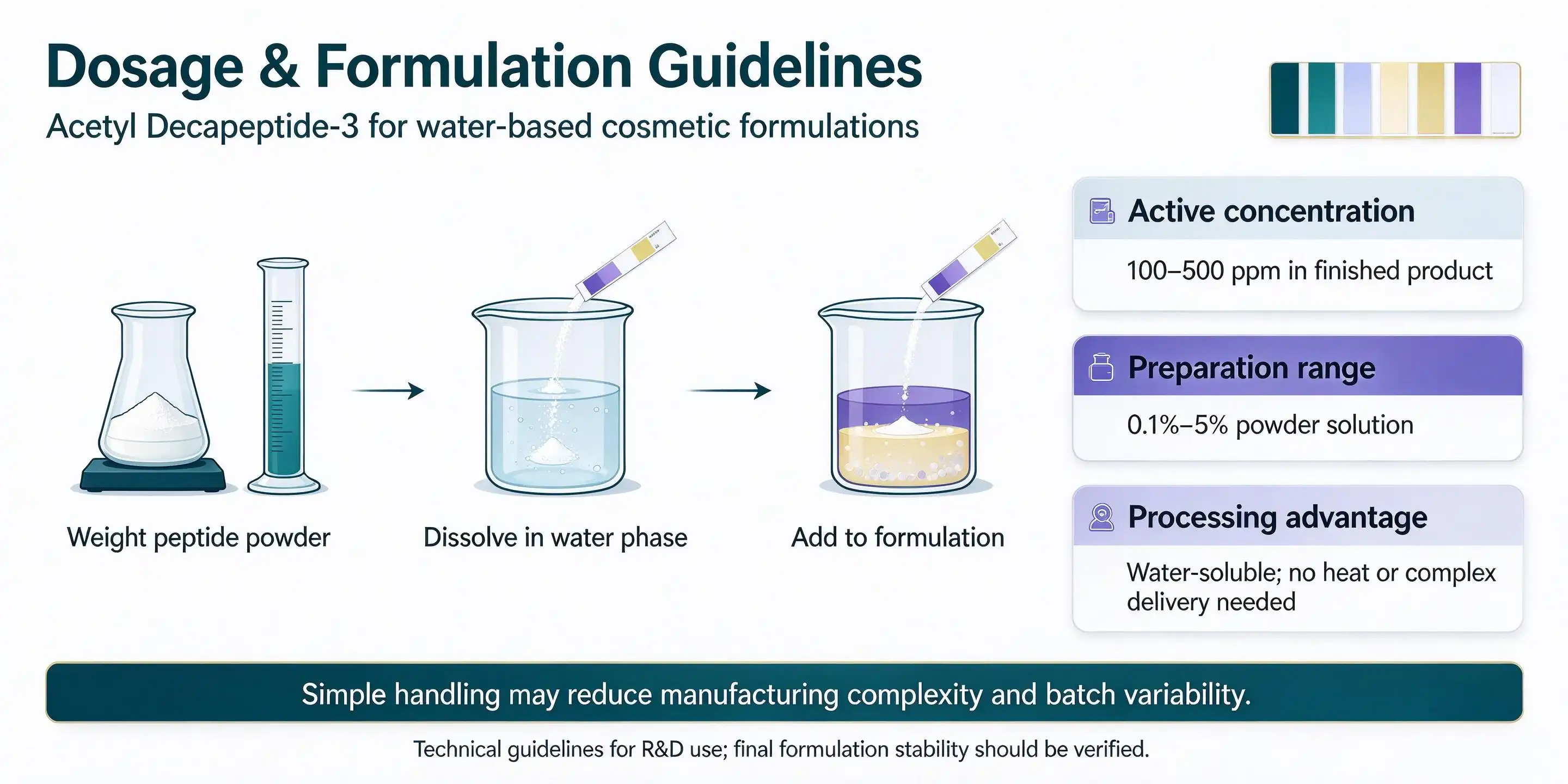
- Intensive anti-aging serums: Liquid concentrates targeting deep wrinkles and skin laxity, typically formulated at 0.1%–5% solution of the powder to deliver 100–500 ppm active concentration. The peptide's water solubility allows direct incorporation into the aqueous phase without additional solubilization steps.
- Post-procedure recovery products: Professional-grade balms used after microneedling or chemical peels, where accelerated re-epithelialization reduces patient downtime. Its non-phototoxic and non-irritating profile makes it well-suited for compromised skin environments where ingredient tolerance is limited.
- Multi-peptide anti-aging complexes: Blended with complementary peptides in emulsion systems. Studies on peptide synergy show that combining agents with different mechanisms—structural stimulation plus relaxation—produces additive outcomes in skin texture scores.
These forms make it easy for buying teams to see where this ingredient makes the most money and how to place it in product lines that are aimed at both retail and clinical channels.
How to Use Acetyl Decapeptide-3 Powder Effectively?
Dosage and Formulation Guidelines
Active peptide concentrations should be between 100 and 500 ppm. This can be reached by mixing a 0.1% to 5% solution of the powder into the mixture. The powder dissolves in water, so it goes right into the water phase without having to use heat or complicated liquid methods. This simple handling cuts down on production complexity and difference from batch to batch.
Stability and Compatibility
Acetyl decapeptide-3 powder stays stable between pH 5.0 and 7.0. Hyaluronic acid, niacinamide, and most peptide actives can be used with it. Formulation teams shouldn't mix it with L-ascorbic acid that is highly concentrated (pH below 4.0), because acidic conditions speed up the breakdown of peptides over time. When antioxidant properties are needed in the same product, buffered Vitamin C products are the best choice.
Storage and Handling
To keep the powder stable for a long time, keep it at -20°C in a container that can't get wet and is kept away from light. As long as the container stays airtight, it can be used for short periods of time for production at 2–8°C. The loss on drying (LOD) should stay below 5%, and the product should be exposed to as little moisture as possible while it is being made. These conditions keep the peptide's active concentration and stop the sequence from breaking down before it gets to the final consumer.
Choosing and Procuring This Peptide for Your Business
Quality Benchmarks to Verify
The teams in charge of buying things should ask for HPLC purity data (≥98.0%), ESI-MS confirmation of the molecular mass, and amino acid analysis to make sure the right sequence ratio. ICP testing for heavy metals (Pb, As, Hg, and Cd below 10 ppm) and microbial limit testing (Total Plate Count below 100 CFU/g, lack of viruses) are also part of a full quality control package. These checkpoints must be met by any supplier wanting to get into a controlled cosmetics supply chain.
Supplier Evaluation Criteria
Beyond analytical data, buyers should check for ISO approval, production conditions that are in line with good manufacturing practice (GMP), and the availability of COA and MSDS documents. Lead time dependability and minimum order freedom are very important for formulation teams in the early stages. A seller that offers both 1 g sample amounts and 100 g and 1 kg packaging choices can help with both R&D testing and full-scale production without making customers commit to too much too soon.
Pricing and Supply Chain Considerations
The cost of acetyl decapeptide-3 powder is not just based on the cost of the raw materials. It also includes the cost of the analysis, quality control, and the complexity of the synthesis process. When purchasing managers only look at unit price, they often find quality problems that lead to higher costs for reformulating later on. Total procurement risk is lower when the seller has stable supply records and recorded batch traceability. This is more effective than just getting the lowest price.
Future Trends in Peptide-Based Skincare Ingredients
Market Growth Trajectory
In 2023, the global beauty peptides market was worth about USD 1.2 billion. It is expected to grow at a rate of more than 8% per year until 2030, thanks to the need for anti-aging products with active ingredients. This market has a lot of high-value growth-factor-mimicking peptides because they have a clear safety profile and a measurable biological reason for being there.
Delivery Technology Advances
Putting bioactive peptides inside liposomes, nano-emulsions, and biodegradable microspheres makes them reach deeper into the skin. For a water-soluble peptide like this one, liposomal delivery systems make the active ingredient stay on the skin longer and evaporate more slowly, which improves the performance of the formulation without changing the peptide's natural chemistry.
Emerging Application Areas
In addition to anti-aging products for the face, scientists are also looking into growth-factor-mimicking peptides for the head and hair follicles, products to build up the skin on the body, and topicals for healing after surgery. Companies that are ready to make application documents ahead of peak demand can find suppliers in these nearby markets.
Conclusion
Acetyl decapeptide-3 powder is a scientifically-backed, mechanism-specific tool that can help formulators and procurement teams make anti-aging products. Because it works to stimulate fibroblasts, dissolves easily in water, and works with common makeup systems, it can be used on a large scale. The peptide's known purity levels and good safety ratings make it less of a risk for brands that work in controlled markets to follow the rules. Teams looking for this ingredient should give more weight to suppliers who offer full analytical documentation and a range of order sizes that can be used for both development and commercial production.
FAQ
Q1: How does acetyl decapeptide-3 differ from Argireline?
A: Argireline (acetyl hexapeptide-8) softens expression lines by stopping muscle micro-contractions. This decapeptide encourages the growth of fibroblasts and the production of ECM proteins. They work in very different ways, but they are often mixed together in multi-peptide formulations.
Q2: What concentration should I use in a serum?
A: Active peptide concentrations of 100 to 500 ppm are normal. This is usually reached by mixing 0.1% to 5% of the bulk powder with water. For placement on sensitive skin, start at the bottom.
Q3: Is it compatible with retinol formulations?
A: Yes, as long as the pH of the mixture stays above 4.5. Emulsions with retinol usually have a pH between 5.0 and 6.5, which is safe for keeping peptides stable.
Q4: What documents should I request from a supplier?
A: For more information, ask for the COA (with HPLC purity and MS data), the MSDS, the amino acid analysis, the heavy metal ICP results, and the microbial limit testing reports. The paperwork for ISO approval is also common.
Q5: What is the shelf life of the powder?
A: When kept at -20°C in a sealed container, high-quality material usually stays in good shape for 24 months. Before you commit to big inventory positions, check the stability data from your seller to make sure the shelf life is correct.
Partner With Xi'an Yihui for Reliable Peptide Supply
Since 2010, Xi'an Yihui Bio-technology Co., Ltd. has sent products for cosmetics and medicines to more than 100 countries. Our acetyl decapeptide-3 powder (CAS 935288-50-9) is ≥98.0% pure and comes with full analytical documentation, ISO certification, and flexible packaging that can hold anywhere from 1 g to 1 kg. We are a reliable company that makes acetyl decapeptide-3 powder, and we give free samples and detailed datasheets to business buyers who are qualified. To get your sample today, email our team at sales@yihuipharm.com.
References
1. Schagen, S.K. (2017). Topical Peptide Treatments with Effective Anti-Aging Results. Cosmetics, MDPI.
2. Varani, J., et al. (2006). Decreased Collagen Production in Chronologically Aged Skin. The American Journal of Pathology.
3. Pai, V.V., et al. (2017). Peptides and Proteins in Cosmetics. Journal of Cutaneous and Aesthetic Surgery.
4. Gendler, E.C. (2008). Treatment of Periorbital Wrinkles. Dermatologic Surgery, Wiley.
5. Gorouhi, F., & Maibach, H.I. (2009). Role of Topical Peptides in Preventing or Treating Aged Skin. International Journal of Cosmetic Science.
6. Lintner, K., & Mas-Chamberlin, C. (2020). Cosmetic Applications of Peptides. Advances in Biochemical Engineering/Biotechnology, Springer.

Send Inquiry
You may like
Related Industry Knowledge